Suh Soh Youn, Clark Robert A, Le Alan, Demer Joseph L
Department of Ophthalmology, David Geffen Medical School at University of California, Los Angeles, Los Angeles, California.
Department of Ophthalmology, David Geffen Medical School at University of California, Los Angeles, Los Angeles, California 2David Geffen Medical School at University of California, Los Angeles, Los Angeles, California.
Invest Ophthalmol Vis Sci. 2016 Oct 1;57(13):5535-5540. doi: 10.1167/iovs.16-20172.
To investigate changes in volumes of extraocular muscle (EOM) compartments in unilateral superior oblique (SO) palsy using magnetic resonance imaging (MRI).
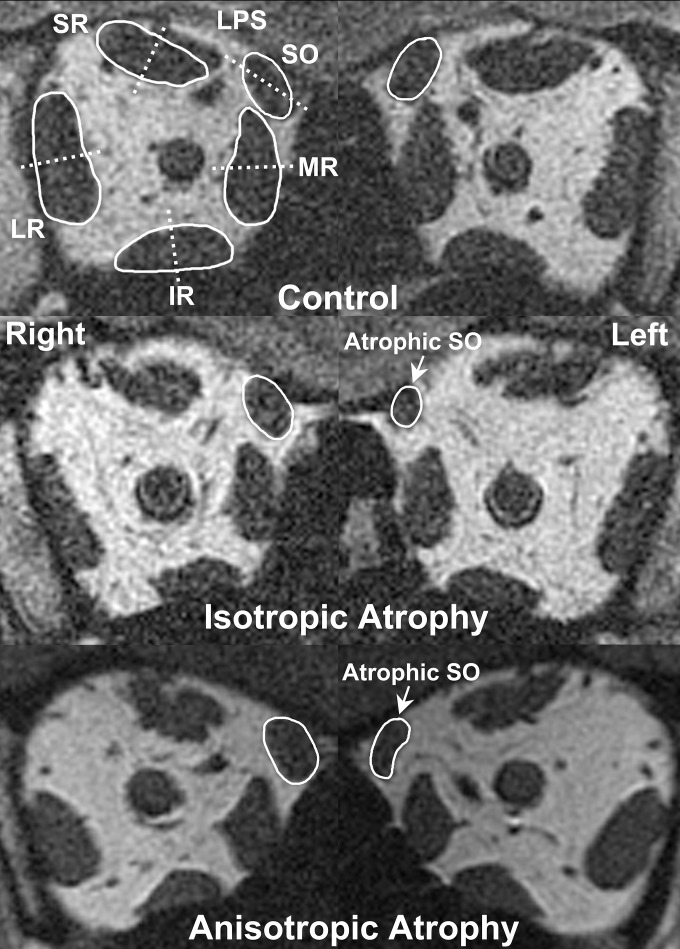
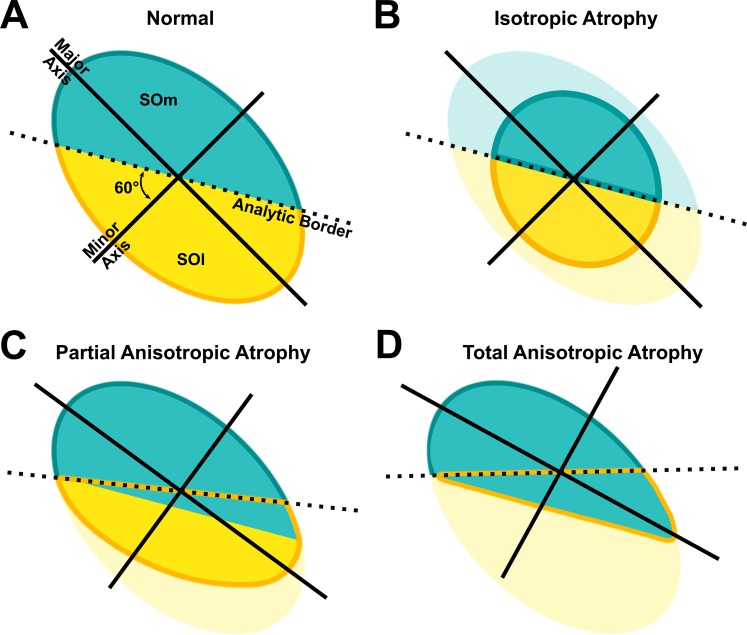
High-resolution, surface-coil MRI was obtained in 19 patients with unilateral SO palsy and 19 age-matched orthotropic control subjects. Rectus EOMs and the SO were divided into two anatomic compartments for volume analysis in patients with unilateral SO palsy, allowing comparison of total compartmental volumes versus controls. Medial and lateral compartmental volumes of the SO muscle were compared in patients with isotropic (round shape) versus anisotropic (elongated shape) SO atrophy.
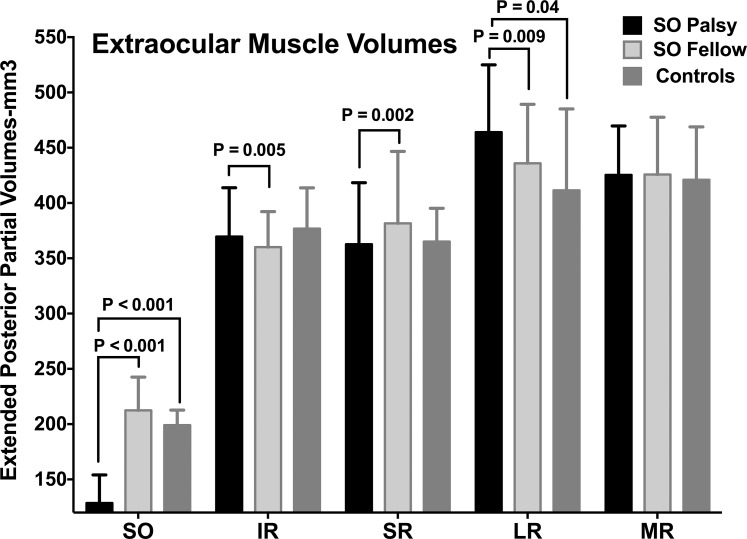
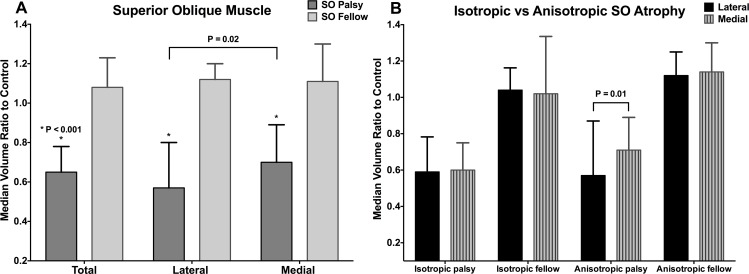
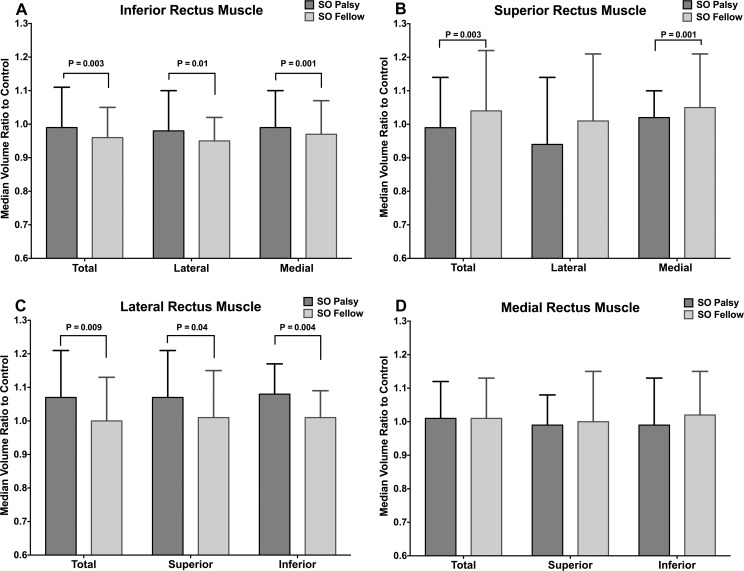
The medial and lateral compartments of the ipsilesional SO muscles were equally atrophic in isotropic SO palsy, whereas the lateral compartment was significantly smaller than the medial in anisotropic SO palsy (P = 0.01). In contrast to the SO, there were no differential compartmental volume changes in rectus EOMs; however, there was significant total muscle hypertrophy in the ipsilesional inferior rectus (IR) and lateral rectus (LR) muscles and contralesional superior rectus (SR) muscles. Medial rectus (MR) volume was normal both ipsi- and contralesionally.
A subset of patients with SO palsy exhibit selective atrophy of the lateral, predominantly vertically acting SO compartment. Superior oblique atrophy is associated with whole-muscle volume changes in the ipsilesional IR, ipsilesional LR, and contralesional SR; however, SO muscle atrophy is not associated with compartmentally selective volume changes in the rectus EOMs. Selective compartmental SO pathology may provide an anatomic mechanism that explains some of the variability in clinical presentations of SO palsy.
使用磁共振成像(MRI)研究单侧上斜肌(SO)麻痹患者眼外肌(EOM)各部分的体积变化。
对19例单侧SO麻痹患者和19例年龄匹配的正视对照者进行高分辨率表面线圈MRI检查。在单侧SO麻痹患者中,将直肌EOM和SO分为两个解剖部分进行体积分析,以便与对照组比较各部分总体积。比较等轴状(圆形)与非等轴状(细长形)SO萎缩患者的SO肌内侧和外侧部分体积。
在等轴状SO麻痹中,患侧SO肌的内侧和外侧部分萎缩程度相同,而在非等轴状SO麻痹中,外侧部分明显小于内侧部分(P = 0.01)。与SO不同,直肌EOM各部分体积没有差异变化;然而,患侧下直肌(IR)和外直肌(LR)以及对侧上直肌(SR)出现明显的整体肌肉肥大。内直肌(MR)同侧和对侧的体积均正常。
一部分SO麻痹患者表现出外侧主要垂直作用的SO部分选择性萎缩。上斜肌萎缩与患侧IR、患侧LR和对侧SR的全肌体积变化有关;然而,SO肌萎缩与直肌EOM各部分选择性体积变化无关。SO部分的选择性病理改变可能提供一种解剖学机制,解释SO麻痹临床表现的一些变异性。