Tu Shih-Hsin, Lin Yin-Ching, Huang Chi-Cheng, Yang Po-Sheng, Chang Hui-Wen, Chang Chien-Hsi, Wu Chih-Hsiung, Chen Li-Ching, Ho Yuan-Soon
Department of Surgery, School of Medicine, College of Medicine, Taipei Medical University, Taipei, Taiwan.
Breast Medical Center, Taipei Medical University Hospital, Taipei, Taiwan.
Oncotarget. 2016 Nov 22;7(47):77516-77531. doi: 10.18632/oncotarget.12717.
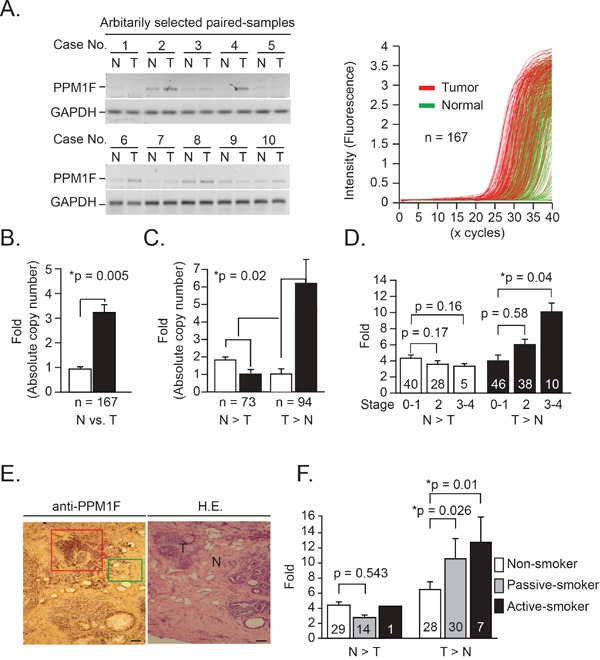
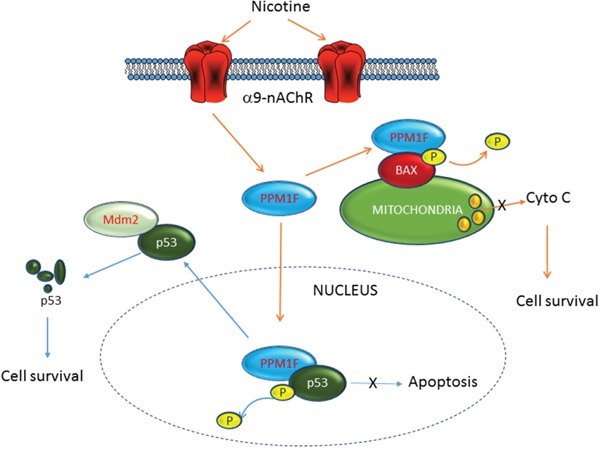
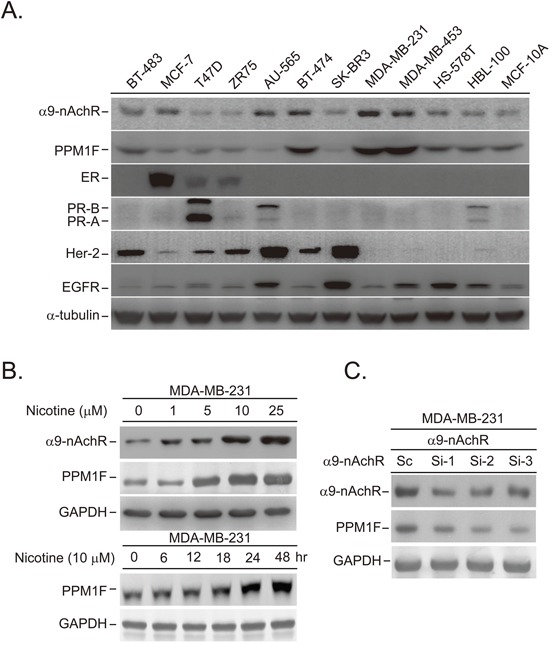
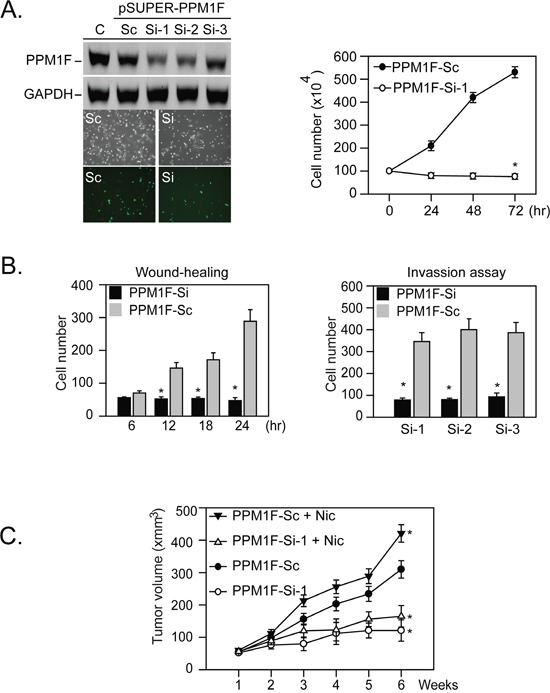
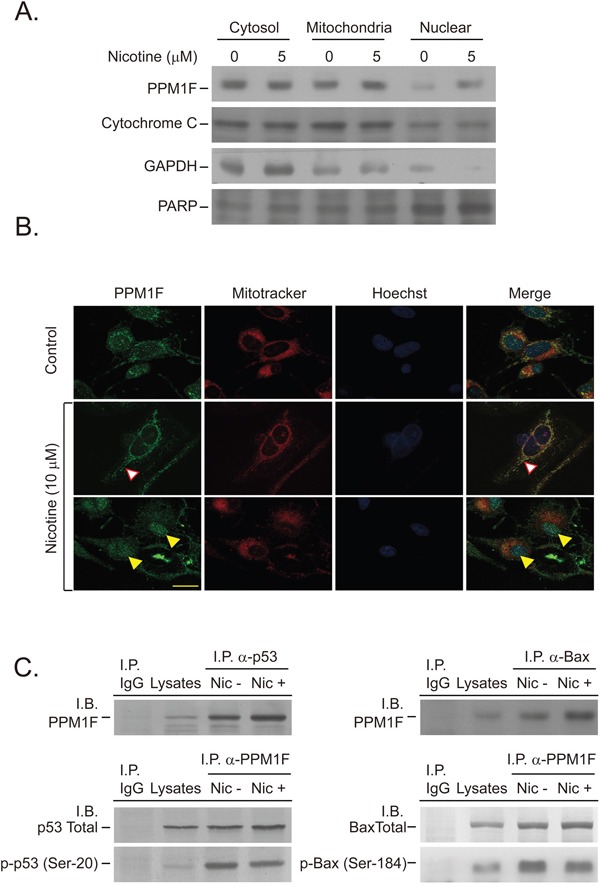
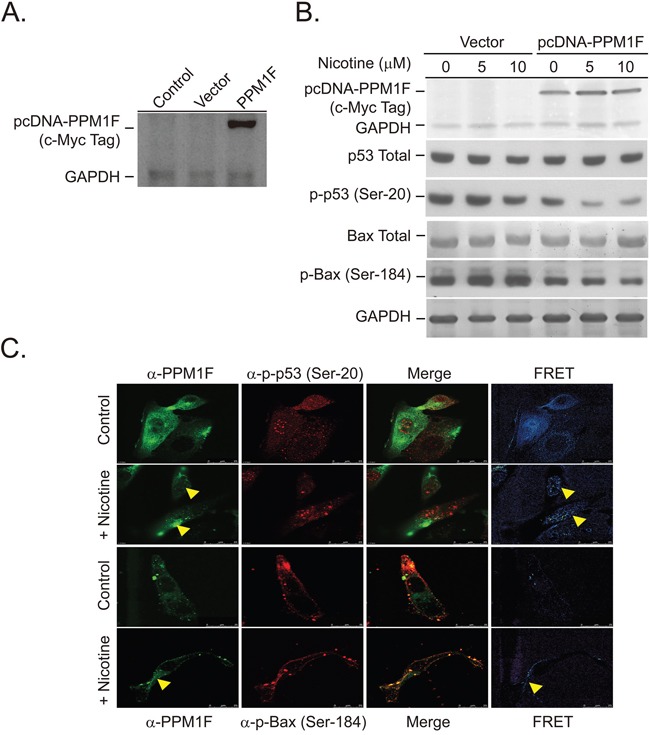
We previously demonstrated that the activation of α9-nicotinic acetylcholine receptor (α9-nAchR) signaling by smoking promotes breast cancer formation. To investigate the downstream signaling molecules involved in α9-nAChR-induced breast tumorigenesis, we used real-time polymerase chain reactions and Western blotting to assess expression of protein phosphatase Mg2+/Mn2+ dependent 1F (PPM1F), a Ser/Thr protein phosphatase, in human breast cancer samples (n=167). Additionally, stable PPM1F-knockdown and -overexpressing cell lines were established to evaluate the function of PPM1F. The phosphatase activity of PPM1F in nicotine-treated cells was assessed through Western blotting, confocal microscopy, and fluorescence resonance energy transfer. Higher levels of PPM1F were detected in the breast cancer tissues of heavy smokers (n=7, 12.8-fold) greater than of non-smokers (n= 28, 6.3-fold) (**p=0.01). In vitro, nicotine induced PPM1F expression, whereas α9-nAChR knockdown reduced the protein expression of PPM1F. A series of biochemical experiments using nicotine-treated cells suggested that the dephosphorylation of p53 (Ser-20) and BAX (Ser-184) by PPM1F is a critical posttranslational modification, as observed in breast cancer patients who were heavy smokers. These observations indicate that PPM1F may be a mediator downstream of α9-nAChR that activates smoking-induced carcinogenic signals. Thus, PPM1F expression could be used for prognostic diagnosis or inhibited for cancer prevention and therapy.
我们之前证明,吸烟激活α9-烟碱型乙酰胆碱受体(α9-nAchR)信号通路可促进乳腺癌形成。为了研究参与α9-nAChR诱导的乳腺肿瘤发生的下游信号分子,我们使用实时聚合酶链反应和蛋白质印迹法评估了丝氨酸/苏氨酸蛋白磷酸酶——蛋白磷酸酶Mg2+/Mn2+依赖性1F(PPM1F)在167例人类乳腺癌样本中的表达。此外,我们建立了稳定的PPM1F敲低和过表达细胞系,以评估PPM1F的功能。通过蛋白质印迹法、共聚焦显微镜和荧光共振能量转移评估了尼古丁处理细胞中PPM1F的磷酸酶活性。重度吸烟者(n = 7,12.8倍)乳腺癌组织中PPM1F的表达水平高于非吸烟者(n = 28,6.3倍)(**p = 0.01)。在体外,尼古丁诱导PPM1F表达,而α9-nAChR敲低则降低了PPM1F的蛋白表达。对尼古丁处理细胞进行的一系列生化实验表明,PPM1F对p53(Ser-20)和BAX(Ser-184)的去磷酸化是一种关键的翻译后修饰,在重度吸烟的乳腺癌患者中也观察到了这一现象。这些观察结果表明,PPM1F可能是α9-nAChR下游的一种介质,可激活吸烟诱导的致癌信号。因此,PPM1F表达可用于预后诊断,或为癌症预防和治疗而抑制其表达。