Hodge Greg, Roscioli Eugene, Jersmann Hubertus, Tran Hai B, Holmes Mark, Reynolds Paul N, Hodge Sandra
Lung Research, Hanson Institute and Department of Thoracic Medicine, Royal Adelaide Hospital, Adelaide, South Australia, Australia.
Department of Medicine, University of Adelaide, Adelaide, South Australia, Australia.
Respir Res. 2016 Oct 21;17(1):135. doi: 10.1186/s12931-016-0450-4.
Corticosteroid resistance is a major barrier to effective treatment of COPD. We have shown that the resistance is associated with decreased expression of glucocorticoid receptor (GCR) by senescent CD28nullCD8+ pro-inflammatory lymphocytes in peripheral blood of COPD patients. GCR must be bound to molecular chaperones heat shock proteins (Hsp) 70 and Hsp90 to acquire a high-affinity steroid binding conformation, and traffic to the nucleus. We hypothesized a loss of Hsp70/90 from these lymphocytes may further contribute to steroid resistance in COPD.
Blood was collected from COPD (n = 10) and aged-matched controls (n = 10). To assess response to steroids, cytotoxic mediators, intracellular pro-inflammatory cytokines, CD28, GCR, Hsp70 and Hsp90 were determined in T and NKT-like cells in the presence of ± 10 μM prednisolone and 2.5 ng/mL cyclosporine A (binds to GCR-Hsp70/90 complex) using flow cytometry, western blot and fluorescence microscopy.
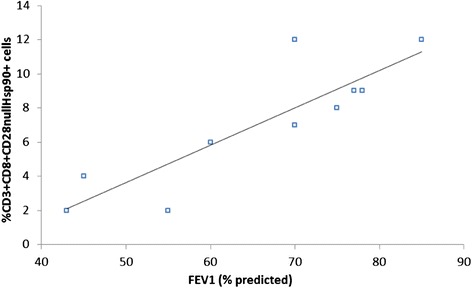
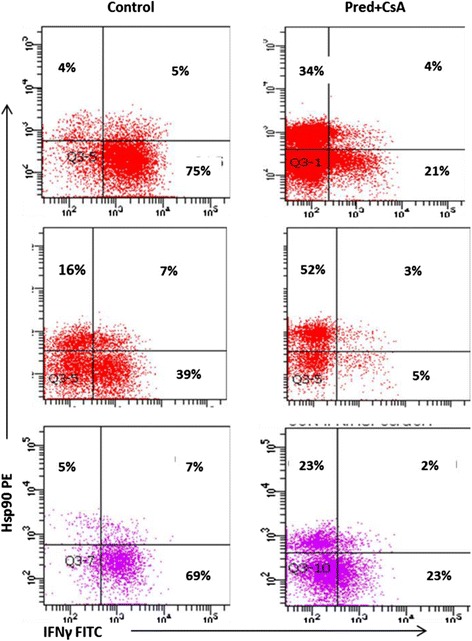
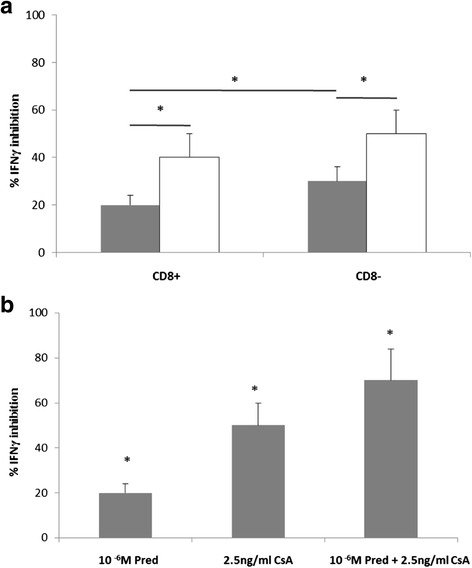
A loss of expression of Hsp90 and GCR from CD28null CD8+ T and NKT-like cells in COPD was noted (Hsp70 unchanged). Loss of Hsp90 expression correlated with the percentage of CD28null CD8+ T and NKT-like cells producing IFNγ or TNFα in all subjects (eg, COPD: R = -0.763, p = 0.007 for T-cell IFNγ). Up-regulation of Hsp90 and associated decrease in pro-inflammatory cytokine production was found in CD28nullCD8+ T and NKT-like cells in the presence of 10 μM prednisolone and 2.5 ng/mL cyclosporine A.
Loss of Hsp90 from cytotoxic/pro-inflammatory CD28nullCD8+ T and NKT-like cells could contribute to steroid resistance in COPD. Combination prednisolone and low-dose cyclosporine A therapy inhibits these pro-inflammatory cells and may reduce systemic inflammation in COPD.
皮质类固醇抵抗是慢性阻塞性肺疾病(COPD)有效治疗的主要障碍。我们已经表明,这种抵抗与COPD患者外周血中衰老的CD28阴性CD8 +促炎淋巴细胞中糖皮质激素受体(GCR)表达降低有关。GCR必须与分子伴侣热休克蛋白(Hsp)70和Hsp90结合,以获得高亲和力的类固醇结合构象,并转运至细胞核。我们推测这些淋巴细胞中Hsp70/90的缺失可能进一步导致COPD中的类固醇抵抗。
从COPD患者(n = 10)和年龄匹配的对照组(n = 10)采集血液。为了评估对类固醇的反应,使用流式细胞术、蛋白质免疫印迹法和荧光显微镜,在存在或不存在10μM泼尼松龙和2.5 ng/mL环孢素A(与GCR-Hsp70/90复合物结合)的情况下,测定T细胞和NKT样细胞中的细胞毒性介质、细胞内促炎细胞因子、CD28、GCR、Hsp70和Hsp90。
注意到COPD患者中CD28阴性CD8 + T细胞和NKT样细胞中Hsp90和GCR表达缺失(Hsp70未改变)。在所有受试者中,Hsp90表达缺失与产生IFNγ或TNFα的CD28阴性CD8 + T细胞和NKT样细胞百分比相关(例如,COPD:T细胞IFNγ的R = -0.763,p = 0.007)。在存在10μM泼尼松龙和2.5 ng/mL环孢素A的情况下,CD28阴性CD8 + T细胞和NKT样细胞中发现Hsp90上调以及促炎细胞因子产生相关减少。
细胞毒性/促炎性CD28阴性CD8 + T细胞和NKT样细胞中Hsp90的缺失可能导致COPD中的类固醇抵抗。泼尼松龙和低剂量环孢素A联合治疗可抑制这些促炎细胞,并可能减轻COPD中的全身炎症。