Lover Andrew A, Gosling Roly, Feachem Richard, Tulloch Jim
Malaria Elimination Initiative, Global Health Group, University of California, San Francisco, USA.
Independent consultant, Cali, Colombia.
Malar J. 2016 Oct 21;15(1):518. doi: 10.1186/s12936-016-1564-3.
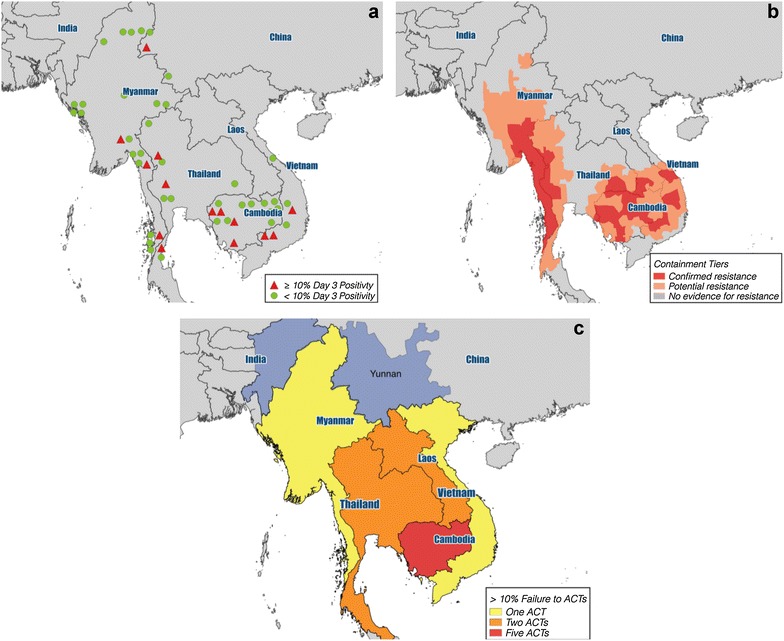
The emergence in 2009 of Plasmodium falciparum parasites resistant to the primary therapies currently in use (artemisinin-based combination therapy, ACT) in Southeast Asia threatens to set back decades of global progress in malaria control and elimination. Progress to date through multiple sets of initiatives and partners to contain or eliminate these parasites has been hampered due to a wide range of organizational, financial, and health systems-level challenges. In this commentary, a set of seven specific and concrete actions are proposed to directly address these issues and to accelerate P. falciparum elimination within the Greater Mekong Subregion to avert a wider public health crisis. These actions are specifically needed to elevate the situation and response mechanisms to those of a true emergency; to address systems-level challenges with personnel limitations and stock-outs of key commodities; and to restructure the response mechanisms to be well-aligned with the required outcomes. Consideration of these issues is especially pressing with planning meetings for renewal of the Regional Artemisinin-resistance Initiative (RAI) framework slated for late 2016 and into 2017, but these suggestions are also relevant for malaria programmes globally.
2009年,东南亚出现了对目前使用的主要疗法(以青蒿素为基础的联合疗法,ACT)产生耐药性的恶性疟原虫,这可能会使全球在疟疾控制和消除方面数十年的进展受挫。由于一系列组织、财务和卫生系统层面的挑战,通过多套举措和合作伙伴控制或消除这些疟原虫的工作至今受阻。在这篇评论中,提出了七项具体行动,以直接解决这些问题,并加速在大湄公河次区域消除恶性疟原虫,避免更广泛的公共卫生危机。特别需要采取这些行动,将情况和应对机制提升到真正紧急情况的水平;解决人员限制和关键商品缺货等系统层面的挑战;并重组应对机制,使其与所需成果保持一致。鉴于计划于2016年底至2017年召开区域青蒿素耐药性倡议(RAI)框架更新规划会议,对这些问题的考虑尤为紧迫,但这些建议对全球疟疾项目也具有相关性。