Garg Deepika, Merhi Zaher
Department of Obstetrics and Gynecology, Maimonides Medical Center, Brooklyn, NY, 11219, USA.
Division of Reproductive Biology, Department of Obstetrics and Gynecology, NYU School of Medicine, 180 Varick Street, sixth floor, New York City, NY, 11014, USA.
Reprod Biol Endocrinol. 2016 Oct 21;14(1):71. doi: 10.1186/s12958-016-0205-6.
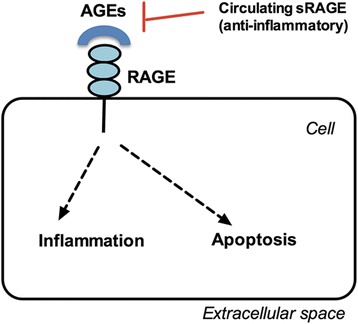
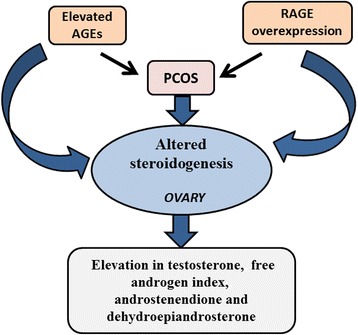
Women with PCOS have elevated levels of the harmful Advanced Glycation End Products (AGEs), which are highly reactive molecules formed after glycation of lipids and proteins. Additionally, AGEs accumulate in the ovaries of women with PCOS potentially contributing to the well-documented abnormal steroidogenesis and folliculogenesis.
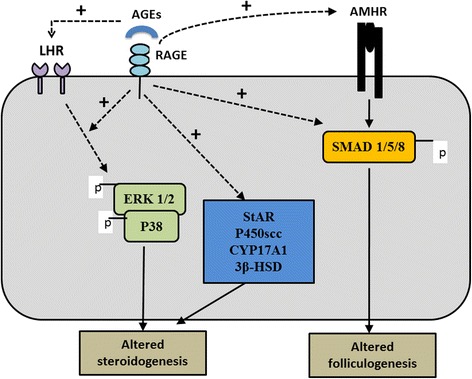
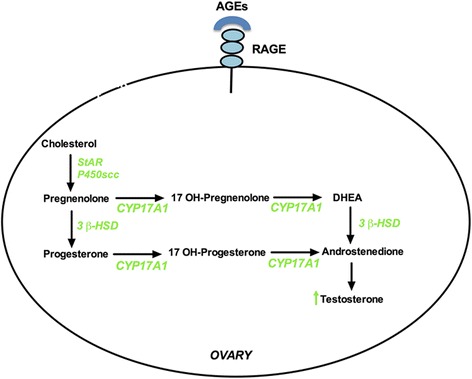
A systematic review of articles and abstracts available in PubMed was conducted and presented in a systemic manner. This article reports changes in steroidogenic enzyme activity in granulosa and theca cells in PCOS and PCOS-models. It also described the changes in AGEs and their receptors in the ovaries of women with PCOS and presents the underlying mechanism(s) whereby AGEs could be responsible for the PCOS-related changes in granulosa and theca cell function thus adversely impacting steroidogenesis and follicular development. AGEs are associated with hyperandrogenism in PCOS possibly by altering the activity of various enzymes such as cholesterol side-chain cleavage enzyme cytochrome P450, steroidogenic acute regulatory protein, 17α-hydroxylase, and 3β-hydroxysteroid dehydrogenase. AGEs also affect luteinizing hormone receptor and anti-Mullerian hormone receptor expression as well as their signaling pathways in granulosa cells.
A better understanding of how AGEs alter granulosa and theca cell function is likely to contribute meaningfully to a conceptual framework whereby new interventions to prevent and/or treat ovarian dysfunction in PCOS can ultimately be developed.
多囊卵巢综合征(PCOS)女性体内有害的晚期糖基化终产物(AGEs)水平升高,AGEs是脂质和蛋白质糖基化后形成的高反应性分子。此外,AGEs在PCOS女性的卵巢中积累,可能导致已被充分证明的异常类固醇生成和卵泡生成。
对PubMed上可获取的文章和摘要进行了系统综述,并以系统的方式呈现。本文报告了PCOS及PCOS模型中颗粒细胞和卵泡膜细胞类固醇生成酶活性的变化。还描述了PCOS女性卵巢中AGEs及其受体的变化,并阐述了AGEs可能导致颗粒细胞和卵泡膜细胞功能发生PCOS相关变化从而对类固醇生成和卵泡发育产生不利影响的潜在机制。AGEs可能通过改变各种酶的活性,如胆固醇侧链裂解酶细胞色素P450、类固醇生成急性调节蛋白、17α-羟化酶和3β-羟类固醇脱氢酶,与PCOS中的高雄激素血症相关。AGEs还影响颗粒细胞中促黄体生成素受体和抗苗勒管激素受体的表达及其信号通路。
更好地理解AGEs如何改变颗粒细胞和卵泡膜细胞功能,可能会对一个概念框架做出有意义的贡献,从而最终开发出预防和/或治疗PCOS卵巢功能障碍的新干预措施。