Shi Yuyan, Pierce John P, White Martha, Vijayaraghavan Maya, Compton Wilson, Conway Kevin, Hartman Anne M, Messer Karen
Cancer Prevention and Control Program, Moores UC San Diego Cancer Center, 3855 Health Sciences Drive #0901, La Jolla, CA, 92093-0901, USA.
Department of Family Medicine and Public Health, University of California, San Diego, 9500 Gilman Drive #0628, La Jolla, CA, 92093-0628, USA.
BMC Public Health. 2016 Oct 21;16(1):1105. doi: 10.1186/s12889-016-3770-x.
Electronic cigarettes (e-cigarettes) are heavily marketed and widely perceived as helpful for quitting or reducing smoking intensity. We test whether ever-use of e-cigarettes among early adopters was associated with: 1) increased cigarette smoking cessation; and 2) reduced cigarette consumption.
A representative cohort of U.S. smokers (N = 2454) from the 2010 Tobacco Use Supplement to the Current Population Survey (TUS-CPS) was re-interviewed 1 year later. Outcomes were smoking cessation for 30+ days and change in cigarette consumption at follow-up. E-cigarettes use was categorized as for cessation purposes or for another reason. Multivariate regression was used to adjust for demographics and baseline cigarette dependence level.
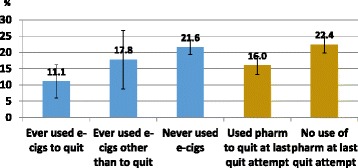
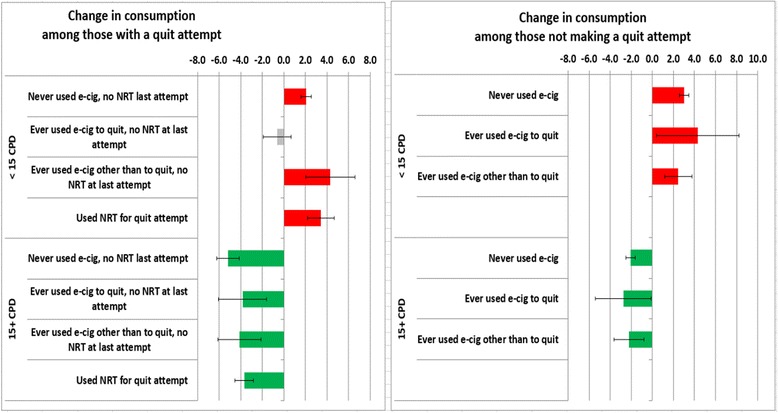
In 2011, an estimated 12 % of adult U.S. smokers had ever used e-cigarettes, and 41 % of these reported use to help quit smoking. Smokers who had used e-cigarettes for cessation were less likely to be quit for 30+ days at follow-up, compared to never-users who tried to quit (11.1 % vs 21.6 %; ORadj = 0.44, 95 % CI = 0.2-0.8). Among heavier smokers at baseline (15+ cigarettes per day (CPD)), ever-use of e-cigarettes was not associated with change in smoking consumption. Lighter smokers (<15 CPD) who had ever used e-cigarettes for quitting had stable consumption, while increased consumption was observed among all other lighter smokers, although this difference was not statistically significant.
Among early adopters, ever-use of first generation e-cigarettes to aid quitting cigarette smoking was not associated with improved cessation or with reduced consumption, even among heavier smokers.
电子烟被大力营销,并且被广泛认为有助于戒烟或降低吸烟强度。我们测试早期使用者中曾经使用电子烟是否与以下因素相关:1)增加戒烟成功率;2)减少香烟消费量。
对来自2010年《当前人口调查烟草使用补充调查》(TUS-CPS)的具有代表性的美国吸烟者队列(N = 2454)在1年后进行重新访谈。结果指标为持续30天以上的戒烟情况以及随访时香烟消费量的变化。电子烟使用被分为用于戒烟目的或其他原因。采用多变量回归来调整人口统计学因素和基线香烟依赖水平。
2011年,估计12%的美国成年吸烟者曾经使用过电子烟,其中41%报告使用电子烟来帮助戒烟。与试图戒烟的从未使用者相比,使用电子烟来戒烟的吸烟者在随访时持续30天以上戒烟的可能性较小(11.1%对21.6%;调整后的比值比=0.44,95%置信区间=0.2 - 0.8)。在基线时吸烟量较大的吸烟者(每天吸15支及以上香烟(CPD))中,曾经使用电子烟与吸烟量变化无关。曾经使用电子烟戒烟的轻度吸烟者(<15 CPD)吸烟量保持稳定,而其他所有轻度吸烟者的吸烟量都有所增加,尽管这种差异没有统计学意义。
在早期使用者中,即使是在吸烟量较大的吸烟者中,曾经使用第一代电子烟辅助戒烟与戒烟成功率提高或消费量减少均无关。