Nance Robin, Delaney Joseph, McEvoy John W, Blaha Michael J, Burke Gregory L, Navas-Acien Ana, Kaufman Joel D, Oelsner Elizabeth C, McClelland Robyn L
Department of Biostatistics, Collaborative Health Studies Coordinating Center, University of Washington, Building 29, Suite 210, 6200 NE 74th Street, Box 354922, Seattle, WA 98115, USA.
Department of Epidemiology, Collaborative Health Studies Coordinating Center, University of Washington, Box 354922, Building 29, Suite 310, 6200 NE 74th Street, Seattle, WA 98115-8160, USA.
J Clin Epidemiol. 2017 Jan;81:111-119. doi: 10.1016/j.jclinepi.2016.09.010. Epub 2016 Oct 18.
Smoking as an epidemiological exposure can be quantified in many ways including duration, intensity, pack-years, recency, and age at initiation. However, it is not clear which of these are most important for cardiovascular disease (CVD) and how they should be modeled.
Using the Multi-Ethnic Study of Atherosclerosis, Cox models for time to incident CVD adjusted for age, sex, race/ethnicity, education category, and income category were compared which included various characterizations of smoking history.
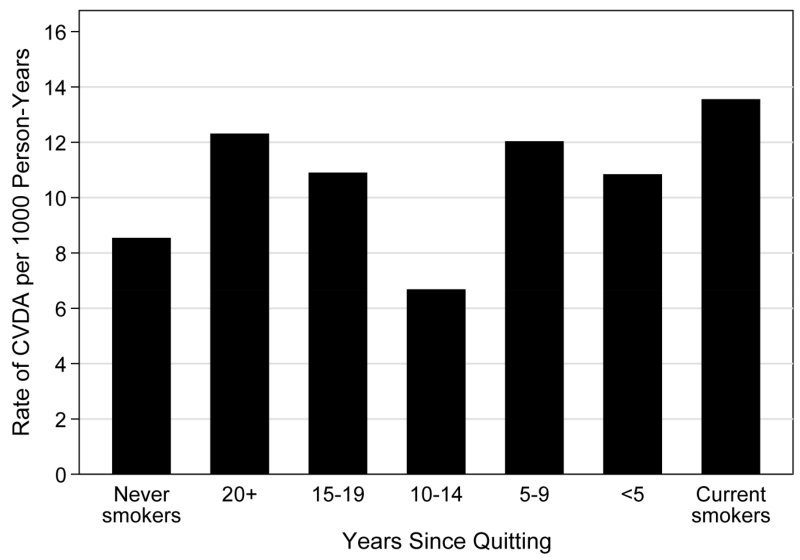
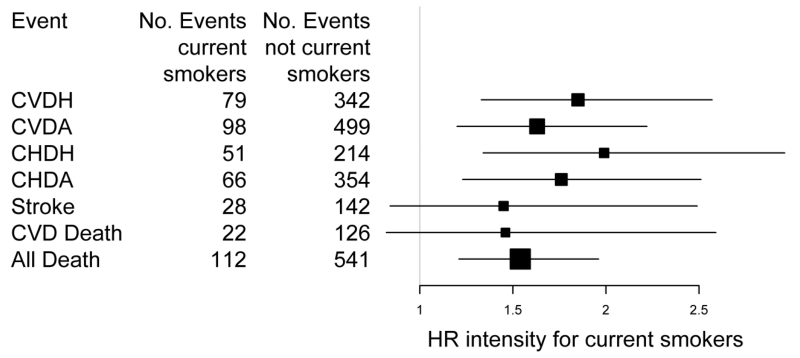
Duration, age at starting, time since quitting, and noncigarette forms of smoking were not independently associated with CVD, whereas baseline current intensity was associated with CVD [e.g., hard CVD hazard ratio 1 pack/d of 1.85 95% confidence interval (1.33, 2.57)]. Former smokers, regardless of duration, intensity, or recency, were not at increased risk, suggesting that risk may risk may drop precipitously from the time of quitting. For CVD events, representing smoking exposure as baseline smoking intensity produced better model fit as measured by Akaike information criterion than models using smoking status or pack-years.
The association of smoking with incident CVD events was well captured by including a simple term for baseline smoking intensity.
吸烟作为一种流行病学暴露因素,可以通过多种方式进行量化,包括持续时间、强度、吸烟包年数、近期吸烟情况以及开始吸烟的年龄。然而,尚不清楚这些因素中哪些对心血管疾病(CVD)最为重要,以及应如何对它们进行建模。
利用动脉粥样硬化多族裔研究,比较了针对CVD发病时间的Cox模型,这些模型根据年龄、性别、种族/族裔、教育程度和收入类别进行了调整,其中包括吸烟史的各种特征描述。
吸烟持续时间、开始吸烟的年龄、戒烟后的时间以及非香烟形式的吸烟与CVD无独立关联,而基线当前吸烟强度与CVD有关[例如,重度CVD风险比为每天1包,为1.85,95%置信区间(1.33,2.57)]。既往吸烟者,无论吸烟持续时间、强度或近期吸烟情况如何,风险均未增加,这表明风险可能在戒烟后急剧下降。对于CVD事件,与使用吸烟状态或吸烟包年数的模型相比,将吸烟暴露表示为基线吸烟强度,根据赤池信息准则衡量,模型拟合效果更好。
通过纳入一个简单的基线吸烟强度项,能够很好地捕捉吸烟与CVD发病事件之间的关联。