Xu Zhongping, Sharma Monal, Gelman Andrew, Hachem Ramsey, Mohanakumar Thalachallour
Department of Surgery, Washington University School of Medicine, St. Louis, Missouri, USA; Norton Thoracic Institute, St. Joseph's Hospital and Medical Center, Phoenix, Arizona, USA.
Department of Surgery, Washington University School of Medicine, St. Louis, Missouri, USA.
J Heart Lung Transplant. 2017 Mar;36(3):331-339. doi: 10.1016/j.healun.2016.08.028. Epub 2016 Sep 12.
MicroRNAs (miRNAs) were recently identified as modulators of immune responses after human lung transplantation (LTx). This study was undertaken to assess the contribution of miRNAs to the pathogenesis of primary graft dysfunction (PGD) after LTx.
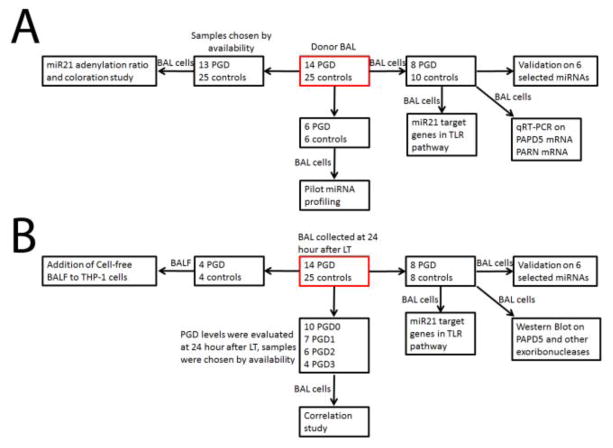
Of the 39 recipients, 14 (35.9%) developed Grade 3 PGD (i.e., severe PGD) within the first 72 hours of LTx. The remaining 25 recipients (64.1%) had Grade 2 or less PGD, and served as the control group. miRNAs were isolated from cells purified by bronchoalveolar lavage (BAL). Bioinformatic prediction and validation by luciferase reporter assays were performed to identify targets regulated by miR-21. Transfection of human monocytic cell line (THP-1) was conducted to determine miR-21's cellular function.
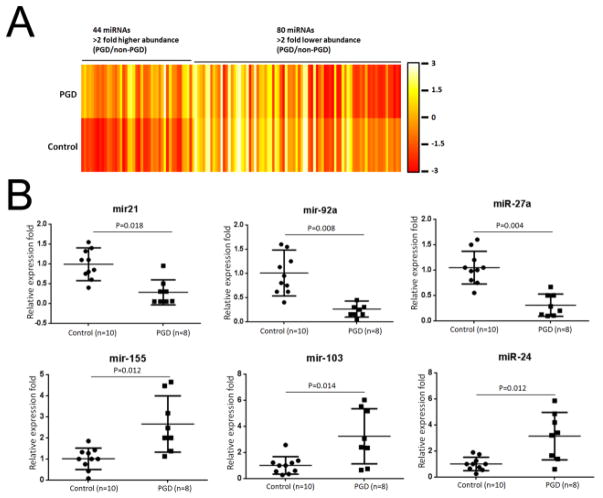
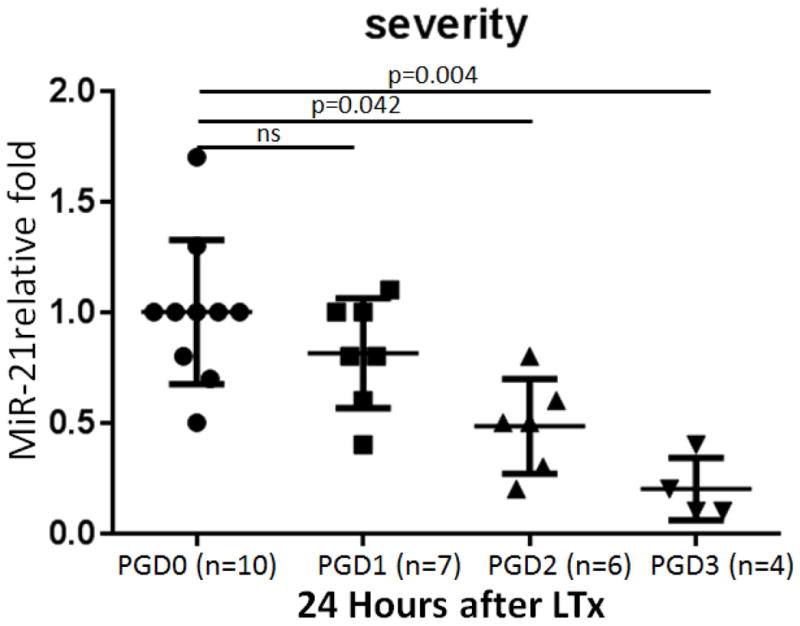
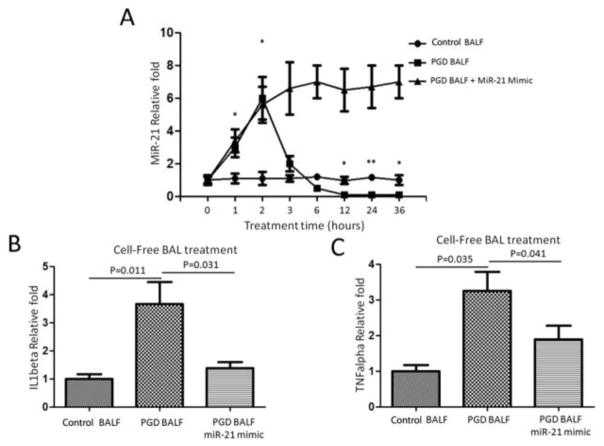
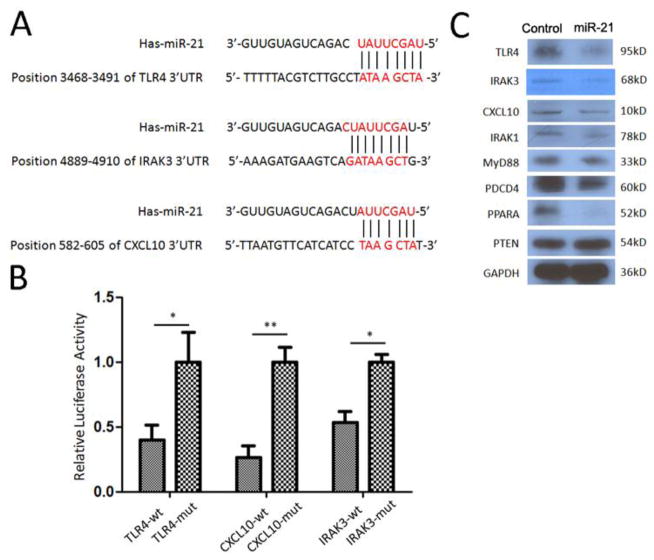
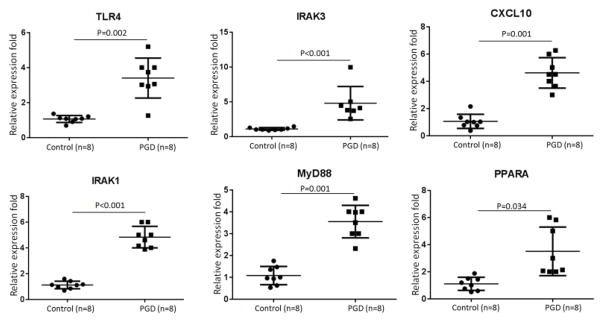
Pilot miRNA profiling of donor BAL samples before implantation in PGD (n = 6) revealed significant upregulation in 44 miRNAs and downregulation in 80 miRNAs compared with control (n = 6). Validation using a separate cohort demonstrated significant underexpression of miR-21 in patients with severe PGD. Furthermore, underexpression of miR-21 levels was negatively correlated with clinical PGD grades (Grade 2 PGD vs Grade 0 PGD: p = 0.042; Grade 3 PGD vs Grade 0 PGD: p = 0.004). Molecular analysis demonstrated that miR-21 targeted key components in the toll-like receptor (TLR) signaling pathway, including TLR4, IRAK3 and CXCL10. Further, incubation of THP-1 cells with cell-free BAL from severe PGD resulted in transactivation of inflammatory cytokines interleukin-1β (IL-1β) and tumor necrosis factor-α (TNF-α). In contrast, increased expression of miR-21 resulted in marked suppression of IL-1-β and TNF-α production.
Underexpression of miR-21 may lead to the development of severe PGD by activating key components of the TLR pathway.
微小RNA(miRNA)最近被确定为人类肺移植(LTx)后免疫反应的调节因子。本研究旨在评估miRNA对LTx后原发性移植功能障碍(PGD)发病机制的影响。
39名接受者中,14名(35.9%)在LTx的前72小时内出现3级PGD(即重度PGD)。其余25名接受者(64.1%)PGD为2级或更低,作为对照组。通过支气管肺泡灌洗(BAL)纯化细胞来分离miRNA。进行生物信息学预测并通过荧光素酶报告基因检测进行验证,以鉴定受miR-21调控的靶标。对人单核细胞系(THP-1)进行转染,以确定miR-21的细胞功能。
与对照组(n = 6)相比,在PGD患者(n = 6)植入前对供体BAL样本进行的初步miRNA分析显示,44种miRNA显著上调,80种miRNA下调。使用另一队列进行的验证表明,重度PGD患者中miR-21表达明显不足。此外,miR-21水平的下调与临床PGD分级呈负相关(2级PGD与0级PGD:p = 0.042;3级PGD与0级PGD:p = 0.004)。分子分析表明,miR-21靶向Toll样受体(TLR)信号通路中的关键成分,包括TLR4、IRAK3和CXCL10。此外,用重度PGD患者的无细胞BAL孵育THP-1细胞会导致炎性细胞因子白细胞介素-1β(IL-1β)和肿瘤坏死因子-α(TNF-α)的反式激活。相反,miR-21表达增加会导致IL-1-β和TNF-α产生明显抑制。
miR-21表达不足可能通过激活TLR途径的关键成分导致重度PGD的发生。