Glowinski Donald, Bracco Fabrizio, Chiorri Carlo, Grandjean Didier
Neuroscience of Emotion and Affective Dynamics Lab, Swiss Center for Affective Sciences, Faculty of Psychology and Educational Sciences, University of Geneva Geneva, Switzerland.
Department of Science of Education, Faculty of Psychology and Educational Sciences, University of Genova Genova, Italy.
Front Psychol. 2016 Oct 7;7:1548. doi: 10.3389/fpsyg.2016.01548. eCollection 2016.
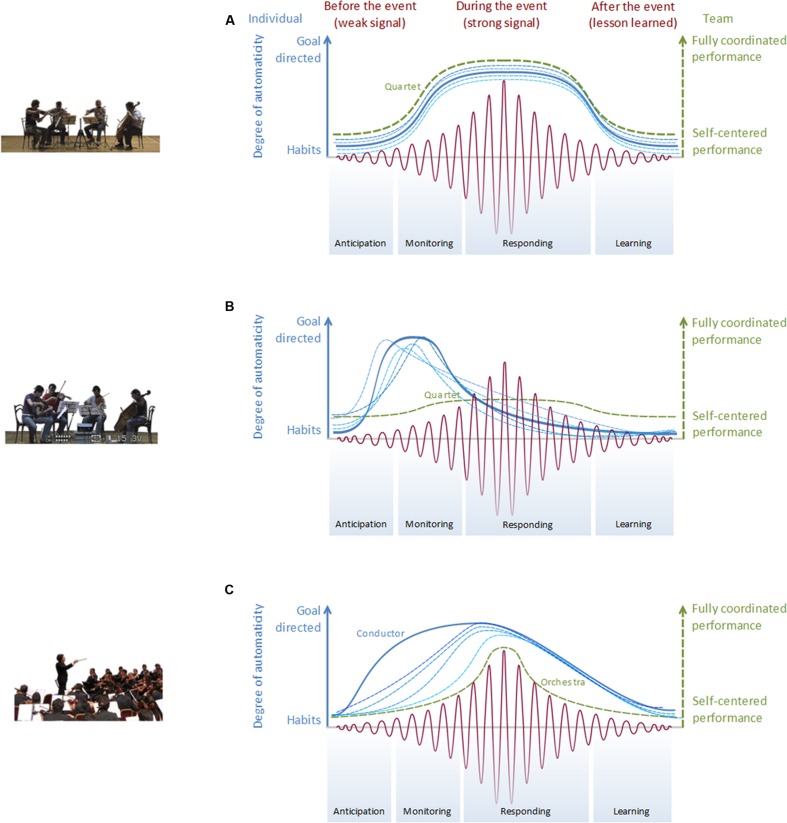
The present contribution provides readers from diverse fields of psychology with a new and comprehensive model for the understanding of the characteristics of music ensembles. The model is based on a novel heuristic approach whose key construct is resilience, intended here as the ability of a system to adapt to external perturbations and anticipate future events. The paper clarifies the specificity of music ensemble as an original social and creative activity, and how some mechanisms, at an individual (cognitive) and group (coordination) level, are enacted in a particular way that endows these groups with exceptional capacity for resilience. There is now a wealth of evidence isolating the psychological mechanisms involved in these processes. However, there is much less focus on conditions in which the group has to face unexpected and potentially performance-disruptive events. The resilience approach offers a more thorough explanation of the regulatory strategies that musicians may resort to in order to maintain their performance at an optimal level. Music ensembles of different size are presented as case studies of how such systems (and their individual members) resist error and maintain joint performance. Three hypothetical scenarios are further proposed that epitomize resilient or non-resilient musical teams. The present contribution further proposes hypotheses and formulates predictions on which combinations of individual and group factors foster team resilience. This model further accommodates the most recent findings in neuroscience and experimental psychology. Besides highlighting the potential of music ensemble for psychological research, it offers hints about how resilience could be trained.
本论文为来自心理学不同领域的读者提供了一个全新且全面的模型,用于理解音乐合奏的特点。该模型基于一种新颖的启发式方法,其关键构建要素是复原力,这里将其定义为系统适应外部干扰并预测未来事件的能力。本文阐明了音乐合奏作为一种独特的社会和创造性活动的特殊性,以及一些在个体(认知)和群体(协调)层面的机制是如何以一种特定方式发挥作用的,这种方式赋予了这些群体非凡的复原力。目前有大量证据分离出了这些过程中涉及的心理机制。然而,对于群体必须面对意外且可能破坏表演的事件的情况,关注则少得多。复原力方法为音乐家为保持最佳表演水平可能采取的调节策略提供了更全面的解释。不同规模的音乐合奏被作为案例研究呈现,展示了这样的系统(及其个体成员)如何抵抗错误并维持共同表演。还进一步提出了三个假设情景,概括了具有复原力或不具有复原力的音乐团队。本论文进一步提出假设并做出预测,即个体和群体因素的哪些组合会促进团队复原力。该模型进一步纳入了神经科学和实验心理学的最新研究成果。除了强调音乐合奏在心理学研究中的潜力外,它还提供了关于如何训练复原力的提示。