Ertel Phillip, Adalig Burkay, Demircan Ipek, Lartey Belinda, Manyak Michael J
GlaxoSmithKline, Durham, NC, USA.
GlaxoSmithKline, Istanbul, Turkey.
Int J Clin Pract. 2016 Oct;70(10):870-880. doi: 10.1111/ijcp.12879.
To assess attitudes and beliefs towards benign prostatic hyperplasia (BPH)/ lower urinary tract symptoms (LUTS) and its treatment among patients and physicians in Latin America, Asia Pacific and the Commonwealth of Independent States (CIS).
Cross-sectional, quantitative study conducted between December 2014 and September 2015. Separate questionnaires were administered to BPH/LUTS patients receiving drug treatment for their condition and to practising physicians who treat patients with BPH/LUTS.
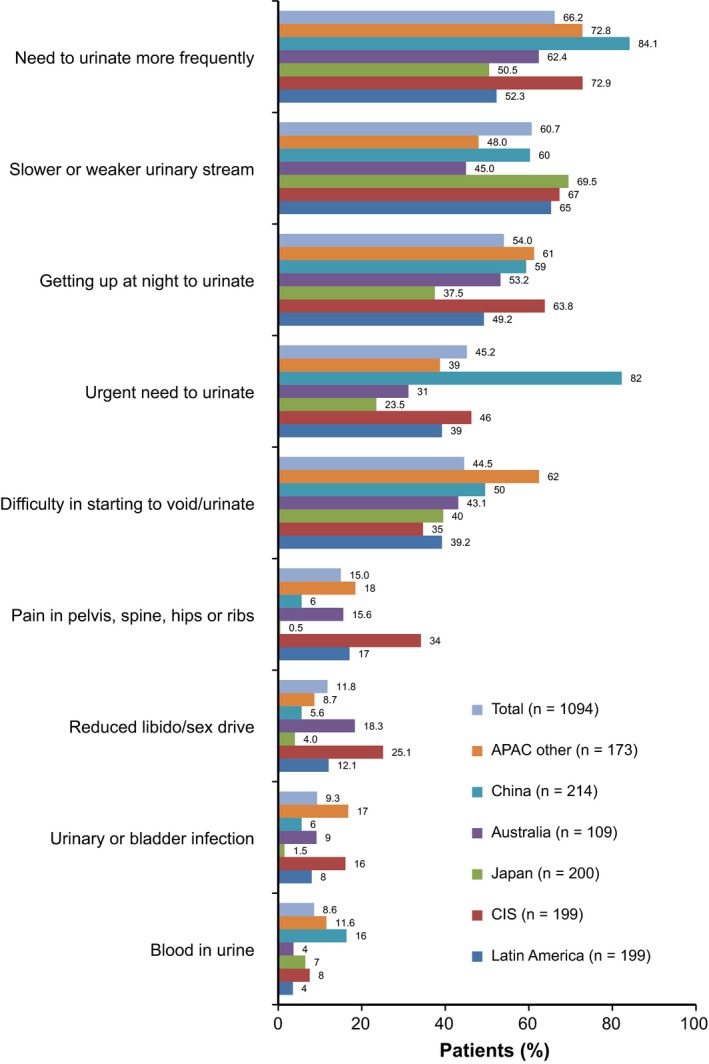
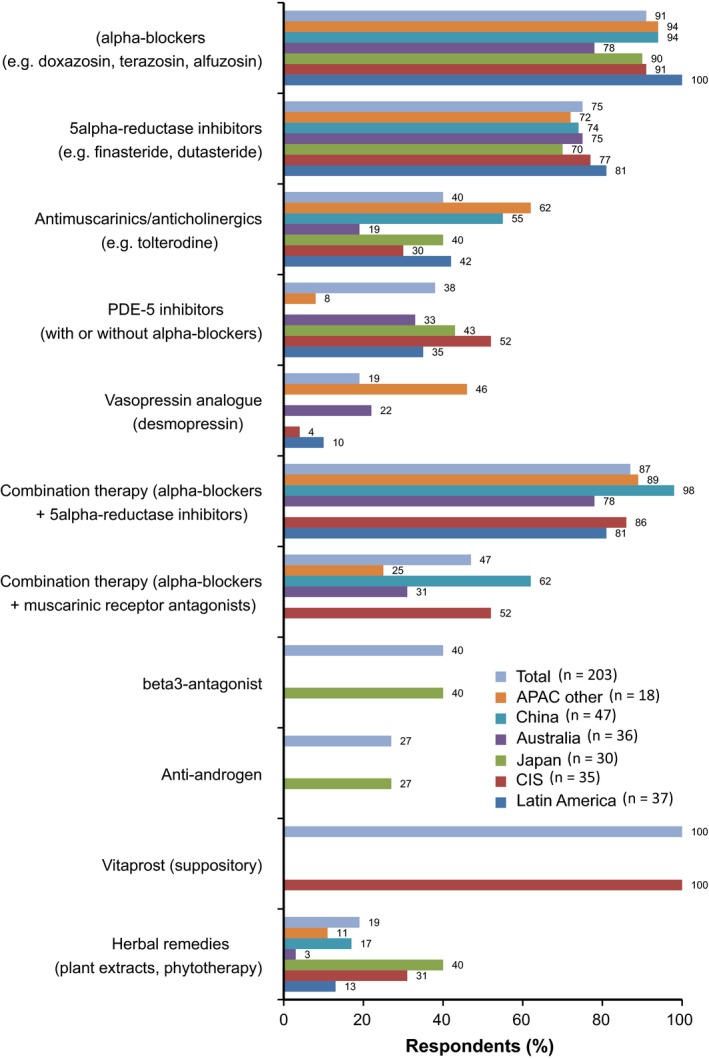
In total, 1094 patients and 202 physicians completed a questionnaire. Most patients (61%) felt very/fairly well informed about BPH/LUTS, and 60% of physicians perceived patients to be very/somewhat informed. Overall, 70% of physicians felt that it would be valuable to raise awareness of BPH/LUTS and encourage men to consult a physician. The first symptoms most commonly noticed by patients were need to urinate more frequently, slower/weaker stream and nocturia. At first consultation, 71% of patients recalled providing a urine sample, 57% having a blood test for prostate-specific antigen and 56% a digital rectal examination being performed. Over two thirds of patients (69%) were satisfied with their current medication; highest satisfaction rates (among both patients and physicians) were reported for alpha blockers and 5ARIs, either as monotherapies or used in combination. Patients were prepared to wait longer for symptom relief in order to have a reduced risk of surgery. Most physicians (90%) thought that at least some patients believe BPH/LUTS to be a progressive condition. Most physicians thought that patients were very/fairly concerned about BPH surgery (92%) and acute urinary retention (72%); 52% of physicians thought treatment adherence was "extremely" important.
This study provides valuable insights into the attitudes and beliefs of patients and physicians in Asia Pacific, Latin America and CIS about BPH/LUTS and its management. It also highlights areas of discordance between patient/physician perceptions and beliefs about BPH/LUTS, and potential areas of focus to improve the experience of affected patients.
评估拉丁美洲、亚太地区及独立国家联合体(独联体)患者和医生对良性前列腺增生(BPH)/下尿路症状(LUTS)及其治疗的态度和看法。
于2014年12月至2015年9月进行横断面定量研究。分别向接受BPH/LUTS药物治疗的患者以及治疗BPH/LUTS患者的执业医生发放问卷。
共有1094名患者和202名医生完成了问卷。大多数患者(61%)感觉对BPH/LUTS了解得非常/比较充分,60%的医生认为患者了解得非常/还算充分。总体而言,70%的医生认为提高对BPH/LUTS的认识并鼓励男性咨询医生很有价值。患者最常注意到的首发症状是排尿更频繁、尿流缓慢/无力和夜尿。初诊时,71%的患者记得提供了尿液样本,57%进行了前列腺特异性抗原血液检测,56%接受了直肠指检。超过三分之二的患者(69%)对当前用药满意;α受体阻滞剂和5α还原酶抑制剂作为单一疗法或联合使用时,患者和医生的满意度最高。患者愿意为了降低手术风险而等待更长时间以缓解症状。大多数医生(90%)认为至少有些患者认为BPH/LUTS是一种进行性疾病。大多数医生认为患者非常/比较担心BPH手术(92%)和急性尿潴留(72%);52%的医生认为治疗依从性“极其”重要。
本研究为亚太地区、拉丁美洲和独联体患者和医生对BPH/LUTS及其管理的态度和看法提供了有价值的见解。它还突出了患者/医生对BPH/LUTS的认知和看法之间存在分歧的领域,以及改善受影响患者体验的潜在重点领域。