Paolino Magdalena, Penninger Josef M
IMBA, Institute of Molecular Biotechnology of the Austrian Academy of Sciences, Dr. Bohrgasse 3, A-1030 Vienna, Austria.
Cancers (Basel). 2016 Oct 21;8(10):97. doi: 10.3390/cancers8100097.
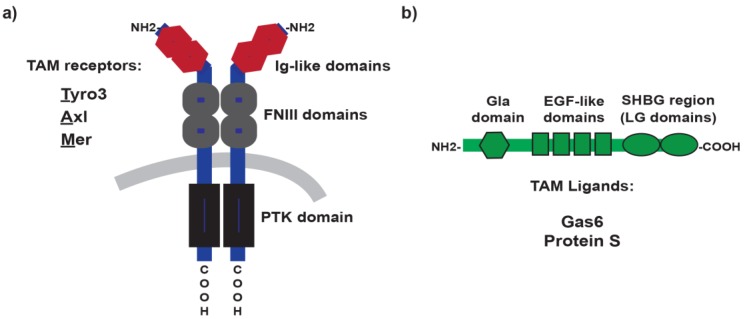
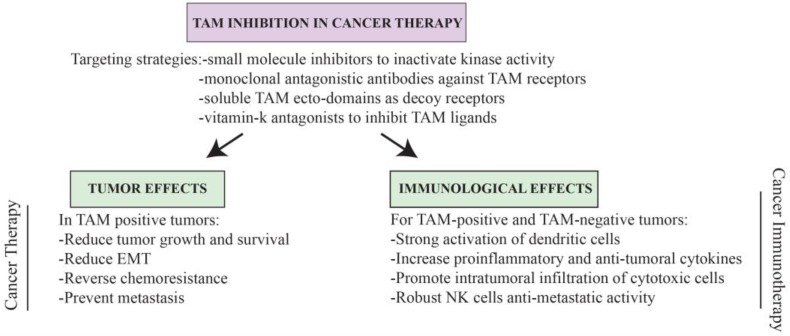
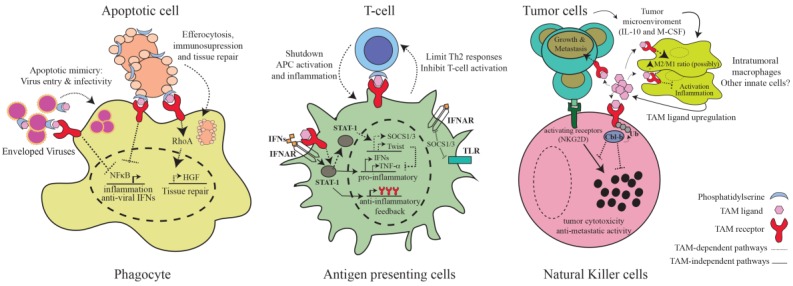
The TAM receptor protein tyrosine kinases-Tyro3, Axl, and Mer-are essential regulators of immune homeostasis. Guided by their cognate ligands Growth arrest-specific gene 6 (Gas6) and Protein S (Pros1), these receptors ensure the resolution of inflammation by dampening the activation of innate cells as well as by restoring tissue function through promotion of tissue repair and clearance of apoptotic cells. Their central role as negative immune regulators is highlighted by the fact that deregulation of TAM signaling has been linked to the pathogenesis of autoimmune, inflammatory, and infectious diseases. Importantly, TAM receptors have also been associated with cancer development and progression. In a cancer setting, TAM receptors have a dual regulatory role, controlling the initiation and progression of tumor development and, at the same time, the associated anti-tumor responses of diverse immune cells. Thus, modulation of TAM receptors has emerged as a potential novel strategy for cancer treatment. In this review, we discuss our current understanding of how TAM receptors control immunity, with a particular focus on the regulation of anti-tumor responses and its implications for cancer immunotherapy.
TAM 受体蛋白酪氨酸激酶(Tyro3、Axl 和 Mer)是免疫稳态的重要调节因子。在其同源配体生长停滞特异性基因 6(Gas6)和蛋白 S(Pros1)的引导下,这些受体通过抑制先天细胞的激活以及通过促进组织修复和清除凋亡细胞来恢复组织功能,从而确保炎症的消退。TAM 信号传导失调与自身免疫性、炎症性和感染性疾病的发病机制有关,这一事实突出了它们作为负性免疫调节因子的核心作用。重要的是,TAM 受体也与癌症的发生和发展有关。在癌症环境中,TAM 受体具有双重调节作用,控制肿瘤发展的起始和进程,同时控制多种免疫细胞的相关抗肿瘤反应。因此,调节 TAM 受体已成为一种潜在的癌症治疗新策略。在这篇综述中,我们讨论了目前对 TAM 受体如何控制免疫的理解,特别关注抗肿瘤反应的调节及其对癌症免疫治疗的影响。