Sakhaie Mohammad Hassan, Soleimani Mansoureh, Pirhajati Vahid, Soleimani Asl Sara, Madjd Zahra, Mehdizadeh Mehdi
Department of Anatomical Sciences, Iran University of Medical Sciences, Tehran, IR Iran.
Cellular and Molecular Research Center, Iran University of Medical Sciences, Tehran, IR Iran.
Iran Red Crescent Med J. 2016 Jun 8;18(8):e30297. doi: 10.5812/ircmj.30297. eCollection 2016 Aug.
Coenzyme Q10 has antioxidative and free radical scavenging effects. CoQ10 supplementation is known to have neuroprotective effects in some neurodegenerative diseases, such as Parkinson's disease and Huntington's disease.
The aim of this study was to evaluate both histopathologic and behavioral whether Coenzyme Q10 is protective against trimethyltin chloride (TMT) induced hippocampal damage.
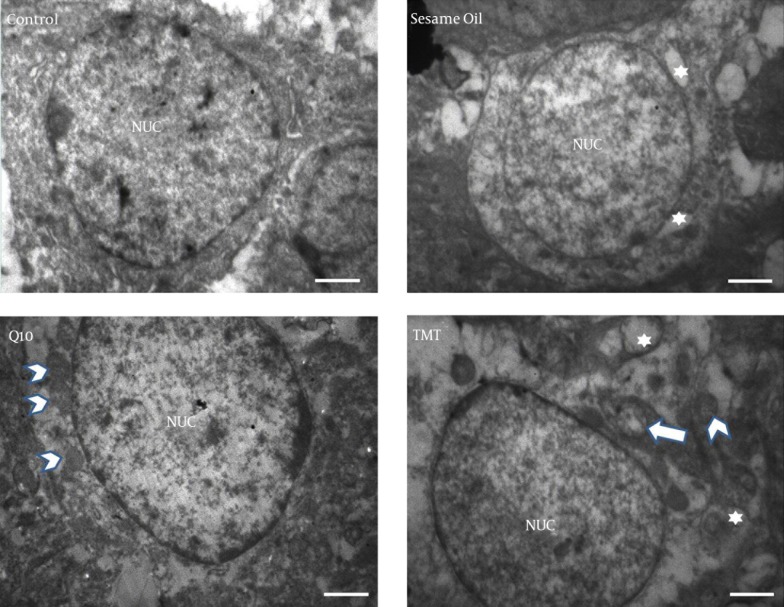
This was an experimental study. Thirty-six Balb/c mice were divided into four groups, as follows: 1) control group; 2) sham group of mice that received a 100 µL intraperitoneal injection (IP) of sesame oil; 3) TMT group of mice that received a single 2.5 mg/kg/day IP injection of TMT; and 4) TMT + CoQ10 group of mice that received a 10 mg/kg IP injection of CoQ10. Body weight and Morris water maze (MWM) responses were investigated. In addition, the dentate gyrus neurons of the hippocampus were evaluated histopathologically by light and electron microscopes.
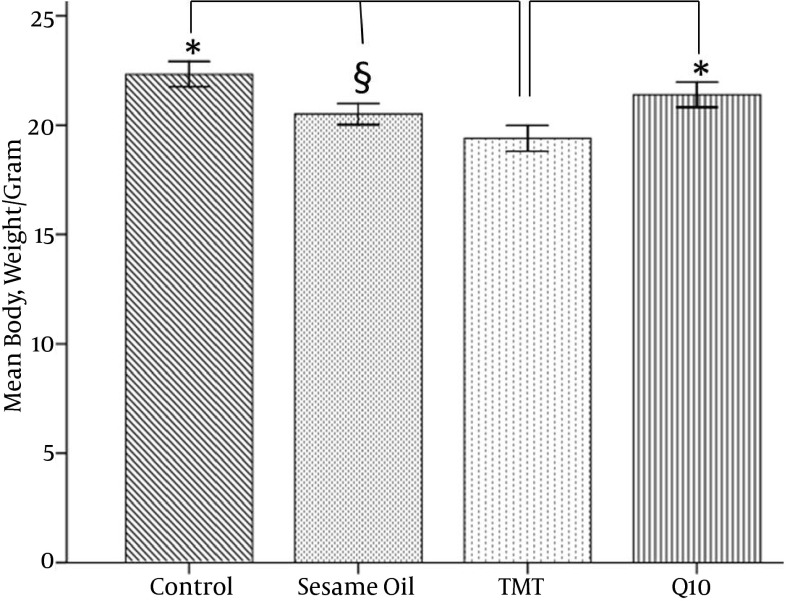
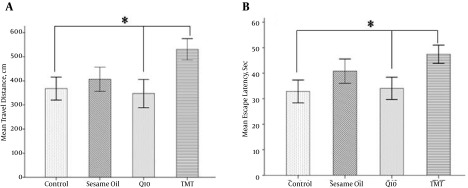
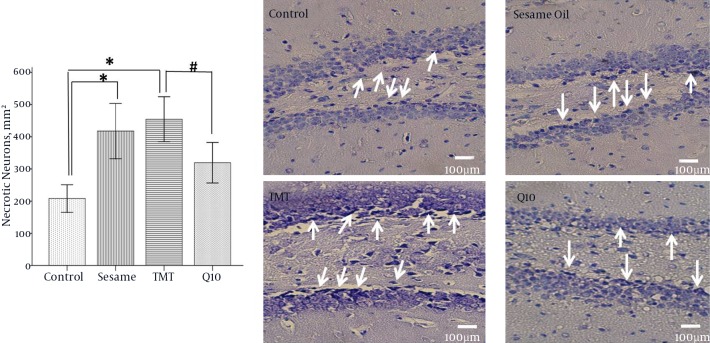
This study revealed that the body weight scale was found to be significantly higher in the CoQ10 group (21.39 ± 2.70), compared to the TMT group (19.39 ± 2.74) (P < 0.05). In the TMT group, the animals showed body a weight loss that was significantly lower than that of the control group (22.33 ± 3.06) (P < 0.05). Our results showed that CoQ10 provided protection against MWM deficits. Furthermore, TMT impaired the ability of mice to locate the hidden platform, compared to the control group (P < 0.05). Microscopic studies showed that TMT caused histopathological changes in the dentate gyrus and increased the number of necrotic neurons (476 ± 78.51), compared to the control group (208 ± 40.84) (P < 0.001). But, CoQ10 significantly attenuated (31 9 ± 60.08) the density of necrotic neurons compared to TMT (P < 0.05).
The results of the present study indicate that Coenzyme Q10 diminished neuronal necrosis and improved learning memory. Part of its beneficial effect is due to its potential to discount oxidative stress.
辅酶Q10具有抗氧化和清除自由基的作用。已知补充辅酶Q10在某些神经退行性疾病如帕金森病和亨廷顿病中具有神经保护作用。
本研究旨在从组织病理学和行为学两方面评估辅酶Q10是否对三甲基氯化锡(TMT)诱导的海马损伤具有保护作用。
这是一项实验性研究。36只Balb/c小鼠被分为四组,如下:1)对照组;2)假手术组,小鼠腹腔注射(IP)100μL芝麻油;3)TMT组,小鼠每天腹腔注射2.5mg/kg的TMT一次;4)TMT +辅酶Q10组,小鼠腹腔注射10mg/kg的辅酶Q10。研究了体重和莫里斯水迷宫(MWM)反应。此外,通过光学显微镜和电子显微镜对海马齿状回神经元进行组织病理学评估。
本研究表明,与TMT组(19.39±2.74)相比,辅酶Q10组(21.39±2.70)的体重秤读数显著更高(P<0.05)。在TMT组中,动物体重减轻明显低于对照组(22.33±3.06)(P<0.05)。我们的结果表明,辅酶Q10对MWM缺陷具有保护作用。此外,与对照组相比,TMT损害了小鼠定位隐藏平台的能力(P<0.05)。显微镜研究表明,与对照组(208±40.84)相比,TMT导致齿状回组织病理学变化并增加坏死神经元数量(476±78.51)(P<0.001)。但是,与TMT组相比,辅酶Q10显著降低了坏死神经元密度(319±60.08)(P<0.05)。
本研究结果表明,辅酶Q10可减少神经元坏死并改善学习记忆。其部分有益作用归因于其减轻氧化应激的潜力。