
流行病模型中准周期强迫的影响。
Effects of quasiperiodic forcing in epidemic models.
作者信息
Bilal Shakir, Singh Brajendra K, Prasad Awadhesh, Michael Edwin
机构信息
Department of Physics and Astrophysics, University of Delhi, Delhi 110 007, India.
Department of Biological Sciences, University of Notre Dame, Notre Dame, Indiana 46556, USA.
出版信息
Chaos. 2016 Sep;26(9):093115. doi: 10.1063/1.4963174.
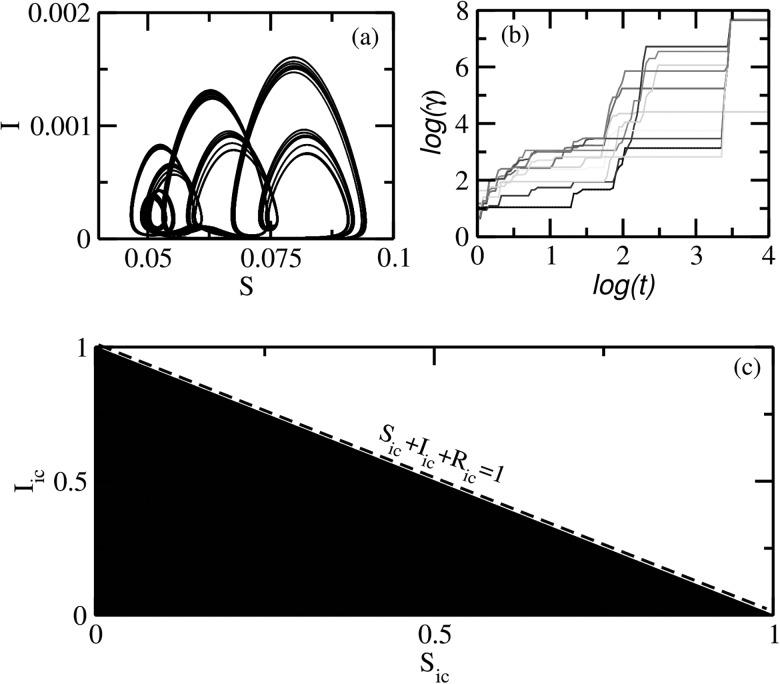
We study changes in the bifurcations of seasonally driven compartmental epidemic models, where the transmission rate is modulated temporally. In the presence of periodic modulation of the transmission rate, the dynamics varies from periodic to chaotic. The route to chaos is typically through period doubling bifurcation. There are coexisting attractors for some sets of parameters. However in the presence of quasiperiodic modulation, tori are created in place of periodic orbits and chaos appears via finite torus doublings. Strange nonchaotic attractors (SNAs) are created at the boundary of chaotic and torus dynamics. Multistability is found to be reduced as a function of quasiperiodic modulation strength. It is argued that occurrence of SNAs gives an opportunity of asymptotic predictability of epidemic growth even when the underlying dynamics is strange.
我们研究了季节性驱动的 compartmental 流行病模型的分歧变化,其中传播率随时间调制。在传播率存在周期性调制的情况下,动力学从周期性变化到混沌。通向混沌的路径通常是通过倍周期分岔。对于某些参数集存在共存吸引子。然而,在准周期调制的情况下,环面取代周期轨道而产生,并且通过有限的环面加倍出现混沌。在混沌和环面动力学的边界处产生了奇怪的非混沌吸引子(SNA)。发现多稳定性随着准周期调制强度而降低。有人认为,即使潜在动力学是奇怪的,SNA 的出现也为流行病增长的渐近可预测性提供了机会。



 Zotero 插件