Kirkhaug Bente, Drugli May Britt, Handegård Bjørn Helge, Lydersen Stian, Åsheim Merethe, Fossum Sturla
The Regional Centre for Child and Youth Mental Health and Child Welfare - Central Norway, Norwegian University of Science and Technology (NTNU), Norway, Klostergata 46, Trondheim, 7030, Norway.
Centre of the Study of Educational Practice (SePU), Hedmark University College, Hedmark, Norway.
BMC Psychiatry. 2016 Oct 26;16(1):362. doi: 10.1186/s12888-016-1077-1.
Young children exhibiting severe externalizing problems in school are at risk of developing several poor outcomes. School-based intervention programs have been found to be effective for students with different problems, including those with behavioral problems, emotional distress, or social problems. The present study investigated whether the IY-TCM programme, as a universal stand-alone school intervention programme, reduced severe child externalizing problems as reported by the teacher, and evaluated if these children improved their social competence, internalizing problems, academic performances and student- teacher relationship as a result of the IY TCM training.
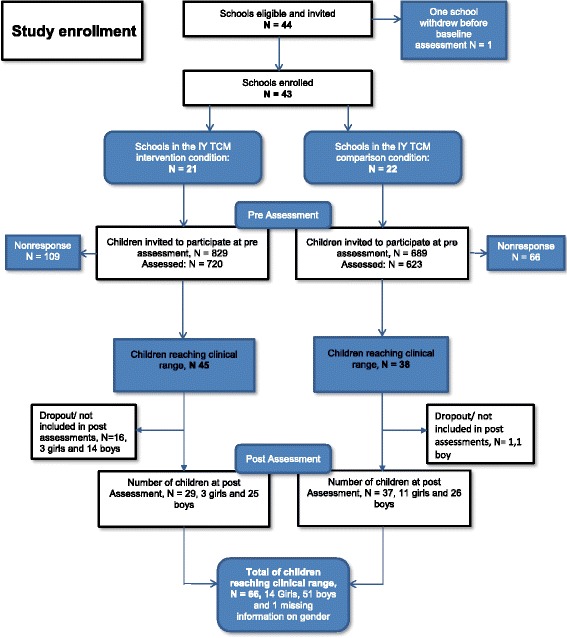
A quasi-experimental pre-post study was conducted, including 21 intervention schools and 22 control schools. Children in 1 - 3 grade (age 6-8 years) assessed by their teacher as having severe externalizing problems on the Sutter-Eyberg Student Behavior Inventory-Revised (SESBI-R) total Intensity score, were included in the study, N = 83 (65 boys and 18 girls). Treatment effects were evaluated using 3- level linear mixed models analysis.
In our study we found no differences in change between the two conditions from baseline to follow-up in externalizing problems, social skills, internalizing problems and closeness with teacher. The intervention condition did however show advantageous development in terms of student-teacher conflicts and increased academic performances.
The IY Teacher Classroom Management program is not sufficient being a stand-alone universal program in a Norwegian primary school setting, for students with severe externalizing problems. However; some important secondary findings were found. Still, young school children with severe externalizing problems are in need of more comprehensive and tailored interventions.
在学校表现出严重外化问题的幼儿面临着出现多种不良后果的风险。已发现基于学校的干预计划对有不同问题的学生有效,包括那些有行为问题、情绪困扰或社交问题的学生。本研究调查了作为一种独立的学校通用干预计划的中医综合干预计划(IY-TCM)是否能减少教师报告的儿童严重外化问题,并评估这些儿童是否因中医综合干预训练而提高了社交能力、内化问题、学业成绩以及师生关系。
进行了一项准实验性前后测研究,包括21所干预学校和22所对照学校。研究纳入了1至3年级(6 - 8岁)、经教师根据修订后的萨特 - 艾伯格学生行为量表(SESBI-R)总强度得分评估为有严重外化问题的儿童,N = 83(65名男孩和18名女孩)。使用三级线性混合模型分析评估治疗效果。
在我们的研究中,我们发现从基线到随访,在外化问题、社交技能、内化问题以及与教师的亲密程度方面,两种情况之间的变化没有差异。然而,干预组在师生冲突和学业成绩提高方面显示出有利的发展。
对于有严重外化问题的学生,在挪威小学环境中,中医教师课堂管理计划作为一个独立的通用计划是不够的。然而,发现了一些重要的次要结果。尽管如此,有严重外化问题的年幼学童仍需要更全面和量身定制的干预措施。