Zhou Guowei, Yuan Tao, Cai Lin, Zhang Weipeng, Tian Renmao, Tong Haoya, Jiang Lei, Yuan Xiangcheng, Liu Sheng, Qian Peiyuan, Huang Hui
Key Laboratory of Tropical Marine Bio-resources and Ecology, South China Sea Institute of Oceanology, Chinese Academy of Sciences, China.
Tropical Marine Biological Research Station in Hainan, Chinese Academy of Sciences, China.
Sci Rep. 2016 Oct 27;6:35971. doi: 10.1038/srep35971.
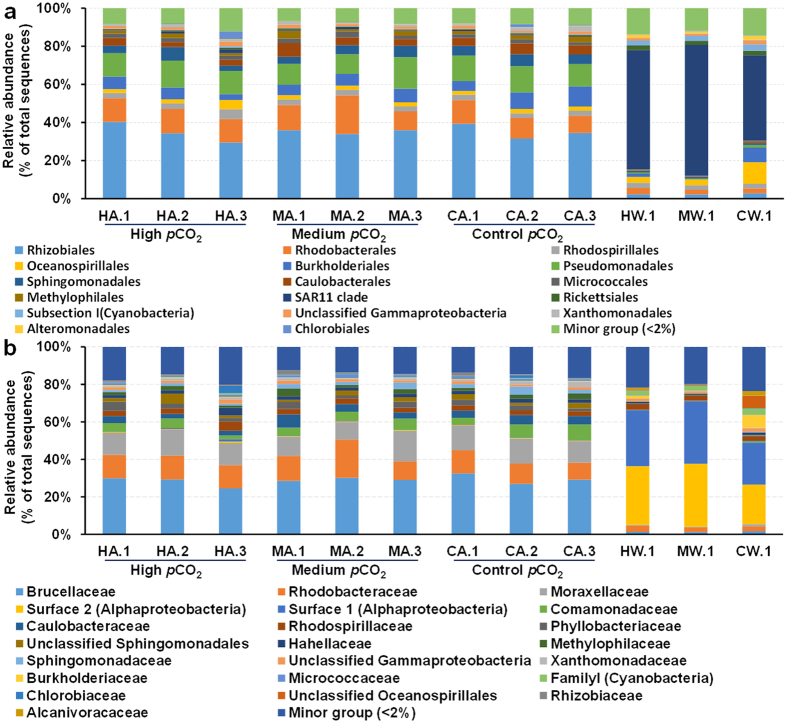
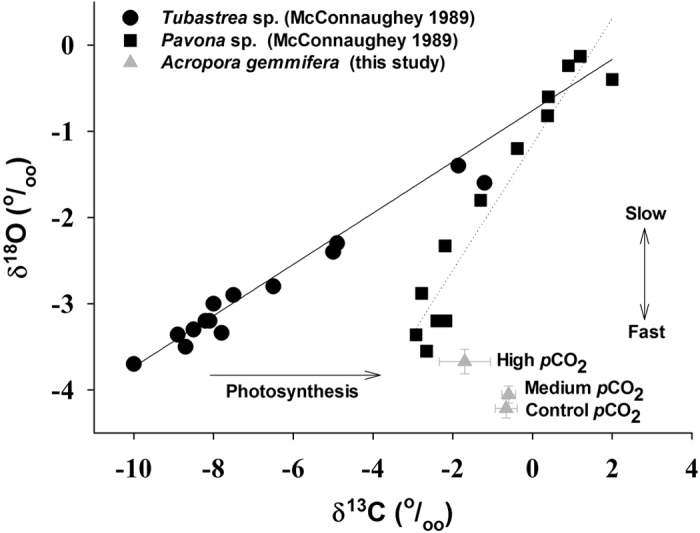
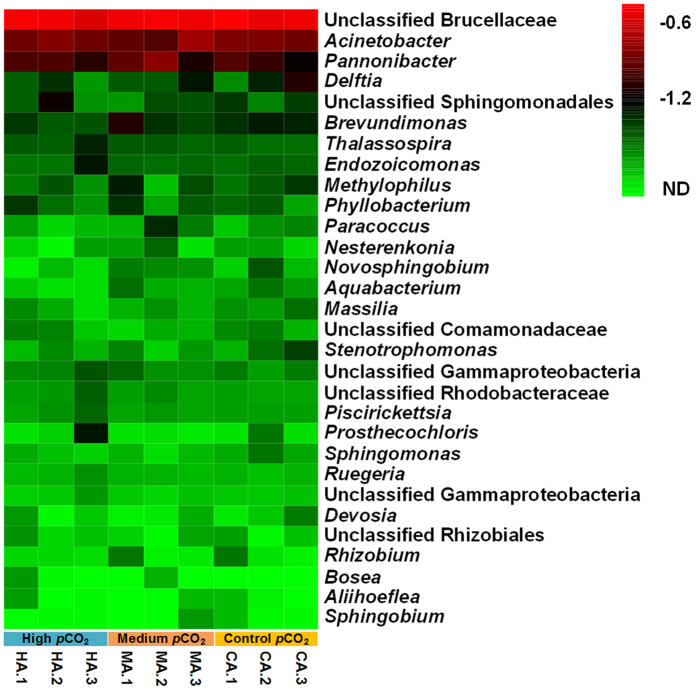
With the increasing anthropogenic CO concentration, ocean acidification (OA) can have dramatic effects on coral reefs. However, the effects of OA on coral physiology and the associated microbes remain largely unknown. In the present study, reef-building coral Acropora gemmifera collected from a reef flat with highly fluctuating environmental condition in the South China Sea were exposed to three levels of partial pressure of carbon dioxide (pCO) (i.e., 421, 923, and 2070 μatm) for four weeks. The microbial community structures associated with A. gemmifera under these treatments were analyzed using 16S rRNA gene barcode sequencing. The results revealed that the microbial community associated with A. gemmifera was highly diverse at the genus level and dominated by Alphaproteobacteria. More importantly, the microbial community structure remained rather stable under different pCO treatments. Photosynthesis and calcification in A. gemmifera, as indicated by enrichment of δO and increased depletion of δC in the coral skeleton, were significantly impaired only at the high pCO (2070 μatm). These results suggest that A. gemmifera can maintain a high degree of stable microbial communities despite of significant physiological changes in response to extremely high pCO.
随着人为源二氧化碳浓度的增加,海洋酸化(OA)会对珊瑚礁产生巨大影响。然而,OA对珊瑚生理及相关微生物的影响仍 largely未知。在本研究中,从南海环境条件高度波动的礁坪采集的造礁石珊瑚宝石鹿角珊瑚暴露于三种二氧化碳分压(pCO₂)水平(即421、923和2070 μatm)下四周。使用16S rRNA基因条形码测序分析这些处理下与宝石鹿角珊瑚相关的微生物群落结构。结果表明,与宝石鹿角珊瑚相关的微生物群落在属水平上高度多样,且以α-变形菌纲为主。更重要的是,在不同的pCO₂处理下,微生物群落结构保持相当稳定。仅在高pCO₂(2070 μatm)时,宝石鹿角珊瑚的光合作用和钙化作用(如珊瑚骨骼中δO富集和δC消耗增加所示)才受到显著损害。这些结果表明,尽管宝石鹿角珊瑚在应对极高pCO₂时生理发生了显著变化,但仍能维持高度稳定的微生物群落。