Harris Rebecca Arden, Xue Xiaonan, Selwyn Peter A
*Department of Family Medicine and Community Health, University of Pennsylvania, Philadelphia, PA; and †Albert Einstein College of Medicine, Bronx, NY.
J Acquir Immune Defic Syndr. 2017 Mar 1;74(3):309-317. doi: 10.1097/QAI.0000000000001213.
Previous research has produced inconsistent evidence of an association between housing stability and medication adherence among HIV-positive individuals in antiretroviral therapy.
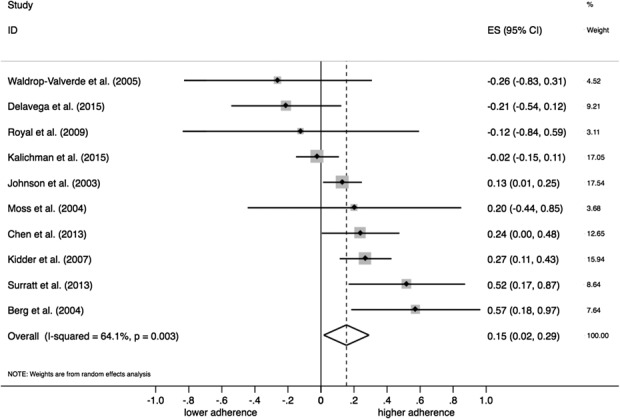
We conducted a meta-analysis of the housing-adherence relationship based on a comprehensive search of observational studies in the PubMed, Embase, and Cochrane databases (January 2000-January 2016). Ten qualifying studies were identified representing 10,556 individuals.
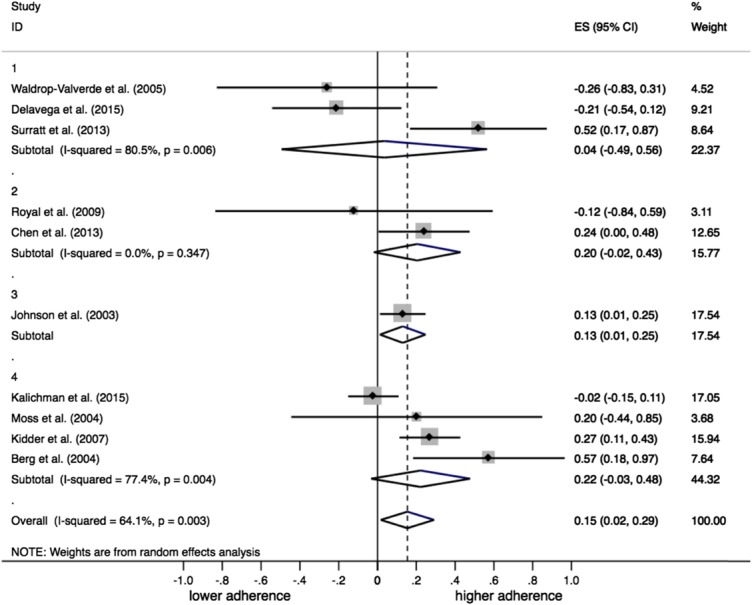
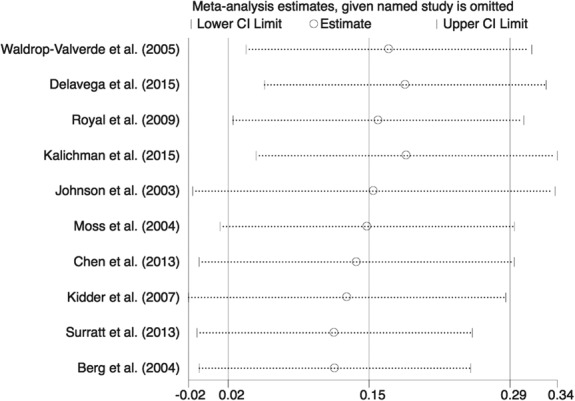
A random-effects model was used to estimate the overall effect size and 95% confidence interval (CI). Robustness of the estimate was determined by sensitivity analysis. Heterogeneity was assessed by meta-regression analysis, subgroup analysis, and quality effects estimation. Publication bias was evaluated with a funnel plot and the Egger and Begg tests.
The summary effect for the association between housing stability and medication adherence was positive and significant (standardized mean difference = 0.15, 95% CI: 0.02 to 0.29). The association was slightly larger in the quality effects analysis (standardized mean difference = 0.20, 95% CI: 0.01 to 0.39). Sensitivity analysis disclosed that the association was robust at the P = 0.09 level. Results of the subgroup and meta-regression analyses were nonsignificant. Publication bias was not detected.
Antiretroviral medication adherence is an increasing function of housing stability, but the magnitude of the effect is small. The finding challenges the view that unstable housing is incompatible with adherence and questions the potential benefit of deferring antiretroviral therapy initiation until the patient's housing circumstances are improved.
先前的研究对于接受抗逆转录病毒治疗的HIV阳性个体的住房稳定性与药物依从性之间的关联,得出了不一致的证据。
我们基于对PubMed、Embase和Cochrane数据库(2000年1月至2016年1月)中观察性研究的全面检索,对住房与依从性的关系进行了荟萃分析。确定了10项符合条件的研究,涉及10556名个体。
采用随机效应模型来估计总体效应大小和95%置信区间(CI)。通过敏感性分析确定估计值的稳健性。通过荟萃回归分析、亚组分析和质量效应估计来评估异质性。用漏斗图以及Egger和Begg检验评估发表偏倚。
住房稳定性与药物依从性之间关联的汇总效应为阳性且具有统计学意义(标准化均数差 = 0.15,95%CI:0.02至0.29)。在质量效应分析中该关联略大(标准化均数差 = 0.20,95%CI:0.01至0.39)。敏感性分析表明该关联在P = 0.09水平上是稳健的。亚组分析和荟萃回归分析的结果无统计学意义。未检测到发表偏倚。
抗逆转录病毒药物依从性是住房稳定性的递增函数,但效应大小较小。这一发现挑战了不稳定住房与依从性不相容的观点,并质疑了在患者住房状况改善之前推迟启动抗逆转录病毒治疗的潜在益处。