Tan Hui Yi, Agarwal Aniruddha, Lee Cecilia S, Chhablani Jay, Gupta Vishali, Khatri Manoj, Nirmal Jayabalan, Pavesio Carlos, Agrawal Rupesh
Yong Loo Lin School of Medicine, National University of Singapore, Singapore.
Department of Vitreoretina, Stanley M Truhlsen Eye Institute, University of Nebraska Medical Center, Omaha, NE.
Clin Ophthalmol. 2016 Oct 13;10:1983-2020. doi: 10.2147/OPTH.S89341. eCollection 2016.
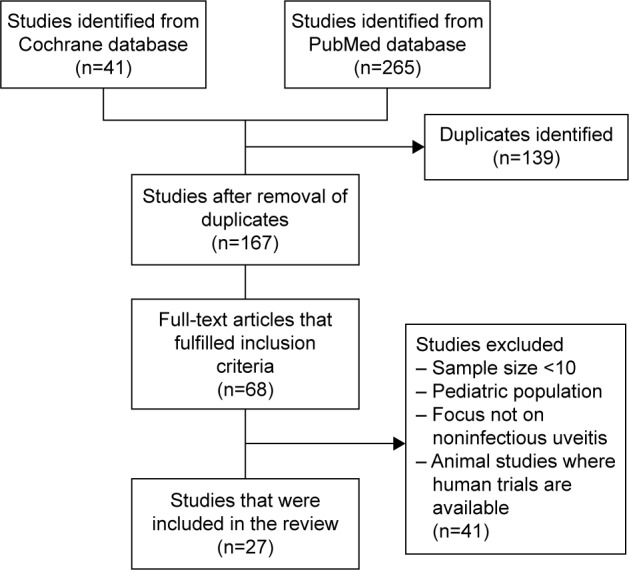
Uveitis is an important cause of vision loss worldwide due to its sight-threatening complications, especially cystoid macular edema, as well as choroidal neovascularization, macular ischemia, cataract, and glaucoma. Systemic corticosteroids are the mainstay of therapy for noninfectious posterior uveitis; however, various systemic side effects can occur. Intravitreal medication achieves a therapeutic level in the vitreous while minimizing systemic complications and is thus used as an exciting alternative. Corticosteroids, antivascular endothelial growth factors, immunomodulators such as methotrexate and sirolimus, and nonsteroidal anti-inflammatory drugs are currently available for intravitreal therapy. This article reviews the existing literature for efficacy and safety of these various options for intravitreal drug therapy for the management of noninfectious uveitis (mainly intermediate, posterior, and panuveitis).
葡萄膜炎是全球视力丧失的一个重要原因,因为它会引发威胁视力的并发症,尤其是黄斑囊样水肿,以及脉络膜新生血管、黄斑缺血、白内障和青光眼。全身用皮质类固醇是治疗非感染性后葡萄膜炎的主要药物;然而,可能会出现各种全身副作用。玻璃体内注射药物可在玻璃体内达到治疗水平,同时将全身并发症降至最低,因此是一种令人兴奋的替代方法。目前可用于玻璃体内治疗的药物有皮质类固醇、抗血管内皮生长因子、免疫调节剂(如甲氨蝶呤和西罗莫司)以及非甾体抗炎药。本文综述了现有文献中这些用于玻璃体内药物治疗非感染性葡萄膜炎(主要是中间部、后部和全葡萄膜炎)的各种方法的疗效和安全性。