Grim Sharon L, Dick Gregory J
Department of Earth and Environmental Sciences, University of Michigan, Ann Arbor MI, USA.
Front Microbiol. 2016 Oct 13;7:1546. doi: 10.3389/fmicb.2016.01546. eCollection 2016.
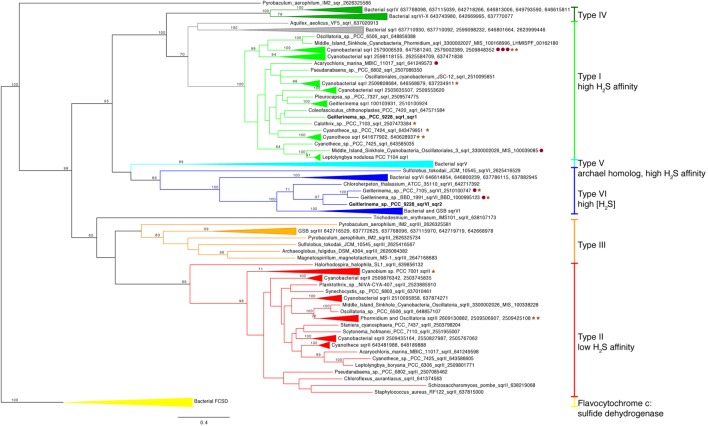
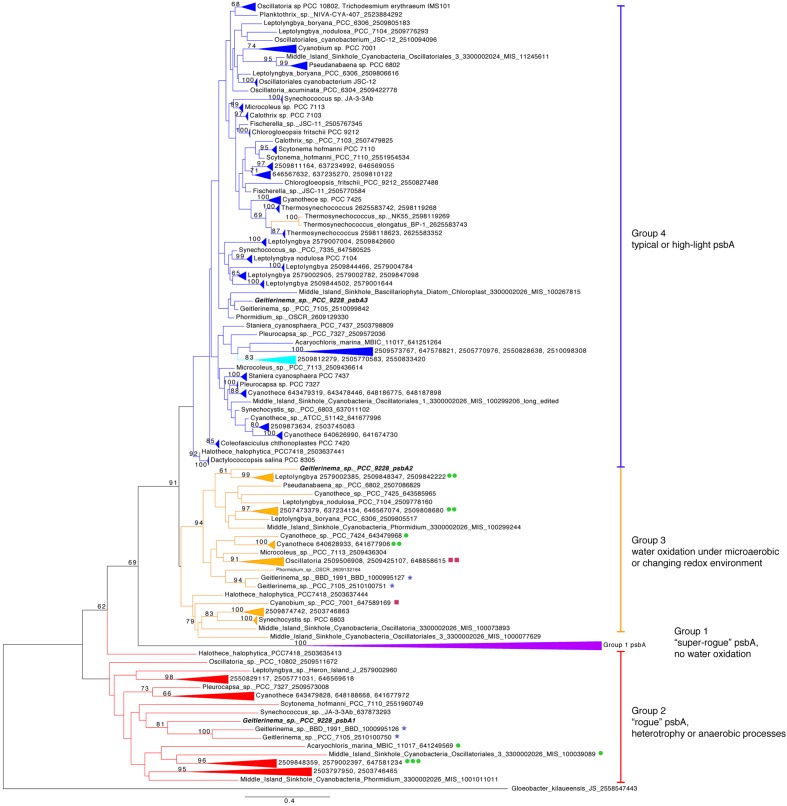
Anoxygenic cyanobacteria that use sulfide as the electron donor for photosynthesis are a potentially influential but poorly constrained force on Earth's biogeochemistry. Their versatile metabolism may have boosted primary production and nitrogen cycling in euxinic coastal margins in the Proterozoic. In addition, they represent a biological mechanism for limiting the accumulation of atmospheric oxygen, especially before the Great Oxidation Event and in the low-oxygen conditions of the Proterozoic. In this study, we describe the draft genome sequence of sp. PCC 9228, formerly 'Solar Lake', a mat-forming diazotrophic cyanobacterium that can switch between oxygenic photosynthesis and sulfide-based anoxygenic photosynthesis (AP). possesses three variants of , which encodes protein D1, a core component of the photosystem II reaction center. Phylogenetic analyses indicate that one variant is closely affiliated with cyanobacterial genes that code for a D1 protein used for oxygen-sensitive processes. Another version is phylogenetically similar to cyanobacterial genes that encode D1 proteins used under microaerobic conditions, and the third variant may be cued to high light and/or elevated oxygen concentrations. has the canonical gene for sulfide quinone reductase (SQR) used in cyanobacterial AP and a putative transcriptional regulatory gene in the same operon. Another operon with a second, distinct and regulatory gene is present, and is phylogenetically related to genes used for high sulfide concentrations. The genome has a comprehensive gene suite for nitrogen fixation, supporting previous observations of nitrogenase activity. possesses a bidirectional hydrogenase rather than the uptake hydrogenase typically used by cyanobacteria in diazotrophy. Overall, the genome sequence of sp. PCC 9228 highlights potential cyanobacterial strategies to cope with fluctuating redox gradients and nitrogen availability that occur in benthic mats over a diel cycle. Such dynamic geochemical conditions likely also challenged Proterozoic cyanobacteria, modulating oxygen production. The genetic repertoire that underpins flexible oxygenic/anoxygenic photosynthesis in cyanobacteria provides a foundation to explore the regulation, evolutionary context, and biogeochemical implications of these co-occurring metabolisms in Earth history.
利用硫化物作为光合作用电子供体的无氧蓝细菌,是地球上生物地球化学中一股潜在影响力巨大但限制因素不明的力量。它们多样的新陈代谢可能在元古宙的缺氧沿海边缘促进了初级生产和氮循环。此外,它们代表了一种限制大气氧积累的生物学机制,特别是在大氧化事件之前以及元古宙的低氧条件下。在本研究中,我们描述了sp. PCC 9228的基因组草图序列,该菌以前被称为“太阳湖”,是一种能形成席状结构的固氮蓝细菌,可在有氧光合作用和基于硫化物的无氧光合作用(AP)之间切换。拥有编码光系统II反应中心核心组分蛋白D1的基因的三个变体。系统发育分析表明,其中一个变体与编码用于对氧敏感过程的D1蛋白的蓝细菌基因密切相关。另一个版本在系统发育上与编码在微需氧条件下使用的D1蛋白的蓝细菌基因相似,第三个变体可能与高光和/或升高的氧浓度有关。拥有用于蓝细菌AP的硫化物醌还原酶(SQR)的典型基因以及同一操纵子中的一个假定转录调控基因。存在另一个具有第二个不同的和调控基因的操纵子,并且在系统发育上与用于高硫化物浓度的基因相关。该基因组具有用于固氮的全面基因套件,支持先前对固氮酶活性的观察。拥有双向氢化酶而非蓝细菌在固氮过程中通常使用的摄取氢化酶。总体而言,sp. PCC 9228的基因组序列突出了蓝细菌应对底栖席状物在昼夜循环中发生的氧化还原梯度和氮可用性波动的潜在策略。这种动态地球化学条件可能也给元古宙蓝细菌带来了挑战,调节了氧气产生。支撑蓝细菌中灵活的有氧/无氧光合作用的基因库为探索地球历史上这些同时出现的新陈代谢的调控、进化背景和生物地球化学影响提供了基础。