Mahmood Kashif, Xu Zhenhua, El-Kereamy Ashraf, Casaretto José A, Rothstein Steven J
Department of Molecular and Cellular Biology, University of Guelph, Guelph ON, Canada.
Front Plant Sci. 2016 Oct 14;7:1548. doi: 10.3389/fpls.2016.01548. eCollection 2016.
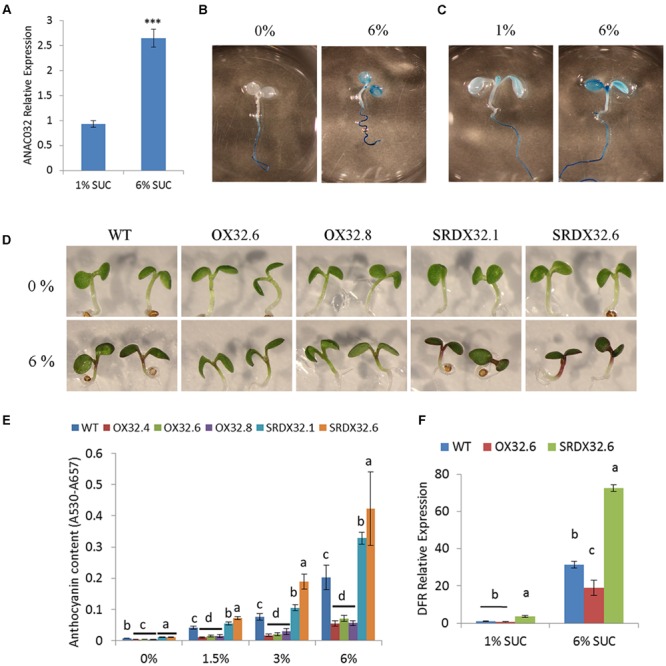
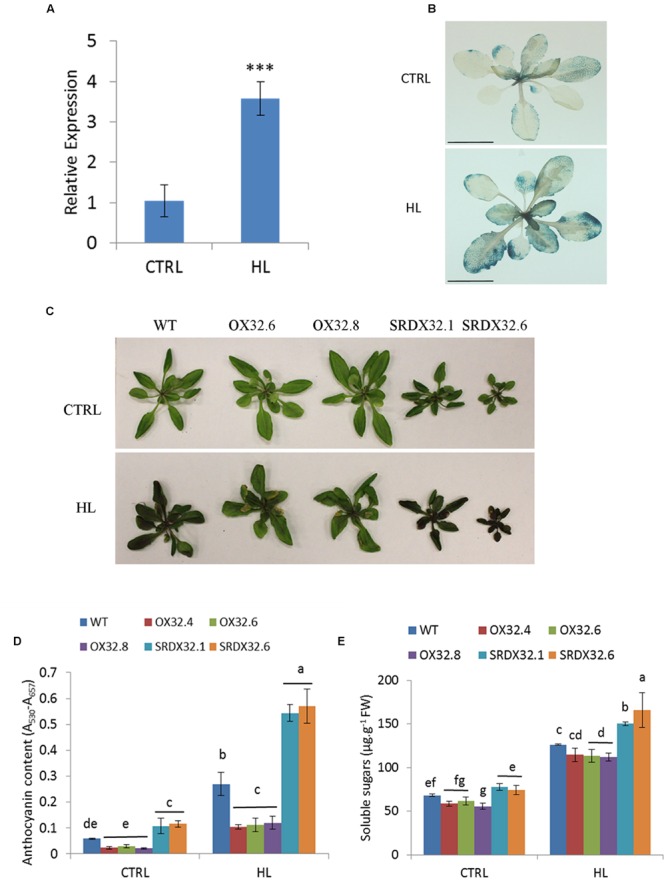
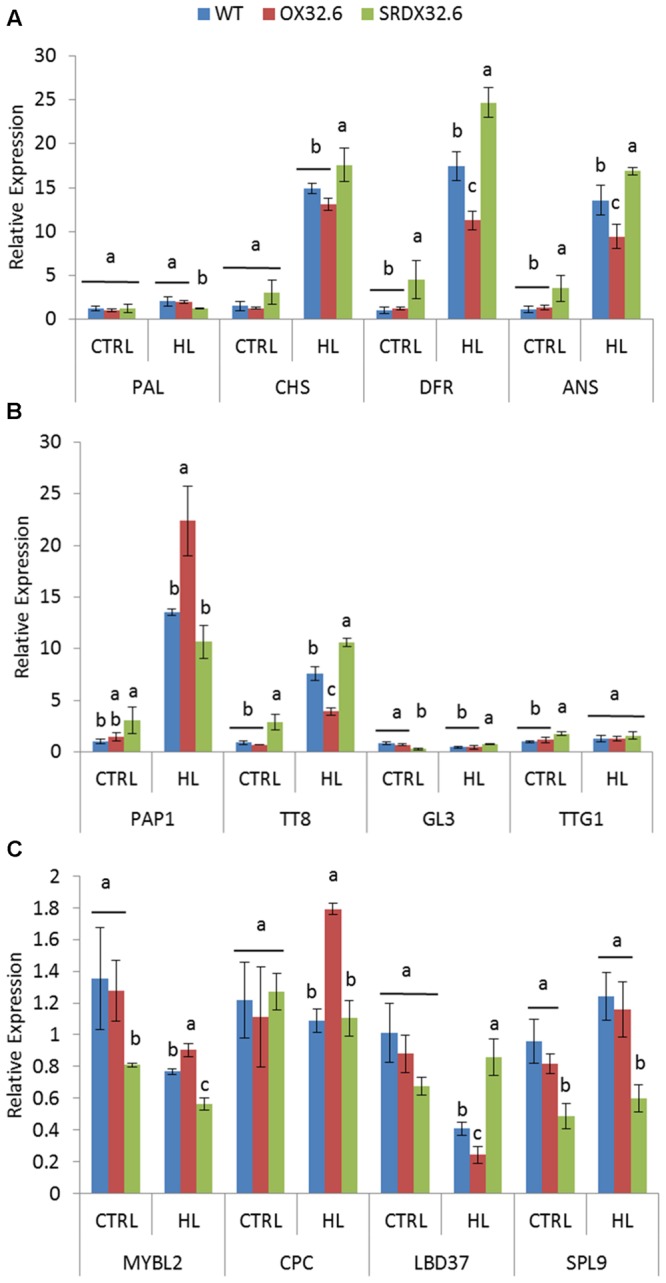
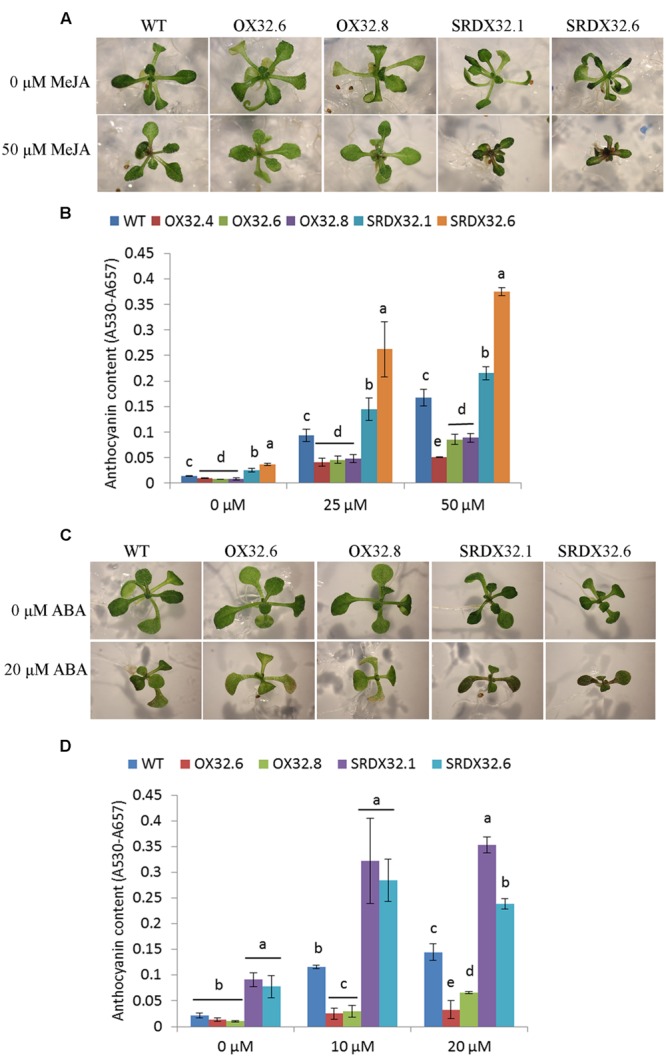
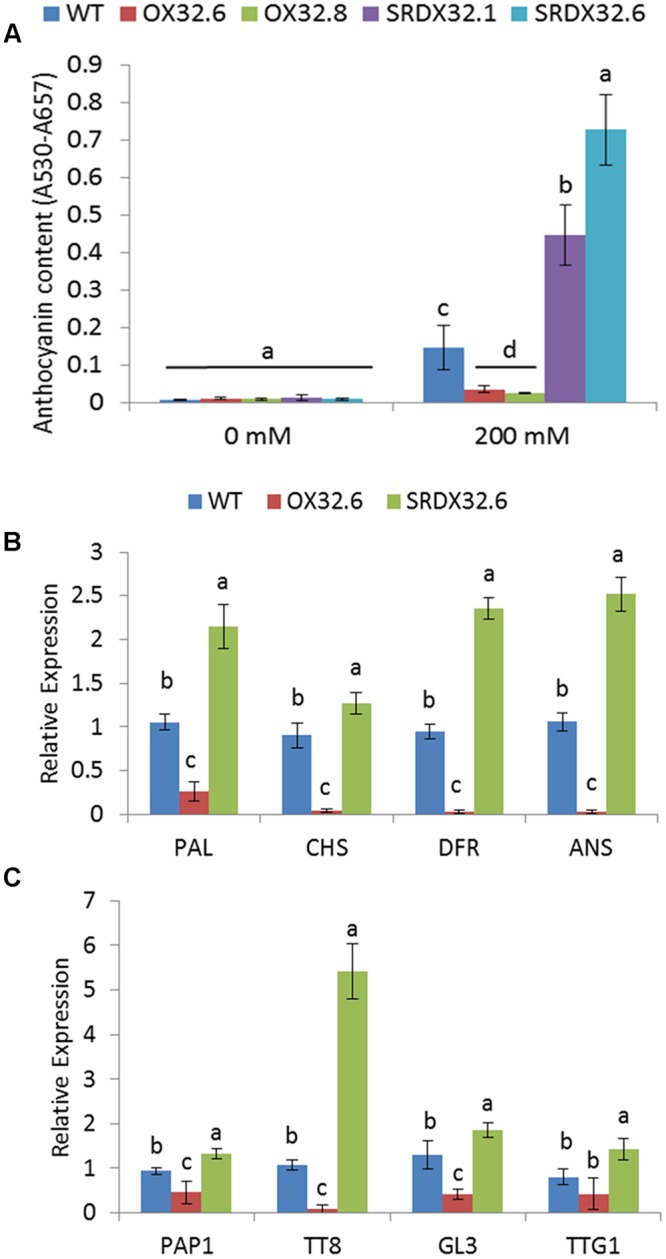
Production of anthocyanins is one of the adaptive responses employed by plants during stress conditions. During stress, anthocyanin biosynthesis is mainly regulated at the transcriptional level via a complex interplay between activators and repressors of anthocyanin biosynthesis genes. In this study, we investigated the role of a NAC transcription factor, ANAC032, in the regulation of anthocyanin biosynthesis during stress conditions. expression was found to be induced by exogenous sucrose as well as high light (HL) stress. Using biochemical, molecular and transgenic approaches, we show that ANAC032 represses anthocyanin biosynthesis in response to sucrose treatment, HL and oxidative stress. ANAC032 was found to negatively affect anthocyanin accumulation and the expression of anthocyanin biosynthesis ( positive regulatory ( genes as demonstrated in overexpression line (35S:ANAC032) compared to wild-type under HL stress. The chimeric repressor line (35S:ANAC032-SRDX) exhibited the opposite expression patterns for these genes. The negative impact of ANAC032 on the expression of and was found to be correlated with the altered expression of negative regulators of anthocyanin biosynthesis, and . In addition to this, ANAC032 also repressed the MeJA- and ABA-induced anthocyanin biosynthesis. As a result, transgenic lines overexpressing (35S:ANAC032) produced drastically reduced levels of anthocyanin pigment compared to wild-type when challenged with salinity stress. However, transgenic chimeric repressor lines (35S:ANAC032-SRDX) exhibited the opposite phenotype. Our results suggest that ANAC032 functions as a negative regulator of anthocyanin biosynthesis in during stress conditions.
花青素的产生是植物在胁迫条件下所采用的适应性反应之一。在胁迫期间,花青素生物合成主要通过花青素生物合成基因的激活因子和抑制因子之间的复杂相互作用在转录水平上受到调控。在本研究中,我们调查了一个NAC转录因子ANAC032在胁迫条件下对花青素生物合成调控中的作用。发现其表达受外源蔗糖以及高光(HL)胁迫诱导。利用生化、分子和转基因方法,我们表明ANAC032在响应蔗糖处理、HL和氧化胁迫时抑制花青素生物合成。与高光胁迫下的野生型相比,过表达株系(35S:ANAC032)中发现ANAC032对花青素积累以及花青素生物合成(正调控(基因的表达有负面影响。嵌合抑制因子株系(35S:ANAC032-SRDX)对这些基因表现出相反的表达模式。发现ANAC032对 和 的表达的负面影响与花青素生物合成负调控因子 和 的表达改变相关。除此之外,ANAC032还抑制茉莉酸甲酯(MeJA)和脱落酸(ABA)诱导的花青素生物合成。因此,当受到盐胁迫挑战时,过表达 (35S:ANAC032)的转基因株系与野生型相比产生的花青素色素水平大幅降低。然而,转基因嵌合抑制因子株系(35S:ANAC032-SRDX)表现出相反的表型。我们的结果表明,在胁迫条件下,ANAC032在 中作为花青素生物合成的负调控因子发挥作用。