Naseri Mandana, Safi Yaser, Akbarzadeh Baghban Alireza, Khayat Akbar, Eftekhar Leila
Department of Endodontics, Dental School, Shahid Beheshti University of Medical Sciences, Tehran, Iran.
Oral and Maxillofacial Radiology Department, Dental School, Shahid Beheshti University of Medical Sciences, Tehran, Iran.
Iran Endod J. 2016 Fall;11(4):298-303. doi: 10.22037/iej.2016.8.
The purpose of this study was to investigate the root and canal morphology of maxillary first molars with regards to patients' age and gender with cone-beam computed tomography (CBCT).
A total of 149 CBCT scans from 92 (67.1%) female and 57 (31.3%) male patients with mean age of 40.5 years were evaluated. Tooth length, presence of root fusion, number of the roots and canals, canal types based on Vertucci's classification, deviation of root and apical foramen in coronal and sagittal planes and the correlation of all items with gender and age were recorded. The Mann Whitney U, Kruskal Wallis and Fisher's exact tests were used to analyze these items.
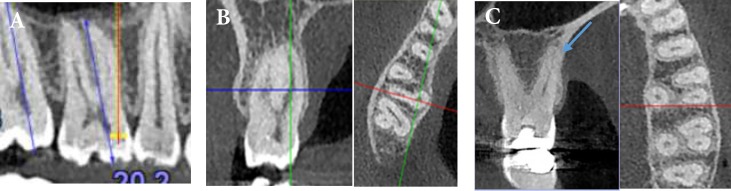
The rate of root fusion was 1.3%. Multiple canals were present in the following frequencies: four canals 78.5%, five canals 11.4% and three canals 10.1%. Additional canal was detected in 86.6% of mesiobuccal roots in which Vertucci's type configuration was the most prevalent followed by type and . Type was the most common one in distobuccal and palatal roots. There was no statistically significant difference in the canal configurations in relation to gender and age as well as the incidence root or canal numbers (>0.05). The mean tooth length was 19.3 and 20.3 mm in female and male patients, respectively which was statistically significant (<0.05). Evaluation of root deviation showed that most commonly, a general pattern of straight-distal in the mesiobuccal and straight-straight for distobuccal and palatal roots occurred. In mesiobuccal roots, straight and distal deviations were more dominant in male and female, respectively (<0.05). The prevalence of apical foramen deviation in mesiobuccal and palatal roots statistically differed with gender.
The root and canal configuration of Iranian population showed different features from those of other populations.
本研究的目的是利用锥形束计算机断层扫描(CBCT),研究上颌第一磨牙的牙根和根管形态与患者年龄及性别的关系。
共评估了149例CBCT扫描,这些扫描来自92例(67.1%)女性和57例(31.3%)男性患者,平均年龄为40.5岁。记录牙齿长度、牙根融合情况、牙根和根管数量、基于维尔图奇分类的根管类型、牙根和根尖孔在冠状面和矢状面的偏差以及所有项目与性别和年龄的相关性。采用曼-惠特尼U检验、克鲁斯卡尔-沃利斯检验和费舍尔精确检验来分析这些项目。
牙根融合率为1.3%。多根管出现的频率如下:四根管78.5%,五根管11.4%,三根管10.1%。在86.6%的近中颊根中检测到额外根管,其中维尔图奇分类的构型最为常见,其次是构型和构型。构型是远中颊根和腭根中最常见的类型。根管构型在性别和年龄方面以及牙根或根管数量的发生率上无统计学显著差异(>0.05)。女性和男性患者的平均牙齿长度分别为19.3毫米和20.3毫米,具有统计学显著性差异(<0.05)。牙根偏差评估显示,最常见的情况是,近中颊根呈直-远中方向,远中颊根和腭根呈直-直方向。在近中颊根中,直向和远中向偏差在男性和女性中分别更为明显(<0.05)。近中颊根和腭根根尖孔偏差的发生率在性别上有统计学差异。
伊朗人群的牙根和根管形态与其他人群表现出不同特征。