Ghoncheh Zahra, Zade Behrang Moghaddam, Kharazifard Mohammad Javad
Assistant Professor, Department of Oral and Maxillofacial Radiology, School of Dentistry, Tehran University of Medical Sciences, International Campus, Tehran, Iran.
Adjunct Professor, Department of Oral and Maxillofacial Radiology, School of Dentistry, Tehran University of Medical Sciences, International Campus, Tehran, Iran.
J Dent (Tehran). 2017 May;14(3):115-122.
This study sought to assess the root morphology and root canal anatomy of the maxillary first and second molars in an Iranian population using cone-beam computed tomography (CBCT).
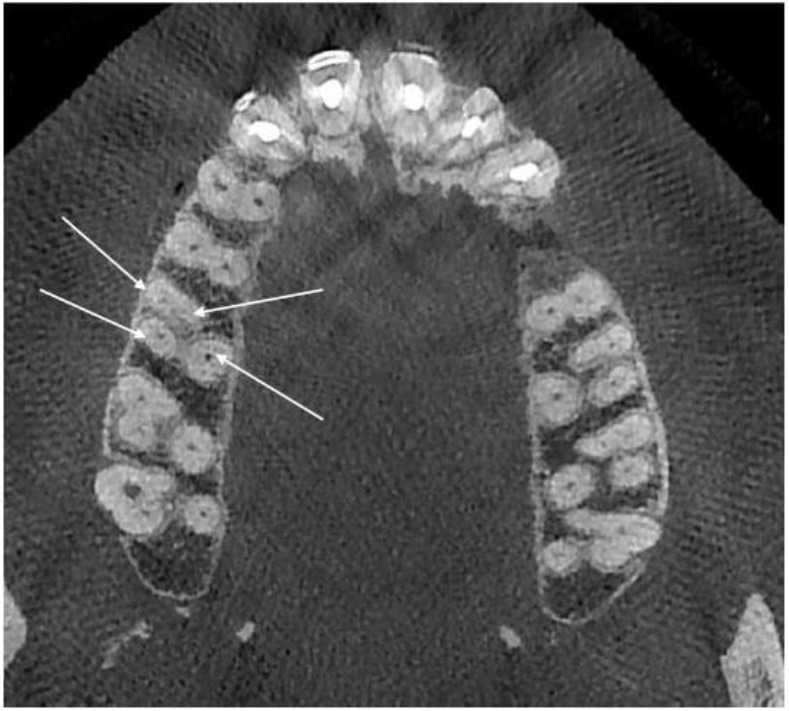
Sound fully-developed maxillary first (n=345) and second (n=423) molars were evaluated on 450 CBCT scans ordered for pre-operative assessment for implant placement. The (I) number of roots and their morphology (II) number of canals per root, (III) canal configuration and presence of a second mesiobuccal canal according to the Vertucci's classification and (IV) unilateral or bilateral occurrence of a second mesiobuccal canal (MB2) were evaluated.
Single roots were found in 1.1% of the first and 11.3% of the second molars. Four separate roots were identified in 0.5% of the first molars; none of the second molars had four separate roots. First and second molars showed a higher prevalence of three separate roots of mesiobuccal, distobuccal and palatal with one canal in each root (54% and 86 %, respectively). The most common anatomical variation in the maxillary first molars was related to the configuration of the MB root; the root canal system of the maxillary second molars showed more anatomical variations.
Mesiobuccal roots of the maxillary molars had more variations in their canal system than the distobuccal or palatal roots. The root canal configuration of the maxillary second molars was more diverse than that of first molars; CBCT enhances mapping of the mesiobuccal root canal system with the potential to improve the quality of root canal treatment.
本研究旨在使用锥形束计算机断层扫描(CBCT)评估伊朗人群上颌第一和第二磨牙的牙根形态及根管解剖结构。
对450例为种植术前评估而进行的CBCT扫描中的完好、发育完全的上颌第一磨牙(n = 345)和第二磨牙(n = 423)进行评估。评估内容包括:(I)牙根数量及其形态;(II)每根根管的数量;(III)根据韦尔图奇分类法的根管形态及第二近中颊根管的存在情况;(IV)第二近中颊根管(MB2)的单侧或双侧出现情况。
在1.1%的第一磨牙和11.3%的第二磨牙中发现单根。在0.5%的第一磨牙中发现有四根独立的牙根;第二磨牙均无四根独立的牙根。第一和第二磨牙中,近中颊根、远中颊根和腭根三根独立且每根有一个根管的情况更为常见(分别为54%和86%)。上颌第一磨牙最常见的解剖变异与近中颊根的形态有关;上颌第二磨牙的根管系统显示出更多的解剖变异。
上颌磨牙的近中颊根根管系统比远中颊根或腭根有更多变异。上颌第二磨牙的根管形态比第一磨牙更多样化;CBCT增强了近中颊根管系统的成像,有可能提高根管治疗的质量。