Jakubowski Jennifer L, Labrie Viviane
Center for Neurodegenerative Science, Van Andel Research Institute, Grand Rapids, MI, USA.
Center for Addiction and Mental Health, Toronto, ON, Canada.
J Parkinsons Dis. 2017;7(1):1-12. doi: 10.3233/JPD-160914.
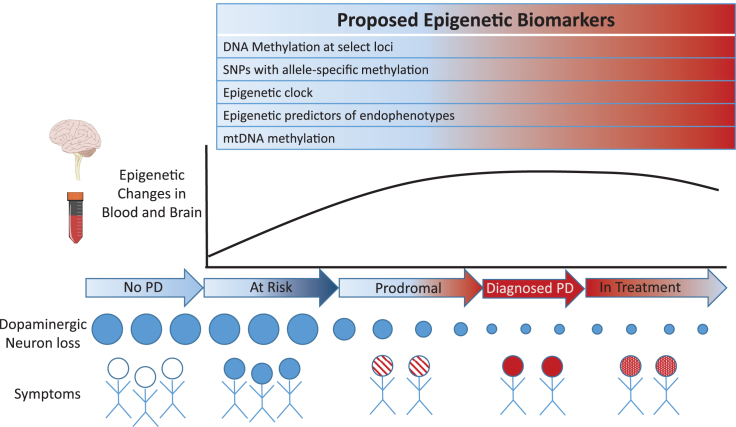
Parkinson's disease (PD) is a prevalent neurodegenerative illness that is often diagnosed after significant pathology and neuronal cell loss has occurred. Biomarkers of PD are greatly needed for early diagnosis, as well as for the prediction of disease progression and treatment outcome. In this regard, the epigenome, which is partially dynamic, holds considerable promise for the development of molecular biomarkers for PD. Epigenetic marks are modified by both DNA sequence and environmental factors associated with PD, and such marks could serve as a unifying predictor of at-risk individuals. Epigenetic abnormalities have been detected in PD and other age-dependent neurodegenerative diseases, some of which were reported to occur early on and were reversible by PD medications. Emerging reports indicate that certain epigenetic differences observed in the PD brain are detectable in more easily accessible tissues. In this review, we examine epigenetic-based strategies for the development of PD biomarkers. Despite the complexities and challenges faced, the epigenome offers a new source of biomarkers with potential etiological relevance to PD, and may expand opportunities for personalized therapies.
帕金森病(PD)是一种常见的神经退行性疾病,通常在出现明显病理变化和神经元细胞损失后才被诊断出来。对于帕金森病,早期诊断以及疾病进展和治疗结果的预测都急需生物标志物。在这方面,部分具有动态性的表观基因组对于开发帕金森病分子生物标志物具有很大潜力。表观遗传标记会受到与帕金森病相关的DNA序列和环境因素的修饰,这些标记可以作为高危个体的统一预测指标。在帕金森病和其他年龄依赖性神经退行性疾病中已检测到表观遗传异常,其中一些据报道在疾病早期就已出现,并且可通过帕金森病药物逆转。新出现的报告表明,在帕金森病大脑中观察到的某些表观遗传差异在更容易获取的组织中也可检测到。在本综述中,我们研究了基于表观遗传学开发帕金森病生物标志物的策略。尽管面临复杂性和挑战,但表观基因组提供了一种新的生物标志物来源,与帕金森病具有潜在的病因学关联,并且可能会扩大个性化治疗的机会。