Veleba Jiri, Matoulek Martin, Hill Martin, Pelikanova Terezie, Kahleova Hana
Institute for Clinical and Experimental Medicine, Videnska 1958/9, 14021 Prague, Czech Republic.
General University Hospital, 3rd Internal Clinic of Endocrinology and Metabolism, 12808 Prague, Czech Republic.
Nutrients. 2016 Oct 26;8(11):671. doi: 10.3390/nu8110671.
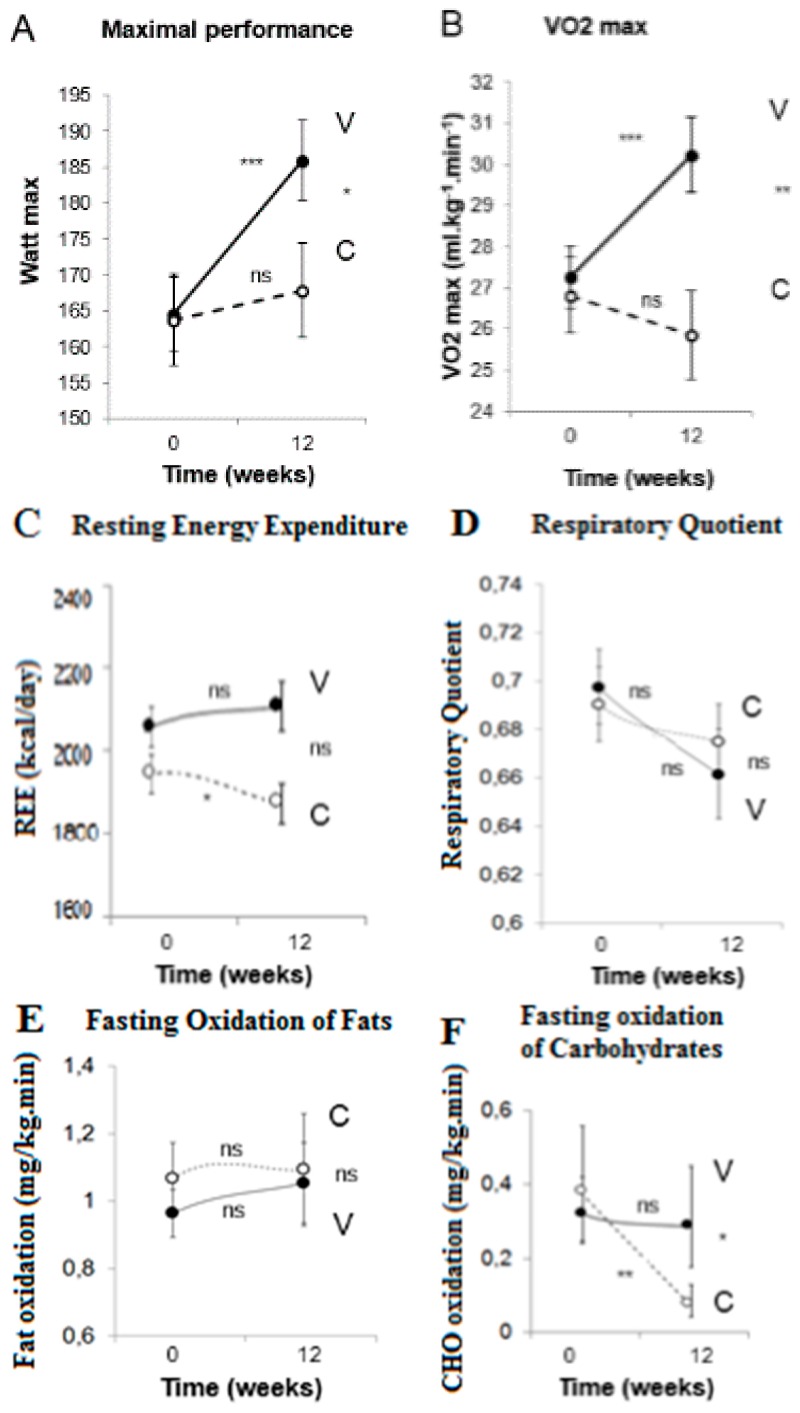
It has been shown that it is possible to modify macronutrient oxidation, physical fitness and resting energy expenditure (REE) by changes in diet composition. Furthermore, mitochondrial oxidation can be significantly increased by a diet with a low glycemic index. The purpose of our trial was to compare the effects of a vegetarian (V) and conventional diet (C) with the same caloric restriction (-500 kcal/day) on physical fitness and REE after 12 weeks of diet plus aerobic exercise in 74 patients with type 2 diabetes (T2D). An open, parallel, randomized study design was used. All meals were provided for the whole study duration. An individualized exercise program was prescribed to the participants and was conducted under supervision. Physical fitness was measured by spiroergometry and indirect calorimetry was performed at the start and after 12 weeks Repeated-measures ANOVA (Analysis of variance) models with between-subject (group) and within-subject (time) factors and interactions were used for evaluation of the relationships between continuous variables and factors. Maximal oxygen consumption (VO) increased by 12% in vegetarian group (V) (F = 13.1, < 0.001, partial ² = 0.171), whereas no significant change was observed in C (F = 0.7, = 0.667; group × time F = 9.3, = 0.004, partial ² = 0.209). Maximal performance (Watt max) increased by 21% in V (F = 8.3, < 0.001, partial ² = 0.192), whereas it did not change in C (F = 1.0, = 0.334; group × time F = 4.2, = 0.048, partial ² = 0.116). Our results indicate that V leads more effectively to improvement in physical fitness than C after aerobic exercise program.
研究表明,通过改变饮食结构可以改变常量营养素氧化、身体素质和静息能量消耗(REE)。此外,低血糖指数饮食可显著增加线粒体氧化。我们试验的目的是比较74例2型糖尿病(T2D)患者在进行12周饮食加有氧运动后,素食(V)和传统饮食(C)且热量限制相同(-500千卡/天)对身体素质和REE的影响。采用开放、平行、随机研究设计。在整个研究期间提供所有餐食。为参与者制定个性化运动计划并在监督下进行。在开始时和12周后通过运动心肺功能测试测量身体素质,并进行间接测热法。采用具有组间(组)和组内(时间)因素及交互作用的重复测量方差分析(ANOVA)模型来评估连续变量与因素之间的关系。素食组(V)的最大耗氧量(VO)增加了12%(F = 13.1,P < 0.001,偏η² = 0.171),而传统饮食组(C)未观察到显著变化(F = 0.7,P = 0.667;组×时间F = 9.3,P = 0.004,偏η² = 0.209)。素食组(V)的最大功率(最大瓦特数)增加了21%(F = 8.3,P < 0.001,偏η² = 0.192),而传统饮食组(C)没有变化(F = 1.0,P = 0.334;组×时间F = 4.2,P = 0.048,偏η² = 0.116)。我们的结果表明,在有氧运动计划后,素食比传统饮食更有效地改善身体素质。