Johnson Zachary V, Walum Hasse, Xiao Yao, Riefkohl Paula C, Young Larry J
Silvio O. Conte Center for Oxytocin and Social Cognition, Center for Translational Social Neuroscience, Department of Psychiatry and Behavioral Sciences, Yerkes National Primate Research Center, Emory University, Atlanta, GA 30329, USA.
Horm Behav. 2017 Jan;87:16-24. doi: 10.1016/j.yhbeh.2016.10.009. Epub 2016 Oct 26.
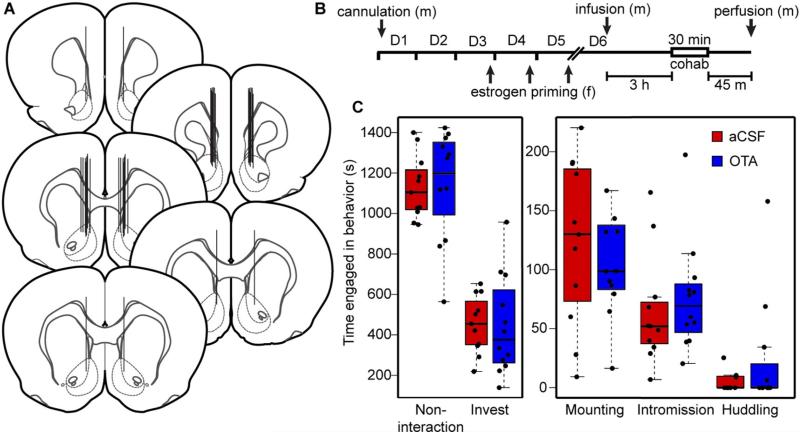
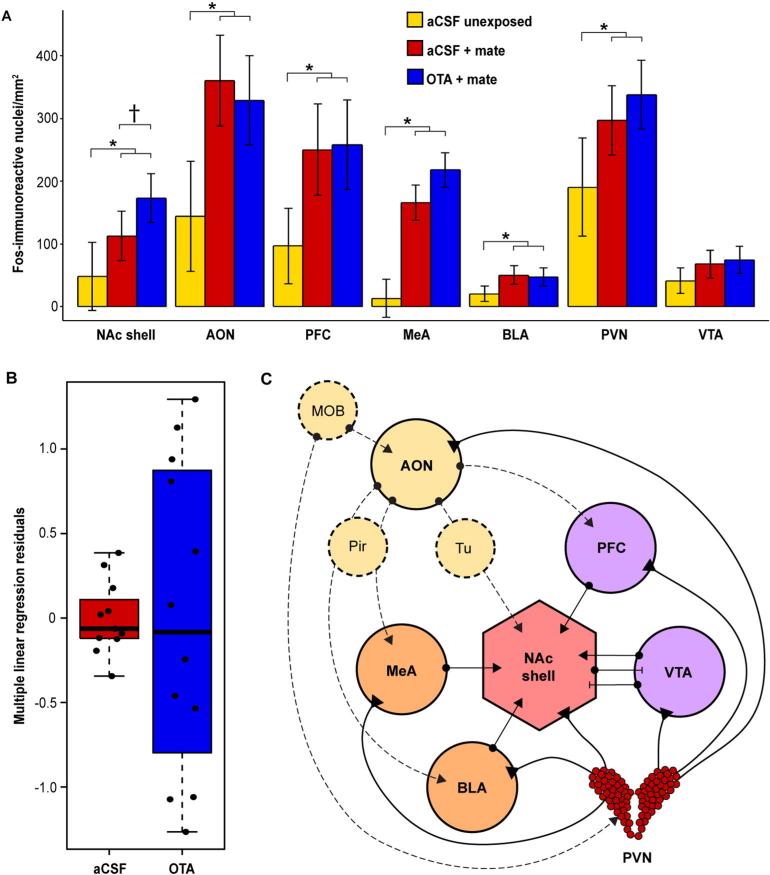
Social behavior is regulated by conserved neural networks across vertebrates. Variation in the organization of neuropeptide systems across these networks is thought to contribute to individual and species diversity in network function during social contexts. For example, oxytocin (OT) is an ancient neuropeptide that binds to OT receptors (OTRs) in the brain and modulates social and reproductive behavior across vertebrate species, including humans. Central OTRs exhibit extraordinarily diverse expression patterns that are associated with individual and species differences in social behavior. In voles, OTR density in the nucleus accumbens (NAc)-a region important for social and reward learning-is associated with individual and species variation in social attachment behavior. Here we test whether OTRs in the NAc modulate a social salience network (SSN)-a network of interconnected brain nuclei thought to encode valence and incentive salience of sociosensory cues-during a social context in the socially monogamous male prairie vole. Using a selective OTR antagonist, we test whether activation of OTRs in the NAc during sociosexual interaction and mating modulates expression of the immediate early gene product Fos across nuclei of the SSN. We show that blockade of endogenous OTR signaling in the NAc during sociosexual interaction and mating does not strongly modulate levels of Fos expression in individual nodes of the network, but strongly modulates patterns of correlated Fos expression between the NAc and other SSN nuclei.
社会行为受脊椎动物中保守的神经网络调节。这些神经网络中神经肽系统组织的变化被认为有助于在社会环境中网络功能的个体和物种多样性。例如,催产素(OT)是一种古老的神经肽,它与大脑中的OT受体(OTRs)结合,并调节包括人类在内的脊椎动物物种的社会和生殖行为。中枢OTRs表现出极其多样的表达模式,这些模式与社会行为中的个体和物种差异相关。在田鼠中,伏隔核(NAc)——一个对社会和奖励学习很重要的区域——中的OTR密度与社会依恋行为中的个体和物种差异有关。在这里,我们测试了在一夫一妻制的雄性草原田鼠的社会环境中,NAc中的OTRs是否调节一个社会显著性网络(SSN)——一个由相互连接的脑核组成的网络,被认为编码社会感觉线索的效价和动机显著性。使用一种选择性OTR拮抗剂,我们测试了在社交性行为和交配过程中激活NAc中的OTRs是否会调节SSN各核中即时早期基因产物Fos的表达。我们发现,在社交性行为和交配过程中阻断NAc中的内源性OTR信号传导,并不会强烈调节网络中各个节点的Fos表达水平,但会强烈调节NAc与其他SSN核之间的Fos相关表达模式。