Jain Paras, Weinrick Brian C, Kalivoda Eric J, Yang Hui, Munsamy Vanisha, Vilcheze Catherine, Weisbrod Torin R, Larsen Michelle H, O'Donnell Max R, Pym Alexander, Jacobs William R
Department of Microbiology and Immunology, Albert Einstein College of Medicine, New York,New York, USA.
Howard Hughes Medical Institute, Albert Einstein College of Medicine, New York, New York, USA.
mBio. 2016 Oct 25;7(5):e01023-16. doi: 10.1128/mBio.01023-16.
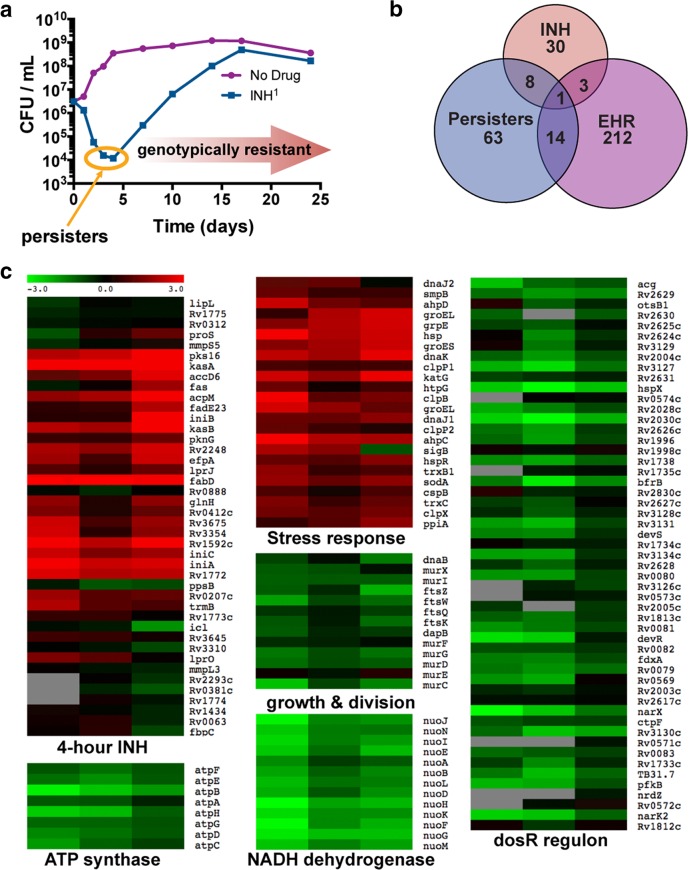
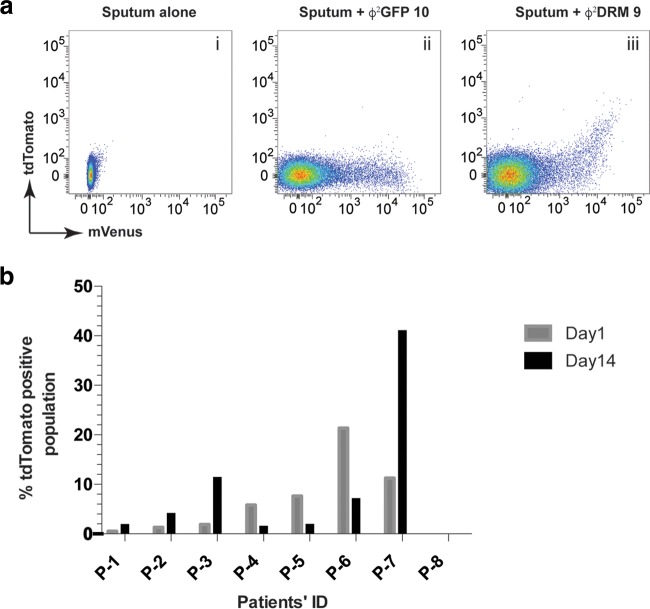
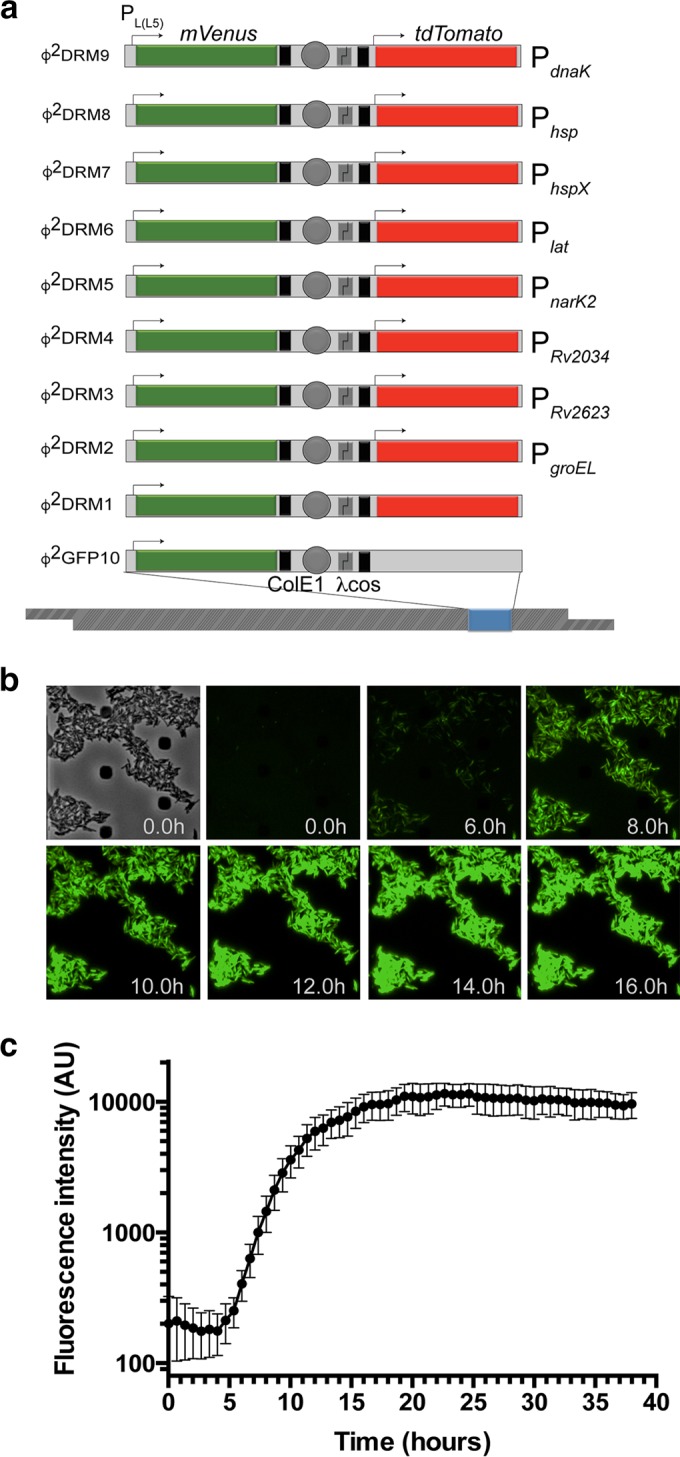
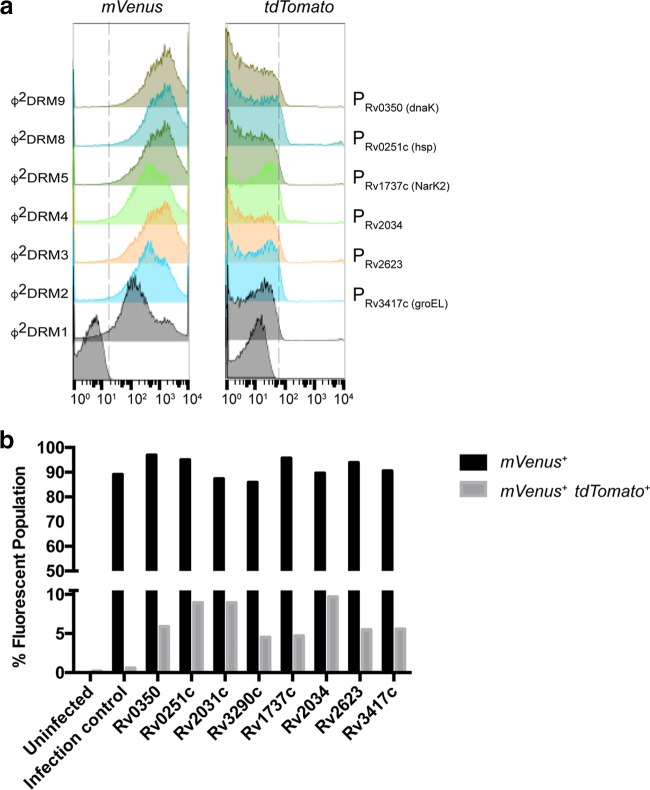
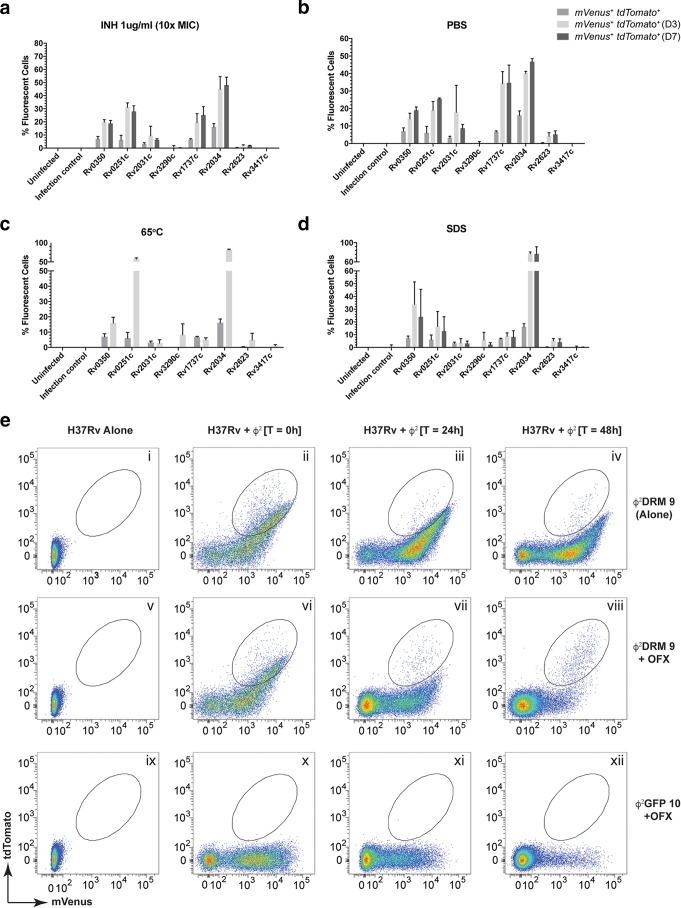
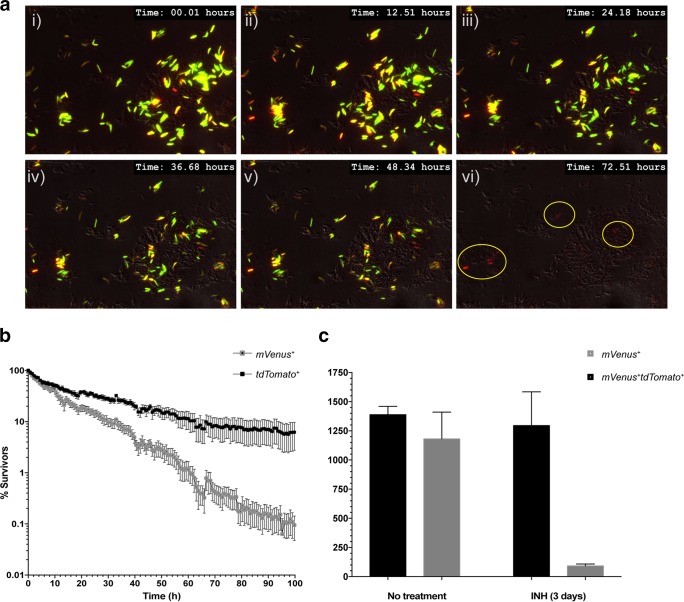
Persisters are the minor subpopulation of bacterial cells that lack alleles conferring resistance to a specific bactericidal antibiotic but can survive otherwise lethal concentrations of that antibiotic. In infections with Mycobacterium tuberculosis, such persisters underlie the need for long-term antibiotic therapy and contribute to treatment failure in tuberculosis cases. Here, we demonstrate the value of dual-reporter mycobacteriophages (ΦDRMs) for characterizing M. tuberculosis persisters. The addition of isoniazid (INH) to exponentially growing M. tuberculosis cells consistently resulted in a 2- to 3-log decrease in CFU within 4 days, and the remaining ≤1% of cells, which survived despite being INH sensitive, were INH-tolerant persisters with a distinct transcriptional profile. We fused the promoters of several genes upregulated in persisters to the red fluorescent protein tdTomato gene in ΦGFP10, a mycobacteriophage constitutively expressing green fluorescent protein (GFP), thus generating ΦDRMs. A population enriched in INH persisters exhibited strong red fluorescence, by microscopy and flow cytometry, using a ΦDRM with tdTomato controlled from the dnaK promoter. Interestingly, we demonstrated that, prior to INH exposure, a population primed for persistence existed in M. tuberculosis cells from both cultures and human sputa and that this population was highly enriched following INH exposure. We conclude that ΦDRMs provide a new tool to identify and quantitate M. tuberculosis persister cells.
Tuberculosis (TB) is again the leading cause of death from a single infectious disease, having surpassed HIV. The recalcitrance of the TB pandemic is largely due to the ability of the pathogen Mycobacterium tuberculosis to enter a persistent state in which it is less susceptible to antibiotics and immune effectors, necessitating lengthy treatment. It has been difficult to study persister cells, as we have lacked tools to isolate these rare cells. In this article, we describe the development of dual-reporter mycobacteriophages that encode a green fluorescent marker of viability and in which the promoters of genes we have identified as induced in the persister state are fused to a gene encoding a red fluorescent protein. We show that these tools can identify heterogeneity in a cell population that correlates with propensity to survive antibiotic treatment and that the proportions of these subpopulations change in M. tuberculosis cells within human sputum during the course of treatment.
持留菌是细菌细胞中的少数亚群,它们缺乏赋予对特定杀菌抗生素耐药性的等位基因,但能在该抗生素的致死浓度下存活。在结核分枝杆菌感染中,此类持留菌是长期抗生素治疗必要性的基础,并导致结核病治疗失败。在此,我们展示了双报告分枝杆菌噬菌体(ΦDRMs)在表征结核分枝杆菌持留菌方面的价值。向指数生长的结核分枝杆菌细胞中添加异烟肼(INH),在4天内始终导致CFU下降2至3个对数,而尽管对INH敏感但仍存活的剩余≤1%的细胞是具有独特转录谱的INH耐受持留菌。我们将持留菌中上调的几个基因的启动子与分枝杆菌噬菌体ΦGFP10中的红色荧光蛋白tdTomato基因融合,该噬菌体组成性表达绿色荧光蛋白(GFP),从而产生ΦDRMs。使用由dnaK启动子控制tdTomato的ΦDRM,通过显微镜和流式细胞术观察到,富含INH持留菌的群体呈现出强烈的红色荧光。有趣的是,我们证明,在暴露于INH之前,来自培养物和人痰液的结核分枝杆菌细胞中存在一个为持留做准备的群体,并且该群体在INH暴露后高度富集。我们得出结论,ΦDRMs提供了一种鉴定和定量结核分枝杆菌持留菌细胞的新工具。
结核病(TB)再次成为单一传染病致死的主要原因,已超过艾滋病。结核病大流行的顽固性很大程度上归因于病原体结核分枝杆菌进入持续状态的能力,在此状态下它对抗生素和免疫效应物的敏感性较低,因此需要长期治疗。由于缺乏分离这些稀有细胞的工具,研究持留菌细胞一直很困难。在本文中,我们描述了双报告分枝杆菌噬菌体的开发,这些噬菌体编码活力的绿色荧光标记,并且我们已确定在持留状态下诱导的基因的启动子与编码红色荧光蛋白的基因融合。我们表明,这些工具可以识别细胞群体中的异质性,这种异质性与抗生素治疗存活倾向相关,并且在治疗过程中,人痰液中结核分枝杆菌细胞内这些亚群的比例会发生变化。