Park Jong-Su, Ryu Jae-Ho, Choi Tae-Ik, Bae Young-Ki, Lee Suman, Kang Hae Jin, Kim Cheol-Hee
Department of Biology, Chungnam National University, Daejeon 34134, Korea.
Comparative Biomedicine Research Branch, National Cancer Center, Goyang 10408, Korea.
Mol Cells. 2016 Oct;39(10):750-755. doi: 10.14348/molcells.2016.0173. Epub 2016 Oct 31.
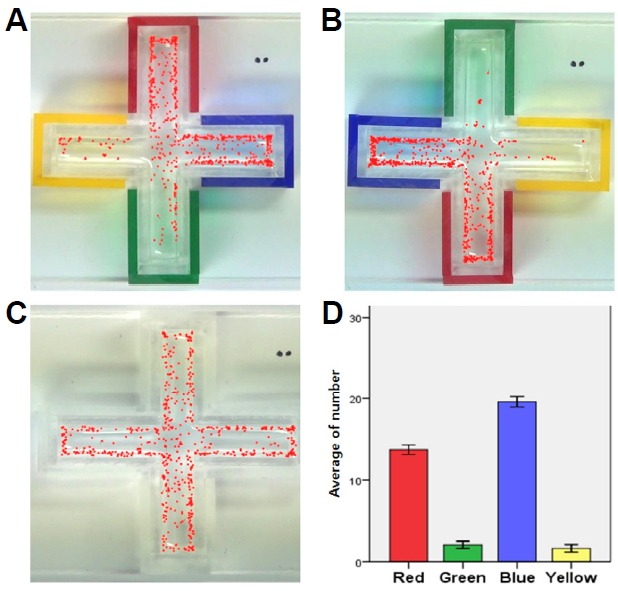
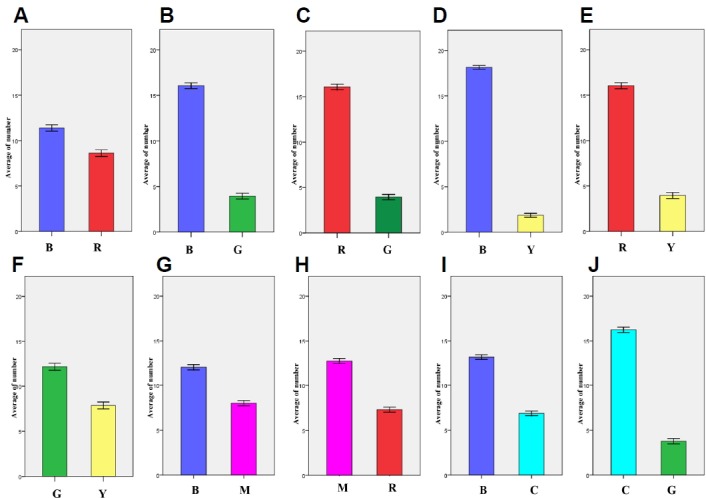
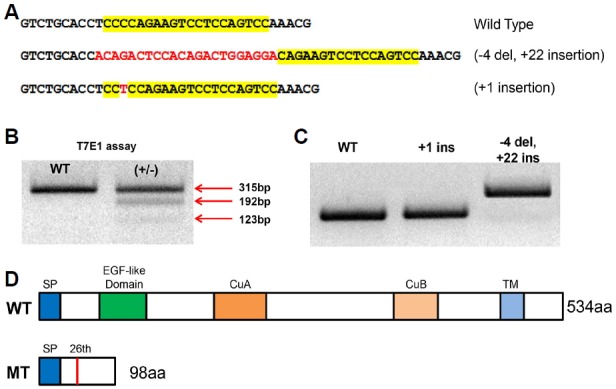
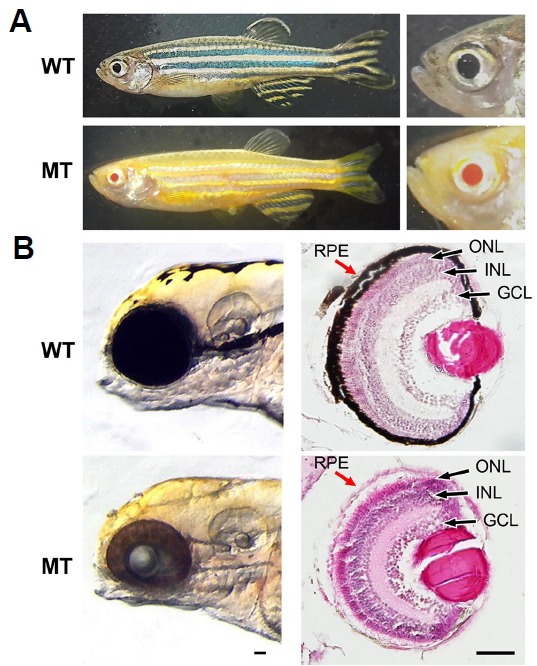
Although innate color preference of motile organisms may provide clues to behavioral biases, it has remained a longstanding question. In this study, we investigated innate color preference of zebrafish larvae. A cross maze with different color sleeves around each arm was used for the color preference test (R; red, G; green, B; blue, Y; yellow). The findings showed that 5 dpf zebrafish larvae preferred blue over other colors (B > R > G > Y). To study innate color recognition further, mutants were generated using CRISPR/Cas9 system. As a model for oculocutaneous albinism (OCA) and color vision impairment, mutants demonstrated diminished color sensation, indicated mainly by hypopigmentation of the retinal pigment epithelium (RPE). Due to its relative simplicity and ease, color preference screening using zebrafish larvae is suitable for high-throughput screening applications. This system may potentially be applied to the analysis of drug effects on larval behavior or the detection of sensory deficits in neurological disorder models, such as autism-related disorders, using mutant larvae generated by the CRISPR/Cas9 technique.
尽管活动生物的先天颜色偏好可能为行为偏向提供线索,但这仍是一个长期存在的问题。在本研究中,我们调查了斑马鱼幼体的先天颜色偏好。使用一个在每个臂周围带有不同颜色套管的十字迷宫进行颜色偏好测试(R;红色,G;绿色,B;蓝色,Y;黄色)。研究结果表明,5日龄的斑马鱼幼体更喜欢蓝色而非其他颜色(B > R > G > Y)。为了进一步研究先天颜色识别,使用CRISPR/Cas9系统生成了突变体。作为眼皮肤白化病(OCA)和色觉障碍的模型,突变体表现出颜色感觉减弱,主要表现为视网膜色素上皮(RPE)色素沉着不足。由于其相对简单和容易操作,使用斑马鱼幼体进行颜色偏好筛选适用于高通量筛选应用。该系统可能潜在地应用于分析药物对幼体行为的影响,或使用CRISPR/Cas9技术产生的突变幼体检测神经疾病模型(如自闭症相关疾病)中的感觉缺陷。