Zhai Yaming, Yang Qian, Wu Yunyu
Key Laboratory of Efficient Irrigation-Drainage and Agricultural Soil-Water Environment in Southern China, Hohai University, Nanjing, 210098, China.
College of Water Conservancy and Hydropower, Hohai University, Nanjing 210098, China.
PLoS One. 2016 Nov 2;11(11):e0165985. doi: 10.1371/journal.pone.0165985. eCollection 2016.
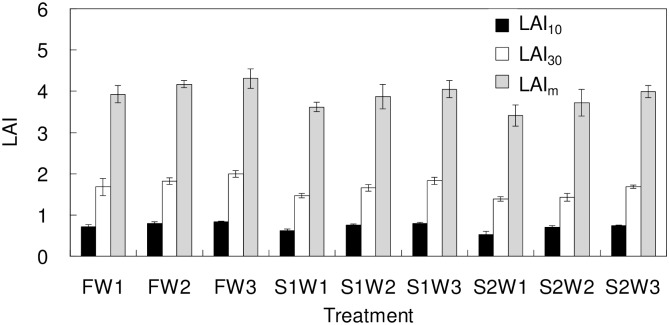
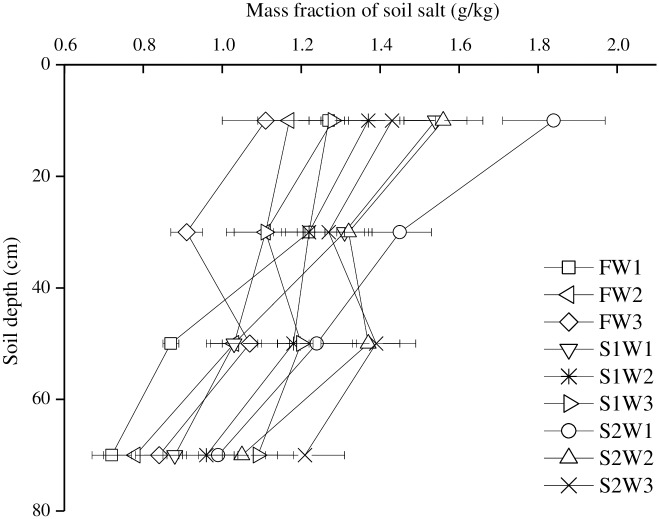
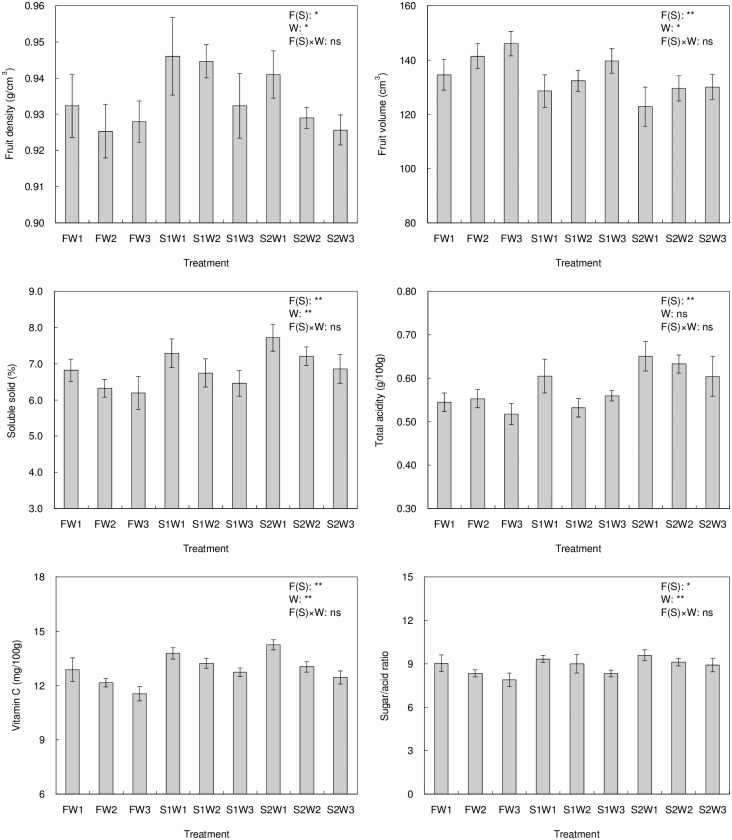
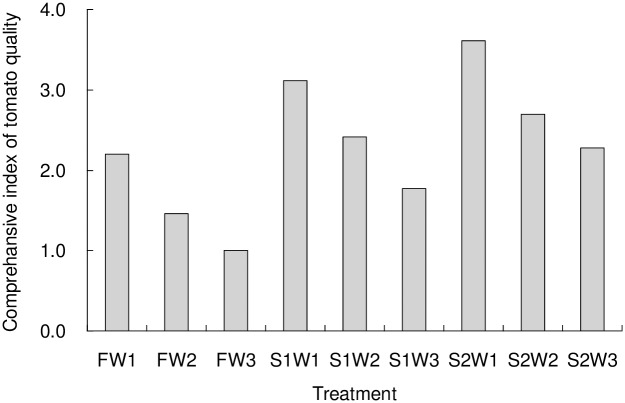
To investigate better saline water irrigation scheme for tomatoes that scheduling with the compromise among yield (Yt), quality, irrigation water use efficiency (IWUE) and soil salt residual, an experiment with three irrigation quotas and three salinities of irrigation water was conducted under straw mulching in northern China. The irrigation quota levels were 280 mm (W1), 320 mm (W2) and 360 mm (W3), and the salinity levels were 1.0 dS/m (F), 3.0 dS/m (S1) and 5.0 dS/m (S2). Compared to freshwater, saline water irrigations decreased the maximum leaf area index (LAIm) of tomatoes, and the LAIm presented a decline tendency with higher salinity and lower irrigation quota. The best overall quality of tomato was obtained by S2W1, with the comprehensive quality index of 3.61. A higher salinity and lower irrigation quota resulted in a decrease of individual fruit weight and an increase of the blossom-end rot incidence, finally led to a reduction in the tomato Yt and marketable yield (Ym). After one growth season of tomato, the mass fraction of soil salt in plough layer under S2W1 treatment was the highest, and which presented a decline trend with an increasing irrigation quota. Moreover, compared to W1, soil salts had a tendency to move to the deeper soil layer when using W2 and W3 irrigation quota. According to the calculation results of projection pursuit model, S1W3 was the optimal treatment that possessed the best comprehensive benefit (tomato overall quality, Yt, Ym, IWUE and soil salt residual), and was recommended as the saline water irrigation scheme for tomatoes in northern China.
为了研究更优的番茄咸水灌溉方案,即在产量(Yt)、品质、灌溉水利用效率(IWUE)和土壤盐分残留之间进行权衡的灌溉计划,在中国北方进行了一项秸秆覆盖下的试验,设置了三个灌溉定额和三种灌溉水盐度。灌溉定额水平分别为280毫米(W1)、320毫米(W2)和360毫米(W3),盐度水平分别为1.0 dS/m(F)、3.0 dS/m(S1)和5.0 dS/m(S2)。与淡水灌溉相比,咸水灌溉降低了番茄的最大叶面积指数(LAIm),且随着盐度升高和灌溉定额降低,LAIm呈下降趋势。S2W1处理获得的番茄综合品质最佳,综合品质指数为3.61。较高的盐度和较低的灌溉定额导致单果重下降和脐腐病发病率增加,最终导致番茄产量(Yt)和商品产量(Ym)降低。经过一个番茄生长季,S2W1处理耕层土壤盐分质量分数最高,且随灌溉定额增加呈下降趋势。此外,与W1相比,采用W2和W3灌溉定额时土壤盐分有向土壤深层移动的趋势。根据投影寻踪模型计算结果,S1W3是综合效益(番茄综合品质、Yt、Ym、IWUE和土壤盐分残留)最佳的最优处理,推荐作为中国北方番茄咸水灌溉方案。