Linhart Christine, Tukana Isimeli, Lin Sophia, Taylor Richard, Morrell Stephen, Vatucawaqa Penina, Magliano Dianna J, Zimmet Paul
School of Public Health and Community Medicine, University of New South Wales, Sydney, Australia.
Ministry of Health, Suva, Fiji.
Nicotine Tob Res. 2017 Nov 1;19(11):1315-1321. doi: 10.1093/ntr/ntw292.
To examine trends from 1980 to 2011 in daily tobacco smoking by sex, ethnicity, age, and urban/rural in Fiji Melanesian (i-Taukei) and Indian adults aged 25-64 years.
Unit record data from five population-based surveys (n = 14 528) allowed classification of participants as: (1) never-smoker, ex-smoker, or non-daily smoker; or (2) daily smoker, reporting smoking <20 or ≥20 tobacco products (cigarettes/cigars/pipes) a day. Trends were examined using spline analyses.
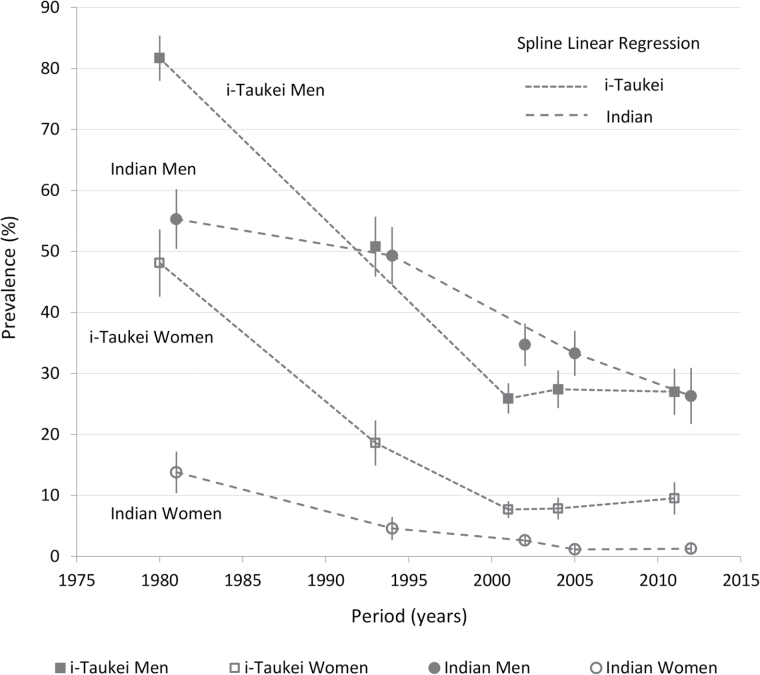
Over 1980-2011 the prevalence of reported daily tobacco smoking decreased significantly in both sexes and ethnicities, with the greatest decline during 1980-2000. Declines were from 81.7% to 27.0% in i-Taukei men; 55.3% to 26.3% in Indian men; 48.1% to 9.5% in i-Taukei women; and 13.8% to 1.3% in Indian women (p < .0001). Declines were consistent across all age groups in men, while there were greater declines among older age groups in women; and greater declines from higher prevalences in rural compared to urban areas in both sexes and ethnicities. Smoking ≥20 tobacco products per day declined significantly in i-Taukei men from 8.0% to 1.9% (p < .0001); there were also declines in Indian men (4.6% to 2.0%) and i-Taukei women (2.6% to 0.6%), but these were not statistically significant; and Indian women remained <0.2% throughout the period.
Significant declines in daily tobacco smoking have occurred in Fiji in both sexes and ethnicities during the past 30 years, which is consistent with declines in tobacco apparent consumption and household expenditure. However, prevalence remains high in men at around 27% in 2011, with plateau at this level in i-Taukei.
This is the first study to show nationally representative population trends in tobacco smoking in a developing country over such a long period (>30 years) based on empirical unit record data (n = 14 528). Cardiovascular disease is a leading cause of mortality throughout the Pacific Island region. This is the first study to show evidence of substantial declines over several decades in a cardiovascular disease risk factor in a Pacific Island country, and provides important evidence for further research into the interventions and events which may have facilitated this decline.
研究1980年至2011年斐济美拉尼西亚人(伊陶凯人)和印度25至64岁成年人按性别、种族、年龄及城乡划分的每日吸烟趋势。
来自五项基于人群调查的单位记录数据(n = 14528),可将参与者分类为:(1)从不吸烟者、已戒烟者或非每日吸烟者;或(2)每日吸烟者,报告每日吸烟<20支或≥20支烟草制品(香烟/雪茄/烟斗)。使用样条分析研究趋势。
在1980 - 2011年期间,报告的每日吸烟流行率在男女两性及各民族中均显著下降,1980 - 2000年期间下降幅度最大。伊陶凯男性从81.7%降至27.0%;印度男性从55.3%降至26.3%;伊陶凯女性从48.1%降至9.5%;印度女性从13.8%降至1.3%(p < .0001)。男性各年龄组下降趋势一致,而女性中年龄较大组下降幅度更大;在男女两性及各民族中,农村地区较高流行率的下降幅度大于城市地区。伊陶凯男性每日吸烟≥20支烟草制品的比例从8.0%显著降至1.9%(p < .0001);印度男性(从4.6%降至2.0%)和伊陶凯女性(从2.6%降至0.6%)也有下降,但无统计学意义;印度女性在此期间一直<0.2%。
在过去30年中,斐济男女两性及各民族的每日吸烟率均显著下降,这与烟草表观消费量和家庭支出的下降一致。然而,2011年男性吸烟率仍高达约27%,伊陶凯男性维持在这一水平。
这是第一项基于经验单位记录数据(n = 14528),展示发展中国家如此长时间(>30年)全国代表性吸烟人群趋势的研究。心血管疾病是整个太平洋岛屿地区的主要死因。这是第一项显示太平洋岛国心血管疾病风险因素在数十年间大幅下降证据的研究,为进一步研究可能促成这种下降的干预措施和事件提供了重要证据。