Säll Johanna, Pettersson Annie M L, Björk Christel, Henriksson Emma, Wasserstrom Sebastian, Linder Wilhelm, Zhou Yuedan, Hansson Ola, Andersson Daniel P, Ekelund Mikael, Degerman Eva, Stenkula Karin G, Laurencikiene Jurga, Göransson Olga
Protein Phosphorylation Research Group, Department of Experimental Medical Science, Lund University, BMC C11, Klinikgatan 28, 22242, Lund, Sweden.
Lipid Laboratory, Department of Medicine Huddinge, Karolinska Institutet, Stockholm, Sweden.
Diabetologia. 2017 Feb;60(2):314-323. doi: 10.1007/s00125-016-4141-y. Epub 2016 Nov 2.
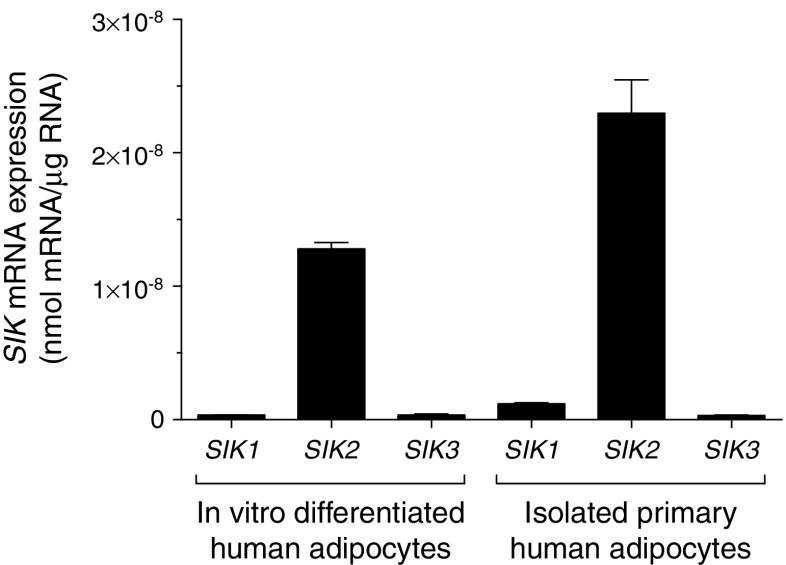
AIMS/HYPOTHESIS: Salt-inducible kinases (SIKs) are related to the metabolic regulator AMP-activated protein kinase (AMPK). SIK2 is abundant in adipose tissue. The aims of this study were to investigate the expression of SIKs in relation to human obesity and insulin resistance, and to evaluate whether changes in the expression of SIKs might play a causal role in the development of disturbed glucose uptake in human adipocytes.
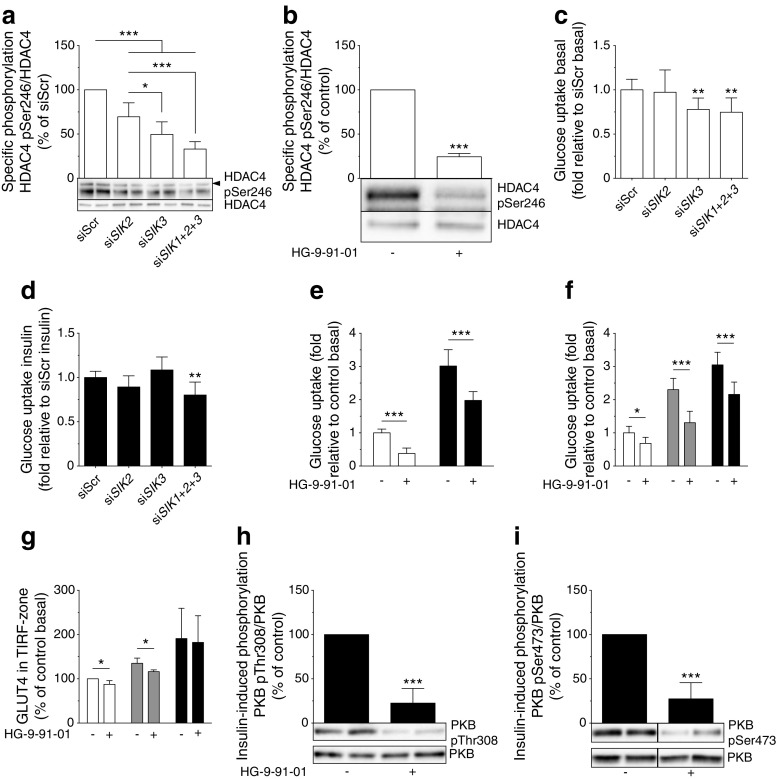
SIK mRNA and protein was determined in human adipose tissue or adipocytes, and correlated to clinical variables. SIK2 and SIK3 expression and phosphorylation were analysed in adipocytes treated with TNF-α. Glucose uptake, GLUT protein levels and localisation, phosphorylation of protein kinase B (PKB/Akt) and the SIK substrate histone deacetylase 4 (HDAC4) were analysed after the SIKs had been silenced using small interfering RNA (siRNA) or inhibited using a pan-SIK-inhibitor (HG-9-91-01).
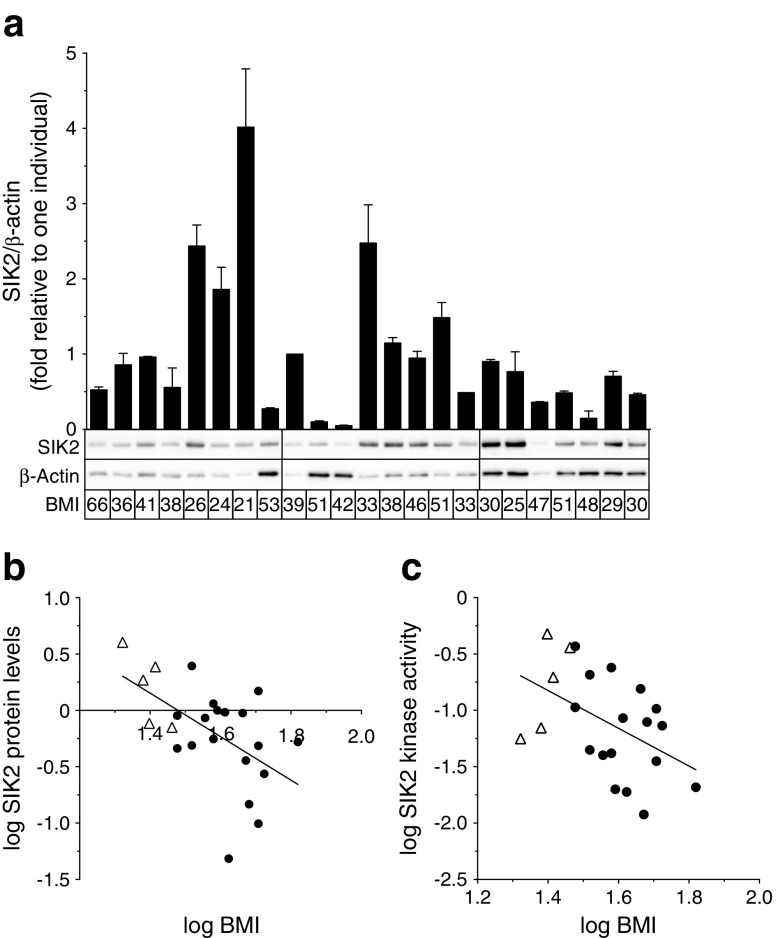
We demonstrate that SIK2 and SIK3 mRNA are downregulated in adipose tissue from obese individuals and that the expression is regulated by weight change. SIK2 is also negatively associated with in vivo insulin resistance (HOMA-IR), independently of BMI and age. Moreover, SIK2 protein levels and specific kinase activity display a negative correlation to BMI in human adipocytes. Furthermore, SIK2 and SIK3 are downregulated by TNF-α in adipocytes. Silencing or inhibiting SIK1-3 in adipocytes results in reduced phosphorylation of HDAC4 and PKB/Akt, less GLUT4 at the plasma membrane, and lower basal and insulin-stimulated glucose uptake in adipocytes.
CONCLUSION/INTERPRETATION: This is the first study to describe the expression and function of SIKs in human adipocytes. Our data suggest that SIKs might be protective in the development of obesity-induced insulin resistance, with implications for future treatment strategies.
目的/假设:盐诱导激酶(SIKs)与代谢调节因子AMP激活的蛋白激酶(AMPK)相关。SIK2在脂肪组织中含量丰富。本研究的目的是调查SIKs与人类肥胖和胰岛素抵抗相关的表达情况,并评估SIKs表达的变化是否可能在人类脂肪细胞葡萄糖摄取紊乱的发展中起因果作用。
测定人类脂肪组织或脂肪细胞中的SIK mRNA和蛋白,并与临床变量相关联。分析用肿瘤坏死因子-α(TNF-α)处理的脂肪细胞中SIK2和SIK3的表达及磷酸化情况。在用小干扰RNA(siRNA)沉默或用泛SIK抑制剂(HG-9-91-01)抑制SIKs后,分析葡萄糖摄取、葡萄糖转运蛋白(GLUT)的蛋白水平和定位、蛋白激酶B(PKB/Akt)的磷酸化以及SIK底物组蛋白去乙酰化酶4(HDAC4)的情况。
我们证明,肥胖个体脂肪组织中SIK2和SIK3 mRNA下调,且该表达受体重变化调节。SIK2也与体内胰岛素抵抗(HOMA-IR)呈负相关,独立于体重指数(BMI)和年龄。此外,在人类脂肪细胞中,SIK2蛋白水平和特定激酶活性与BMI呈负相关。此外,脂肪细胞中TNF-α可下调SIK2和SIK3。在脂肪细胞中沉默或抑制SIK1-3会导致HDAC4和PKB/Akt磷酸化减少、质膜上GLUT4减少,以及脂肪细胞基础葡萄糖摄取和胰岛素刺激的葡萄糖摄取降低。
结论/解读:这是第一项描述SIKs在人类脂肪细胞中的表达和功能的研究。我们的数据表明,SIKs可能对肥胖诱导的胰岛素抵抗的发展具有保护作用,这对未来的治疗策略具有启示意义。