Durgam Suresh, Greenberg William M, Li Dayong, Lu Kaifeng, Laszlovszky Istvan, Nemeth Gyorgy, Migliore Raffaele, Volk Stephen
Allergan, Jersey City, NJ, USA.
Gedeon Richter Plc, Budapest, Hungary.
Psychopharmacology (Berl). 2017 Jan;234(2):199-209. doi: 10.1007/s00213-016-4450-3. Epub 2016 Nov 2.
Cariprazine, a dopamine D/D receptor partial agonist antipsychotic, demonstrated efficacy and tolerability in 6-week, randomized, placebo-controlled schizophrenia trials. Schizophrenia is a chronic disorder that requires continuous treatment; therefore, the long-term safety and tolerability profile of antipsychotic agents is an important factor in guiding clinician decisions.
This single-arm, open-label extension study evaluated the long-term safety and tolerability of cariprazine in patients with schizophrenia.
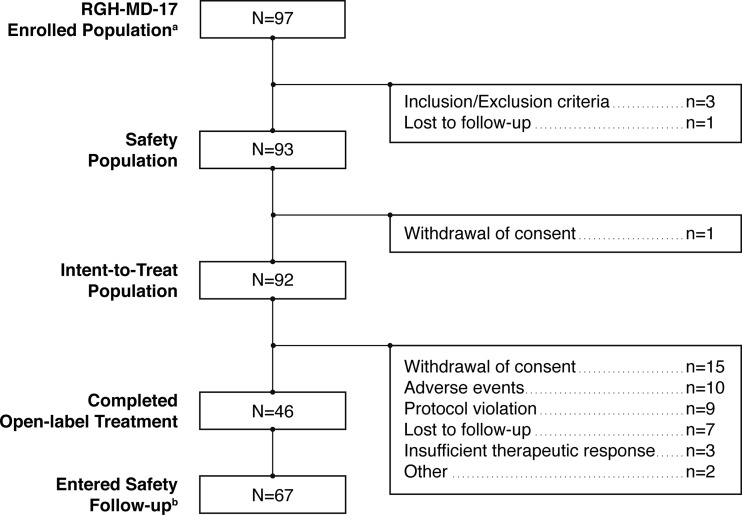
Patients enrolled in this study completed a 6-week, randomized, placebo- and active-controlled study and had responded (Clinical Global Impressions-Severity [CGI-S] ≤3; ≥20 % reduction in Positive and Negative Syndrome Scale [PANSS] total score) to treatment at the end of the lead-in study. Patients (N = 93) received flexibly dosed, open-label cariprazine (1.5-4.5 mg/day) for up to 48 weeks.
Approximately 50 % (46/93) of patients completed the 48 weeks of open-label treatment. The most common adverse events (AEs) were akathisia (14 %), insomnia (14 %), and weight increased (12 %). Serious AEs (SAEs) occurred in 13 % of patients; 11 % discontinued due to AEs. Mean changes in metabolic parameters were generally small and not clinically relevant. Mean body weight increased by 1.9 kg from the start of the lead-in study to the end of the extension study. There were no discontinuations associated with change in metabolic parameters or body weight. Long-term cariprazine treatment was not associated with prolactin elevation or clinically significant changes in cardiovascular parameters.
In this 48-week, single-arm trial, open-label cariprazine (1.5-4.5 mg/day) treatment was generally safe and well tolerated with no new safety concerns associated with long-term treatment.
卡立哌嗪是一种多巴胺D/D受体部分激动剂抗精神病药物,在为期6周的随机、安慰剂对照精神分裂症试验中显示出疗效和耐受性。精神分裂症是一种需要持续治疗的慢性疾病;因此,抗精神病药物的长期安全性和耐受性是指导临床医生决策的重要因素。
这项单臂、开放标签扩展研究评估了卡立哌嗪在精神分裂症患者中的长期安全性和耐受性。
参与本研究的患者完成了一项为期6周的随机、安慰剂和活性对照研究,并在导入期研究结束时对治疗有反应(临床总体印象-严重程度[CGI-S]≤3;阳性和阴性症状量表[PANSS]总分降低≥20%)。患者(N = 93)接受灵活剂量的开放标签卡立哌嗪(1.5 - 4.5毫克/天)治疗,最长可达48周。
约50%(46/93)的患者完成了48周的开放标签治疗。最常见的不良事件(AE)是静坐不能(14%)、失眠(14%)和体重增加(12%)。13%的患者发生了严重不良事件(SAE);11%因不良事件停药。代谢参数的平均变化一般较小,无临床相关性。从导入期研究开始到扩展期研究结束,平均体重增加了1.9千克。没有因代谢参数或体重变化而停药的情况。长期卡立哌嗪治疗与催乳素升高或心血管参数的临床显著变化无关。
在这项为期48周的单臂试验中,开放标签卡立哌嗪(1.5 - 4.5毫克/天)治疗总体安全且耐受性良好,长期治疗未出现新的安全问题。