Research Laboratory for Electronics, Massachusetts Institute of Technology, Cambridge, Massachusetts 02139, USA.
Department of Physics, University of California, Berkeley, California 94720-7300, USA.
Nat Commun. 2016 Nov 3;7:12964. doi: 10.1038/ncomms12964.
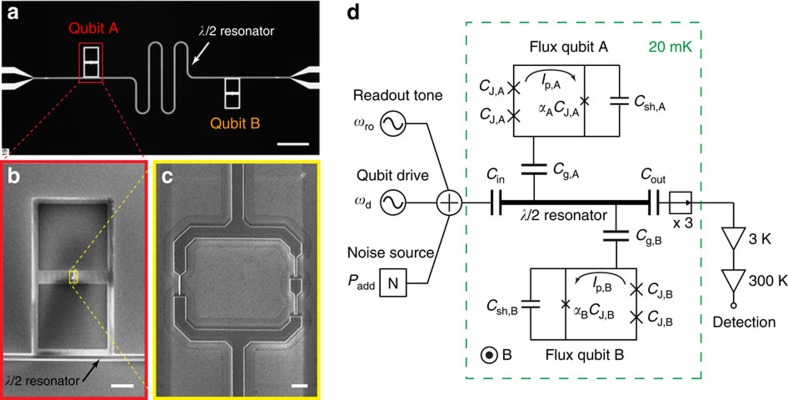
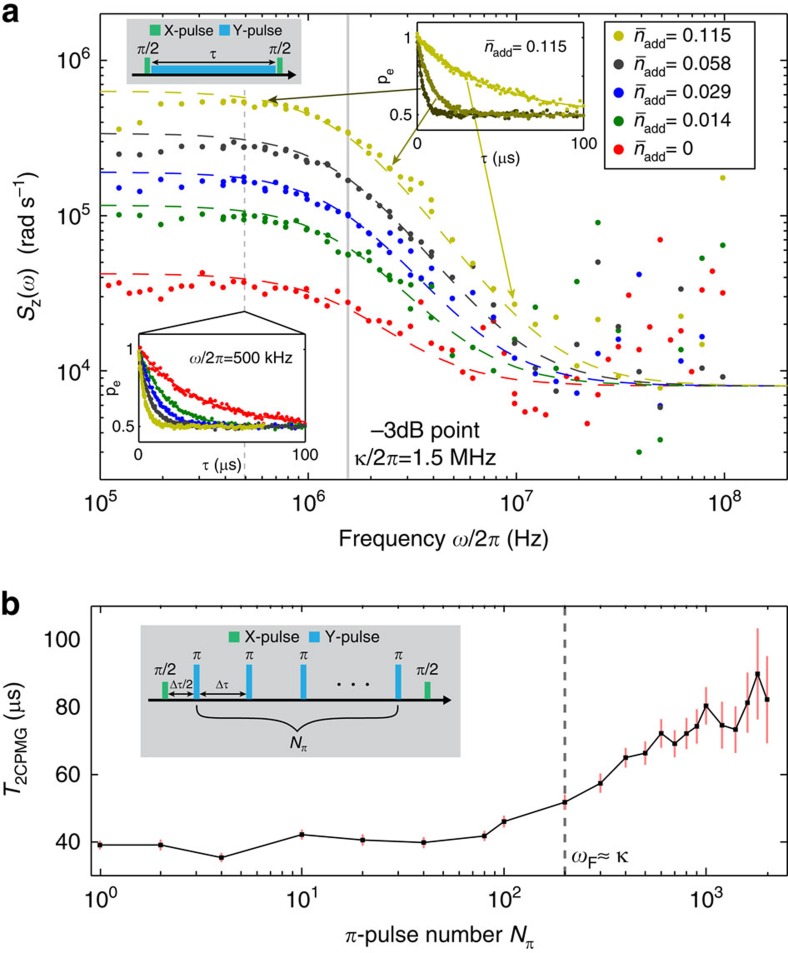
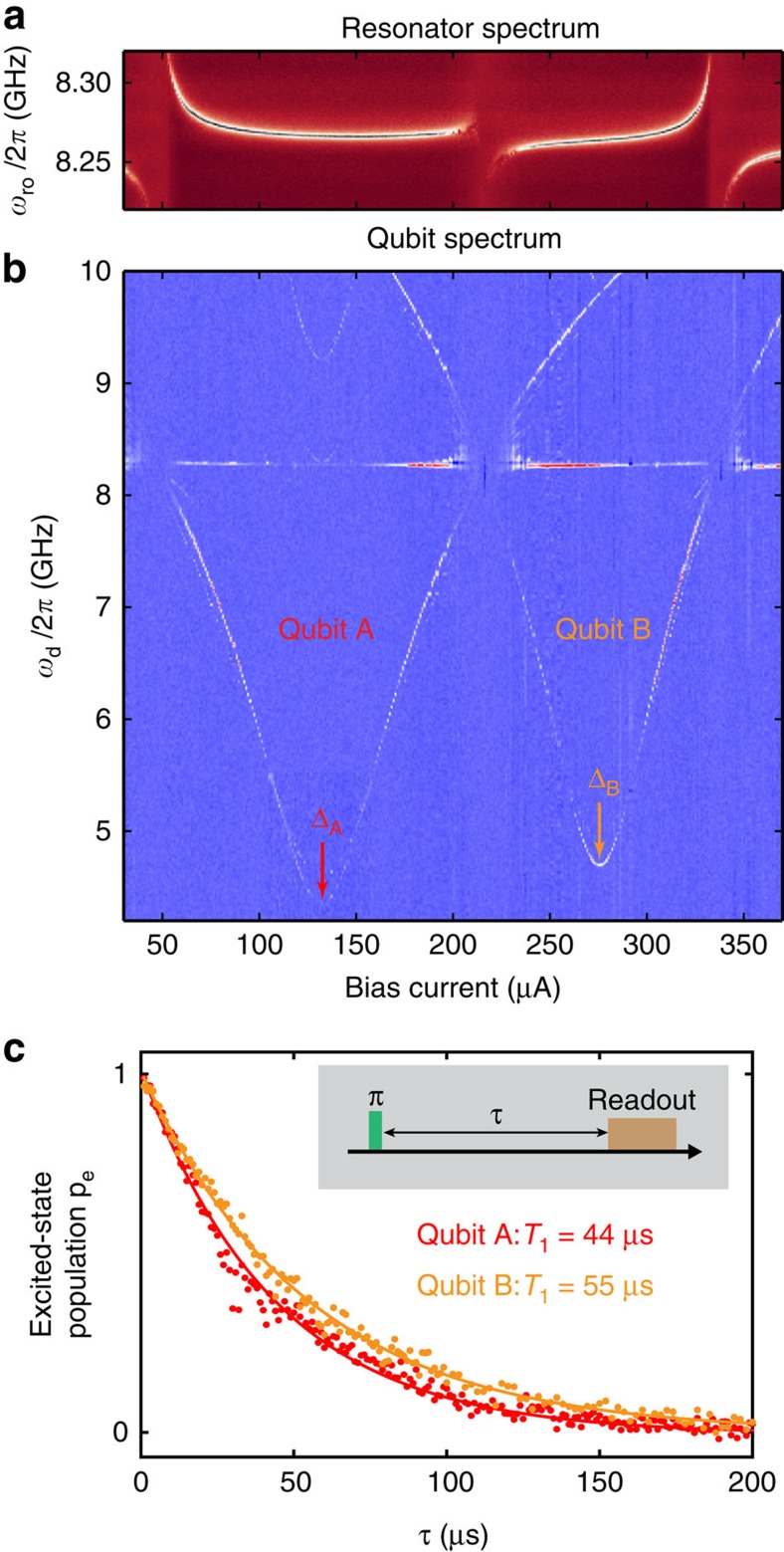
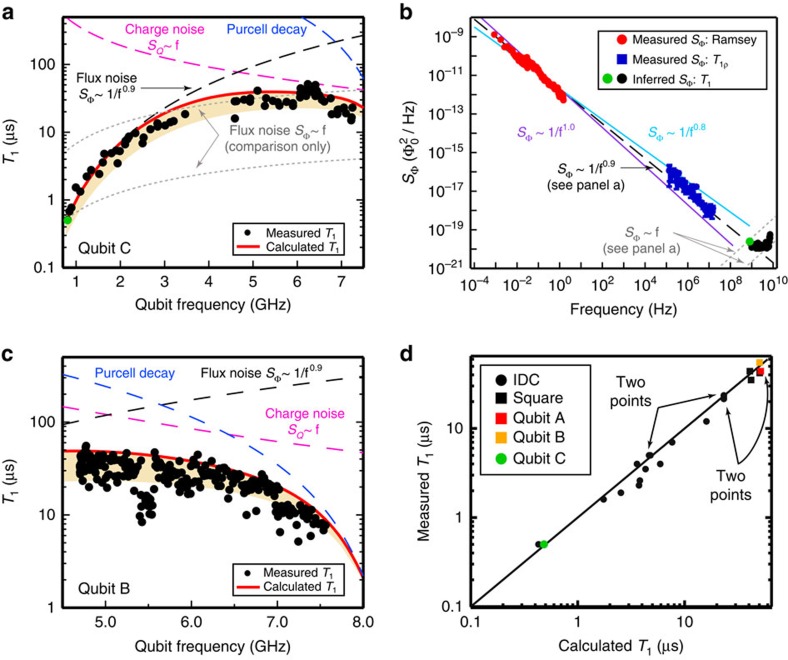
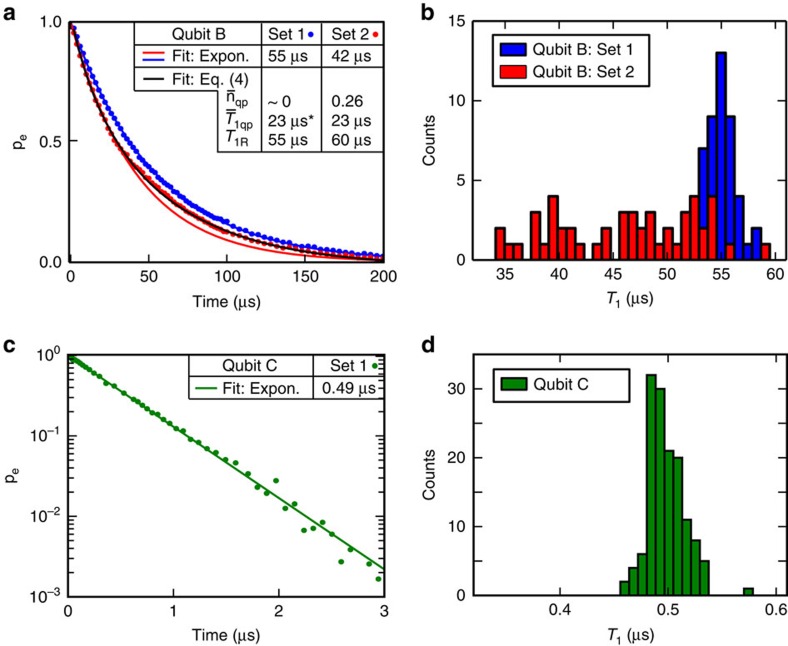
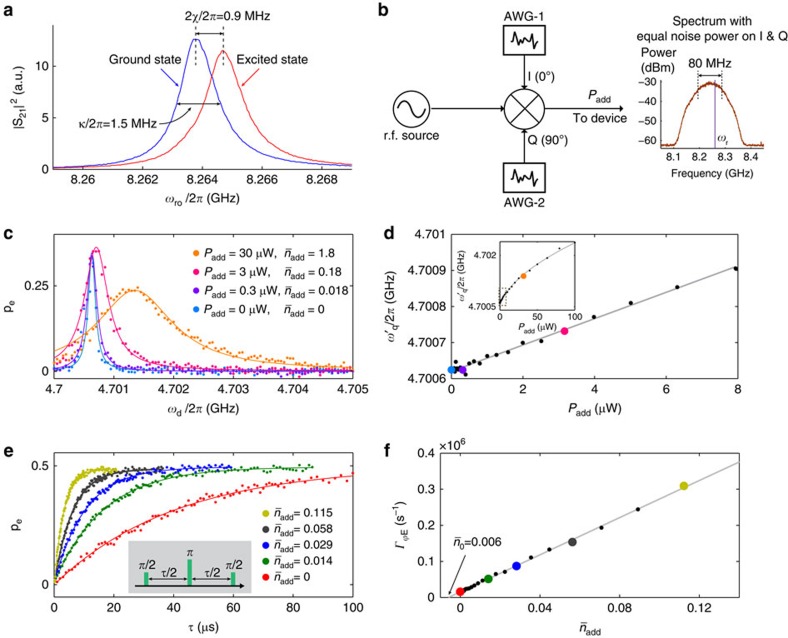
The scalable application of quantum information science will stand on reproducible and controllable high-coherence quantum bits (qubits). Here, we revisit the design and fabrication of the superconducting flux qubit, achieving a planar device with broad-frequency tunability, strong anharmonicity, high reproducibility and relaxation times in excess of 40 μs at its flux-insensitive point. Qubit relaxation times T across 22 qubits are consistently matched with a single model involving resonator loss, ohmic charge noise and 1/f-flux noise, a noise source previously considered primarily in the context of dephasing. We furthermore demonstrate that qubit dephasing at the flux-insensitive point is dominated by residual thermal-photons in the readout resonator. The resulting photon shot noise is mitigated using a dynamical decoupling protocol, resulting in T≈85 μs, approximately the 2T limit. In addition to realizing an improved flux qubit, our results uniquely identify photon shot noise as limiting T in contemporary qubits based on transverse qubit-resonator interaction.
可扩展的量子信息科学应用将依赖于可重复和可控制的高相干量子位(qubit)。在这里,我们重新审视超导磁通量子比特的设计和制造,实现了一种具有宽频调谐、强非谐性、高重复性和弛豫时间超过 40μs 的平面器件,其磁通非敏感点。在 22 个量子比特中,量子比特弛豫时间 T 始终与一个单一的模型相匹配,该模型涉及谐振器损耗、欧姆电荷噪声和 1/f-磁通噪声,这是以前主要在退相背景下考虑的噪声源。此外,我们还证明了在磁通非敏感点的量子比特退相主要由读出谐振器中的残余热光子引起。使用动态去耦协议来减轻由此产生的光子散粒噪声,从而导致 T≈85μs,大约是 2T 的限制。除了实现改进的磁通量子比特外,我们的结果还独特地表明,基于横向量子比特-谐振器相互作用的当代量子比特中,光子散粒噪声限制了 T。