Iturralde Esti, Weissberg-Benchell Jill, Hood Korey K
Department of Pediatrics, Stanford University School of Medicine.
Northwestern University Feinberg School of Medicine/Ann and Robert H. Lurie Children's Hospital of Chicago.
Health Psychol. 2017 Mar;36(3):236-244. doi: 10.1037/hea0000445. Epub 2016 Nov 3.
Adolescents with Type 1 diabetes (T1D) are vulnerable to diabetes-related distress and often struggle to complete self-management tasks needed to maintain blood glucose values in target range. One way that youth with T1D handle problems is through avoidant coping. The current study examined cross-time associations between avoidant coping style and diabetes outcomes and tested the possible mediating role of diabetes-related distress.
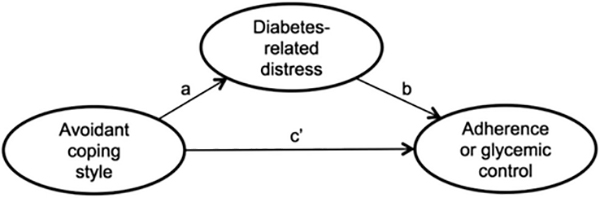
Adolescents with T1D (N = 264) were assessed 4 times over 1 year to measure avoidant coping style, diabetes-related distress, adherence (on the basis of glucometer data and self-report), and glycemic control (hemoglobin A1c). Mediation and direct effects were tested across time using time-lagged autoregressive path models, making use of the repeated measurement of all constructs.
The hypothesized mediation effect was found for all 3 diabetes outcomes. Higher levels of avoidant coping style were associated with greater diabetes-related distress at the subsequent time point, which was related in turn to fewer blood glucose checks, less frequent self-care behaviors, and poorer glycemic control (higher A1c) at the next assessment.
In the context of diabetes, an avoidant coping style may contribute to greater diabetes-specific distress followed by deterioration in self-management and glycemic control over time. Maladaptive coping styles are modifiable factors that offer an entry point into intervention before further difficulties can take hold. (PsycINFO Database Record
1型糖尿病(T1D)青少年易受糖尿病相关困扰,且常常难以完成将血糖值维持在目标范围内所需的自我管理任务。T1D青少年处理问题的一种方式是通过回避应对。本研究考察了回避应对方式与糖尿病结局之间的跨时关联,并检验了糖尿病相关困扰可能的中介作用。
对264名T1D青少年在1年时间内进行了4次评估,以测量回避应对方式、糖尿病相关困扰、依从性(基于血糖仪数据和自我报告)以及血糖控制(糖化血红蛋白)。使用时间滞后自回归路径模型对所有构念进行重复测量,从而跨时间检验中介效应和直接效应。
在所有3项糖尿病结局中均发现了假设的中介效应。较高水平的回避应对方式与随后时间点更大的糖尿病相关困扰相关,而这又与下一次评估时更少的血糖检查、更低频率的自我护理行为以及更差的血糖控制(更高的糖化血红蛋白)相关。
在糖尿病背景下,回避应对方式可能会导致更大的糖尿病特异性困扰,随后随着时间推移自我管理和血糖控制恶化。适应不良的应对方式是可改变的因素,在进一步的问题出现之前,它们为干预提供了一个切入点。(PsycINFO数据库记录)