Rubio-Tapia Alberto, Ludvigsson Jonas F, Choung Rok Seon, Brantner Tricia L, Rajkumar S Vincent, Landgren Ola, Murray Joseph A
Division of Gastroenterology and Hepatology, Department of Medicine, Mayo Clinic, Rochester, MN, 55905, USA.
Deparment of Pediatrics, Orebro University Hospital, Orebro, Sweden.
BMC Gastroenterol. 2016 Nov 3;16(1):136. doi: 10.1186/s12876-016-0547-8.
Immunoglobulin A (IgA) antibodies to tissue transglutaminase (tTG) are the serologic test of choice for diagnosing celiac disease (CD). Our aim was to determine if elevated IgA anti-tTG were associated with increased mortality risk.
Stored serum samples of National Health and Nutrition Examination Survey (NHANES) III (1988-1992) were available for 6032 individuals aged 50 years old or above, which were screened for IgA anti-tTG, and if positive, for IgA endomysial antibodies. Mortality was determined from the National Death Index records through 2006. Hazard ratios were calculated through Cox proportional hazards regression.
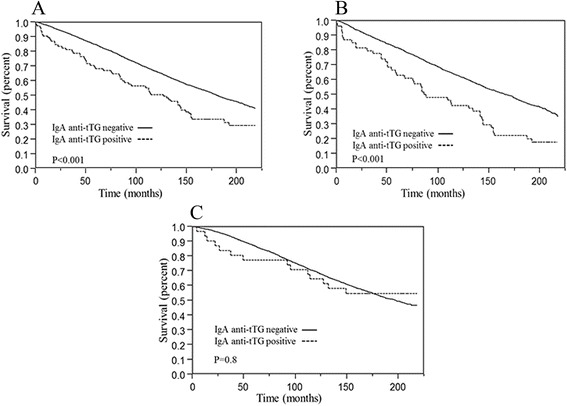
From a total of 6032, 85 participants tested positive for IgA anti-tTG (1.4 %) and 5947 tested negative. After a median follow-up of 13 years, IgA anti-tTG positive participants were at increased risk of death in both crude (HR = 1.68; 95 % CI = 1.30-2.18) and adjusted analyses (adjusted hazard ratio = 1.43; 95 % CI = 1.10-1.85) as compared to IgA anti-tTG negative participants. The excess mortality was restricted to IgA anti-tTG positive males (adjusted hazard ratio = 1.69 (95 % CI = 1.26-2.29), as opposed to a hazard ratio of 0.96 (95 % CI = 0.57-1.62) among IgA anti-tTG positive females. Although the most common cause of death in IgA anti-tTG positive participants was cardiovascular disease (36 %), the increased hazard ratio was only observed in respiratory cause of death as compared to IgA anti-tTG negative participants (adjusted hazard ratio = 5.11; 2.76-9.46).
Men aged 50 years old or above participants of NHANES III with elevated IgA anti-tTG antibodies had increased mortality risk. Elevated IgA anti-tTG antibodies could be a nonspecific marker of serious disease in older men.
抗组织转谷氨酰胺酶(tTG)的免疫球蛋白A(IgA)抗体是诊断乳糜泻(CD)的血清学首选检测方法。我们的目的是确定IgA抗tTG升高是否与死亡风险增加相关。
美国国家健康与营养检查调查(NHANES)III(1988 - 1992年)中存储的血清样本可用于6032名50岁及以上的个体,对其进行IgA抗tTG筛查,若为阳性,则进一步筛查IgA抗肌内膜抗体。通过国家死亡指数记录确定截至2006年的死亡率。通过Cox比例风险回归计算风险比。
在总共6032名个体中,85名参与者IgA抗tTG检测呈阳性(1.4%),5947名检测呈阴性。经过13年的中位随访,与IgA抗tTG阴性参与者相比,IgA抗tTG阳性参与者在粗分析(风险比[HR]=1.68;95%置信区间[CI]=1.30 - 2.18)和校正分析(校正风险比=1.43;95% CI=1.10 - 1.85)中死亡风险均增加。额外的死亡风险仅限于IgA抗tTG阳性男性(校正风险比=1.69(95% CI=1.26 - 2.29)),而IgA抗tTG阳性女性的风险比为0.96(95% CI=0.57 - 1.62)。虽然IgA抗tTG阳性参与者最常见的死亡原因是心血管疾病(36%),但与IgA抗tTG阴性参与者相比,仅在呼吸相关死亡原因中观察到风险比增加(校正风险比=5.11;2.76 - 9.46)。
NHANES III中50岁及以上且IgA抗tTG抗体升高的男性参与者死亡风险增加。IgA抗tTG抗体升高可能是老年男性严重疾病的非特异性标志物。