
启动达格列净治疗的2型糖尿病患者糖化血红蛋白、体重和收缩压的变化:一项初级保健数据库研究
Changes in HbA1c, body weight, and systolic blood pressure in type 2 diabetes patients initiating dapagliflozin therapy: a primary care database study.
作者信息
Scheerer Markus F, Rist Roland, Proske Orm, Meng Annika, Kostev Karel
机构信息
Medical Department, AstraZeneca GmbH, Wedel, Germany.
IMS Health GmbH & Co. OHG, Frankfurt am Main, Germany.
出版信息
Diabetes Metab Syndr Obes. 2016 Oct 31;9:337-345. doi: 10.2147/DMSO.S116243. eCollection 2016.
AIMS
To investigate changes in glycated hemoglobin (HbA1c), body weight (BW), and systolic blood pressure (SBP) in type 2 diabetes (T2D) primary care patients initiating dapagliflozin treatment.
METHODS
T2D patients who started dapagliflozin in 985 general and 32 diabetologist practices (Disease Analyzer, Germany: December 2012-October 2014) were analyzed (3- and 6-month follow-up). Multivariate linear regression analyses were used to identify clinical characteristics and comorbidity associated with changes in HbA1c, BW, and SBP.
RESULTS
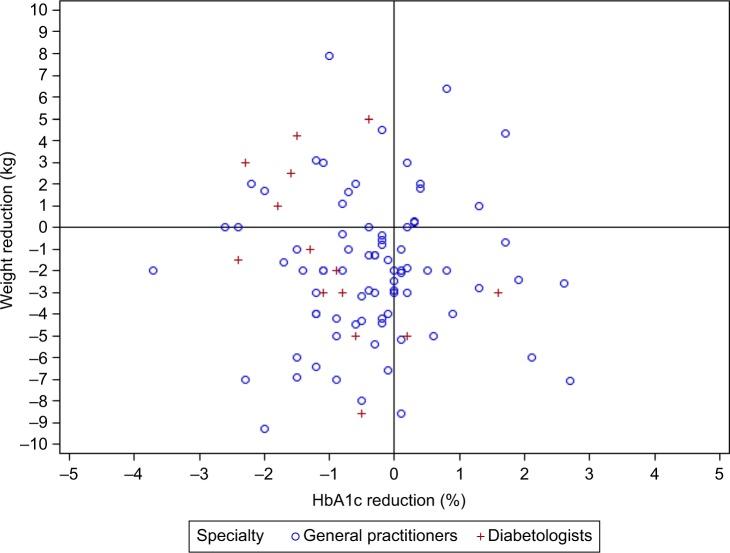
The study included 1,169 T2D patients (age: 62.5 years; men: 59.3%; diabetologist care: 23%) with newly initiated dapagliflozin therapy. At the 3-month stage, dapagliflozin significantly reduced HbA1c (-0.8%±1.4%) compared to the baseline (8.5%±1.5%) (<0.001). Changes were maintained after 6 months (-0.8%±1.5%) (<0.001). Patients with high baseline HbA1c values (>9%) showed greater reductions in HbA1c than the overall sample (3 months -1.8%, 6 months -1.8%; both <0.05). BW and SBP also showed statistically significant reductions with dapagliflozin over 3 and 6 months (-2.2 kg, <0.001; -2.2 mmHg, =0.003 and -2.5 kg, <0.001; -2.3 mmHg, =0.011, respectively). After 3 months, 53% of patients achieved a reduction in both HbA1c and BW; the same holds true for 45% of patients at the 6-month mark. Similar results were observed both in general and diabetologist practices. In multivariate analyses, baseline HbA1c (parameter estimate: -0.6479) and diabetologist care (-0.2553) were independent predictors of HbA1c change (6 months) (all <0.05).
CONCLUSION
T2D patients treated with dapagliflozin therapy achieved statistically significant reductions in HbA1c, BW, and SBP in a real-world primary and diabetologist care setting. The changes were comparable to the results of the dapagliflozin clinical trial program.
目的
研究2型糖尿病(T2D)基层医疗患者开始使用达格列净治疗后糖化血红蛋白(HbA1c)、体重(BW)和收缩压(SBP)的变化。
方法
分析了在985家普通诊所和32家糖尿病专家诊所(德国疾病分析仪:2012年12月至2014年10月)开始使用达格列净的T2D患者(随访3个月和6个月)。采用多变量线性回归分析来确定与HbA1c、BW和SBP变化相关的临床特征和合并症。
结果
该研究纳入了1169例新开始使用达格列净治疗的T2D患者(年龄:62.5岁;男性:59.3%;糖尿病专家护理:23%)。在3个月时,与基线水平(8.5%±1.5%)相比,达格列净显著降低了HbA1c(-0.8%±1.4%)(<0.001)。6个月后变化仍持续存在(-0.8%±1.5%)(<0.001)。基线HbA1c值较高(>9%)的患者HbA1c降低幅度大于总体样本(3个月时降低1.8%,6个月时降低1.8%;均<0.05)。在3个月和6个月期间,达格列净治疗的患者BW和SBP也有统计学意义的降低(分别为-2.2 kg,<0.001;-2.2 mmHg,=0.0(此处疑似有误,应为=0.003)和-2.5 kg,<0.001;-2.3 mmHg,=0.011)。3个月后,53%的患者HbA1c和BW均降低;6个月时45%的患者也是如此。在普通诊所和糖尿病专家诊所均观察到类似结果。在多变量分析中,基线HbA1c(参数估计值:-0.6479)和糖尿病专家护理(-0.2553)是HbA1c变化(6个月)的独立预测因素(均<0.05)。
结论
在现实世界的基层医疗和糖尿病专家护理环境中,接受达格列净治疗的T2D患者在HbA1c、BW和SBP方面有统计学意义的降低。这些变化与达格列净临床试验项目的结果相当。

 Zotero 插件