Chen Jung-Fu, Peng Yun-Shing, Chen Chung-Sen, Tseng Chin-Hsiao, Chen Pei-Chi, Lee Ting-I, Lu Yung-Chuan, Yang Yi-Sun, Lin Ching-Ling, Hung Yi-Jen, Chen Szu-Ta, Lu Chieh-Hsiang, Yang Chwen-Yi, Chen Ching-Chu, Lee Chun-Chuan, Hsiao Pi-Jung, Jiang Ju-Ying, Tu Shih-Te
Division of Endocrinology and Metabolism, Department of Internal Medicine, Kaohsiung Chang Gung Memorial Hospital, Kaohsiung, Taiwan.
College of Medicine, Chang Gung University, Taoyuan, Taiwan.
PeerJ. 2020 Nov 17;8:e9998. doi: 10.7717/peerj.9998. eCollection 2020.
AIMS/INTRODUCTION: To investigate the clinical outcomes of patients with type 2 diabetes mellitus (T2DM) who initiated dapagliflozin in real-world practice in Taiwan.
In this multicenter retrospective study, adult patients with T2DM who initiated dapagliflozin after May 1 2016 either as add-on or switch therapy were included. Changes in clinical and laboratory parameters were evaluated at 3 and 6 months. Baseline factors associated with dapagliflozin response in glycated hemoglobin (HbA1c) were analyzed by univariate and multivariate logistic regression.
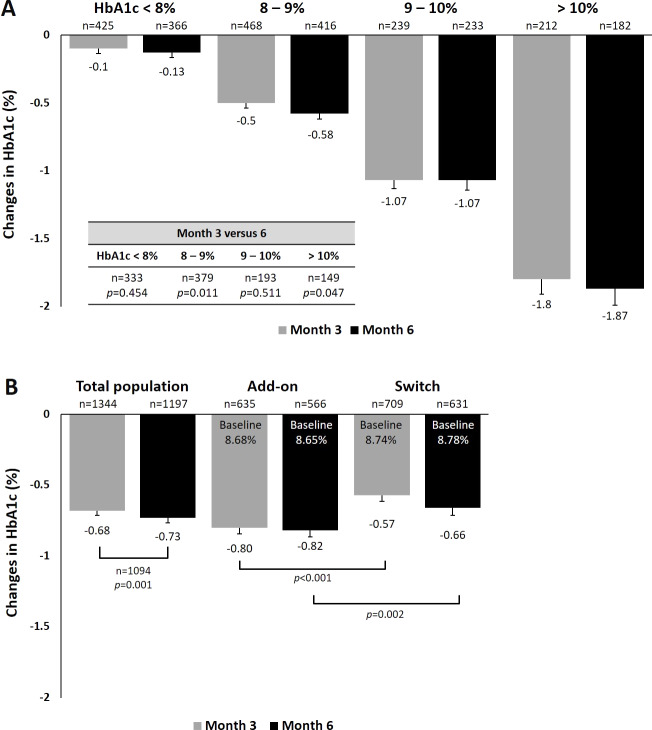
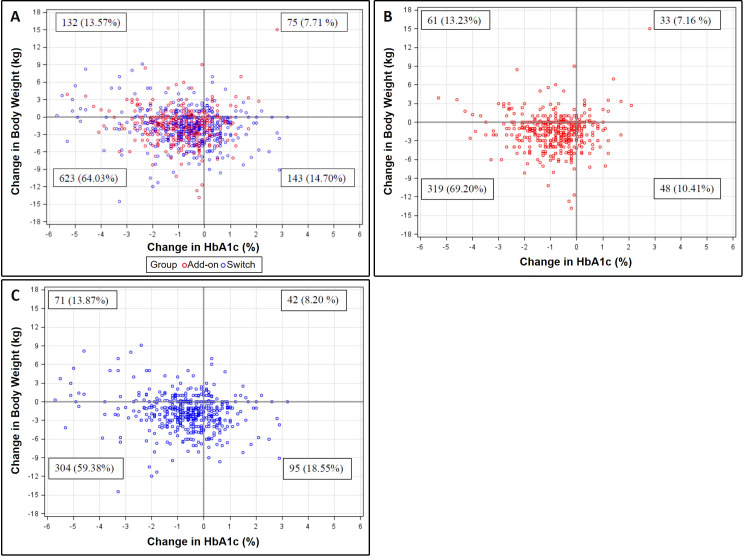
A total of 1,960 patients were eligible. At 6 months, significant changes were observed: HbA1c by -0.73% (95% confidence interval [CI] -0.80, -0.67), body weight was -1.61 kg (95% CI -1.79, -1.42), and systolic/diastolic blood pressure by -3.6/-1.4 mmHg. Add-on dapagliflozin showed significantly greater HbA1c reduction (-0.82%) than switched therapy (-0.66%) ( = 0.002). The proportion of patients achieving HbA1c <7% target increased from 6% at baseline to 19% at Month 6. Almost 80% of patients experienced at least 1% reduction in HbA1c, and 65% of patients showed both weight loss and reduction in HbA1c. Around 37% of patients had at least 3% weight loss. Multivariate logistic regression analysis indicated patients with higher baseline HbA1c and those who initiated dapagliflozin as add-on therapy were associated with a greater reduction in HbA1c.
In this real-world study with the highest patient number of Chinese population to date, the use of dapagliflozin was associated with significant improvement in glycemic control, body weight, and blood pressure in patients with T2DM. Initiating dapagliflozin as add-on therapy showed better glycemic control than as switch therapy.
目的/引言:探讨在台湾实际临床中起始使用达格列净治疗的2型糖尿病(T2DM)患者的临床结局。
在这项多中心回顾性研究中,纳入了2016年5月1日之后起始使用达格列净作为附加治疗或转换治疗的成年T2DM患者。在3个月和6个月时评估临床和实验室参数的变化。通过单因素和多因素逻辑回归分析与糖化血红蛋白(HbA1c)中达格列净反应相关的基线因素。
共有1960例患者符合条件。在6个月时,观察到显著变化:HbA1c降低0.73%(95%置信区间[CI] -0.80,-0.67),体重减轻1.61 kg(95% CI -1.79,-1.42),收缩压/舒张压降低3.6/-1.4 mmHg。附加使用达格列净的患者HbA1c降低幅度(-0.82%)显著大于转换治疗的患者(-0.66%)(P = 0.002)。达到HbA1c <7%目标的患者比例从基线时的6%增加到第6个月时的19%。近80%的患者HbA1c降低至少1%,65%的患者体重减轻且HbA1c降低。约37%的患者体重减轻至少3%。多因素逻辑回归分析表明,基线HbA1c较高的患者以及起始使用达格列净作为附加治疗的患者HbA1c降低幅度更大。
在这项迄今为止中国人群患者数量最多的真实世界研究中,使用达格列净与T2DM患者的血糖控制、体重和血压显著改善相关。起始使用达格列净作为附加治疗的血糖控制效果优于转换治疗。