Kawai Takaharu, Yamazaki Shintaro, Iwama Atsuko, Higaki Tokio, Sugitani Masahiko, Takayama Tadatoshi
Department of Digestive Surgery and Pathology, School of Medicine, Nihon University, Tokyo, Japan.
Hepat Mon. 2016 Aug 21;16(9):e37572. doi: 10.5812/hepatmon.37572. eCollection 2016 Sep.
Sinusoidal obstruction syndrome (SOS) is a severe adverse event of long-term chemotherapy in patients with colorectal cancer. It usually develops as liver congestion due to diffuse microscopic obstruction in liver parenchyma. In contrast, it sometimes appears as a liver mass occurring with local parenchymal hemorrhaging, and is often misdiagnosed as liver metastasis.
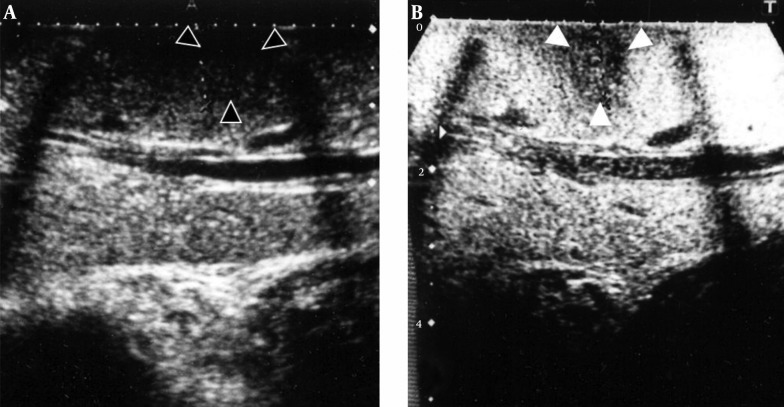
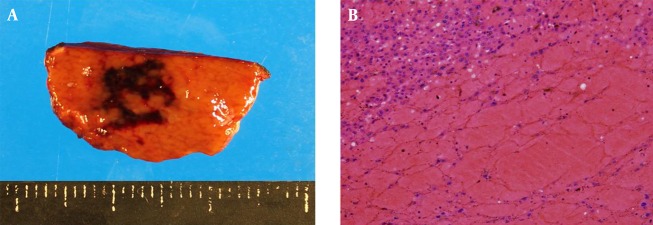
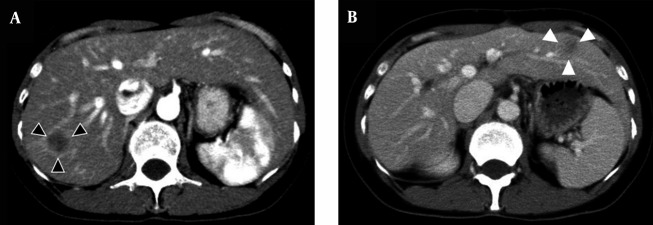
A 40-year-old woman with rectal cancer underwent high anterior resection and partial liver resection of segment 7 due to synchronous liver metastasis. She received oxaliplatin-based chemotherapy (mFOLFOX6) as adjuvant chemotherapy for 6 months. A 13-mm irregular low-echoic mass was detected by CT in segment 3 of the liver 12 months after the operation. The mass was again resected as a liver metastasis because it had increased in size. The pathological diagnosis was focal SOS, which showed sinusoidal dilation and congestion by hepatocyte trabeculae in the liver parenchyma.
Atypical irregular tumors should be considered as SOS when the patient has received oxaliplatin-based chemotherapy. A qualitative imaging modality diagnosis, such as with diffusion-weighted MRI, is superior to a morphological diagnosis in focal SOS. This imaging modality can prevent unnecessary operations.
窦性阻塞综合征(SOS)是结直肠癌患者长期化疗的严重不良事件。它通常是由于肝实质内弥漫性微小阻塞导致肝脏充血而发展形成。相比之下,它有时表现为伴有局部实质出血的肝脏肿块,且常被误诊为肝转移。
一名40岁的直肠癌女性患者因同时性肝转移接受了高位前切除术和肝7段部分切除术。她接受了以奥沙利铂为基础的化疗(mFOLFOX6)作为辅助化疗,为期6个月。术后12个月,CT在肝脏3段检测到一个13毫米不规则低回声肿块。由于肿块增大,再次将其作为肝转移瘤切除。病理诊断为局灶性SOS,显示肝实质内肝细胞小梁间的窦性扩张和充血。
当患者接受以奥沙利铂为基础的化疗时,非典型不规则肿瘤应考虑为SOS。定性成像方式诊断,如扩散加权磁共振成像,在局灶性SOS中优于形态学诊断。这种成像方式可以避免不必要的手术。