Hardwick Laura J A, Davies John D, Philpott Anna
Department of Oncology, University of Cambridge, Hutchison/MRC Research Centre, Cambridge Biomedical Campus, Cambridge CB2 0XZ, UK; Wellcome Trust Centre for Stem Cell Research, University of Cambridge, Tennis Court Road, Cambridge, CB2 1QR, UK; Peterhouse, University of Cambridge, Trumpington Street, Cambridge, CB2 1RD, UK.
Department of Oncology, University of Cambridge, Hutchison/MRC Research Centre, Cambridge Biomedical Campus, Cambridge CB2 0XZ, UK; Wellcome Trust Centre for Stem Cell Research, University of Cambridge, Tennis Court Road, Cambridge, CB2 1QR, UK.
Biochem Biophys Res Commun. 2016 Dec 2;481(1-2):97-103. doi: 10.1016/j.bbrc.2016.11.009. Epub 2016 Nov 4.
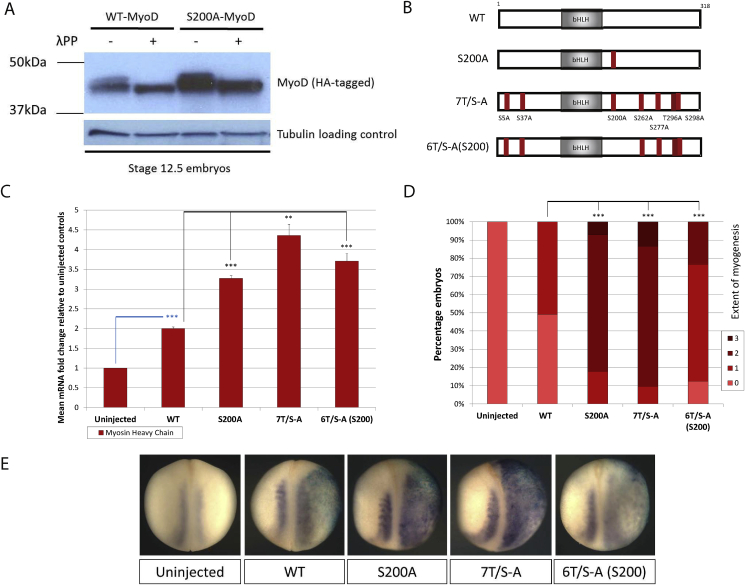
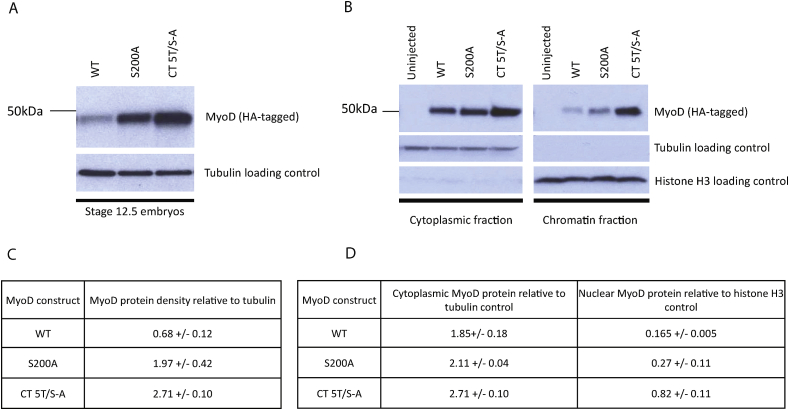
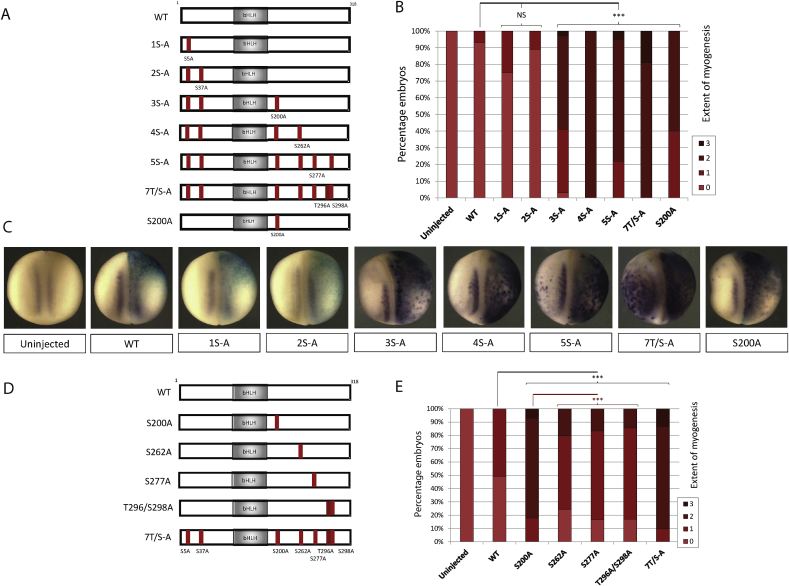
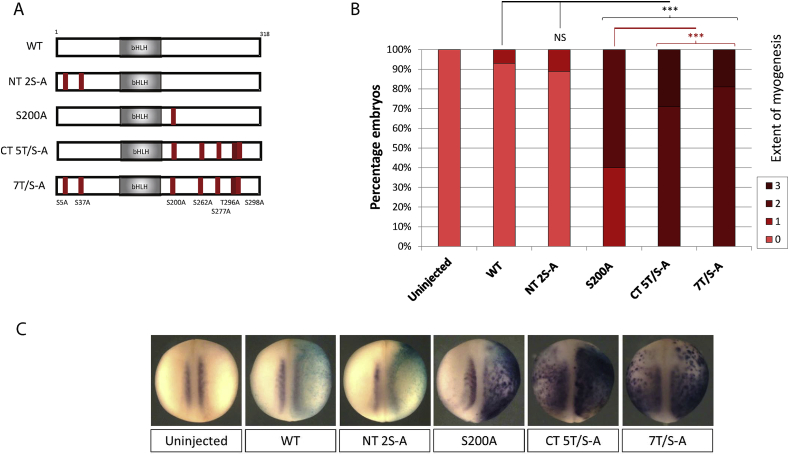
MyoD is a master regulator of myogenesis with a potent ability to redirect the cell fate of even terminally differentiated cells. Hence, enhancing the activity of MyoD is an important step to maximising its potential utility for in vitro disease modelling and cell replacement therapies. We have previously shown that the reprogramming activity of several neurogenic bHLH proteins can be substantially enhanced by inhibiting their multi-site phosphorylation by proline-directed kinases. Here we have used Xenopus embryos as an in vivo developmental and reprogramming system to investigate the multi-site phospho-regulation of MyoD during muscle differentiation. We show that, in addition to modification of a previously well-characterised site, Serine 200, MyoD is phosphorylated on multiple additional serine/threonine sites during primary myogenesis. Through mutational analysis, we derive an optimally active phospho-mutant form of MyoD that has a dramatically enhanced ability to drive myogenic reprogramming in vivo. Mechanistically, this is achieved through increased protein stability and enhanced chromatin association. Therefore, multi-site phospho-regulation of class II bHLH proteins is conserved across cell lineages and germ layers, and manipulation of phosphorylation of these key regulators may have further potential for enhancing mammalian cell reprogramming.
肌分化决定因子(MyoD)是成肌作用的主要调节因子,具有强大的能力,甚至能改变终末分化细胞的细胞命运。因此,增强MyoD的活性是将其在体外疾病建模和细胞替代疗法中的潜在效用最大化的重要一步。我们之前已经表明,通过抑制脯氨酸定向激酶对几种神经源性bHLH蛋白的多位点磷酸化,可显著增强它们的重编程活性。在此,我们利用非洲爪蟾胚胎作为体内发育和重编程系统,来研究肌肉分化过程中MyoD的多位点磷酸化调节。我们发现,除了一个之前已充分表征的位点丝氨酸200的修饰外,MyoD在初级成肌过程中还在多个额外的丝氨酸/苏氨酸位点发生磷酸化。通过突变分析,我们获得了一种活性最佳的MyoD磷酸化突变体形式,其在体内驱动成肌重编程的能力显著增强。从机制上讲,这是通过增加蛋白质稳定性和增强染色质结合来实现的。因此,II类bHLH蛋白的多位点磷酸化调节在不同细胞谱系和胚层中是保守的,对这些关键调节因子磷酸化的操控可能在增强哺乳动物细胞重编程方面具有进一步的潜力。