Huang Jinzhu, Wang Xiaofang, Chen Xiaohong, Song Qiuyue, Liu Wen, Lu Laichun
Department of Pharmacy, Daping Hospital, Third Military Medical University, Chongqing, China.
Department of Laboratory Medicine, Key Laboratory of Diagnostic Medicine (Ministry of Education), Chongqing Medical University, Chongqing, China.
PLoS One. 2016 Nov 8;11(11):e0166141. doi: 10.1371/journal.pone.0166141. eCollection 2016.
Post-operative endophthalmitis is a rare and dreaded complication in ophthalmic operations because it often induces irreparable vision loss. Although many ophthalmological studies aimed at reducing the rate of endophthalmitis have been performed around the world, controversy continues to surround some issues, including the choice of antimicrobials and their route of administration, duration and timing. The aim of this study is to investigate some of these unresolved issues.
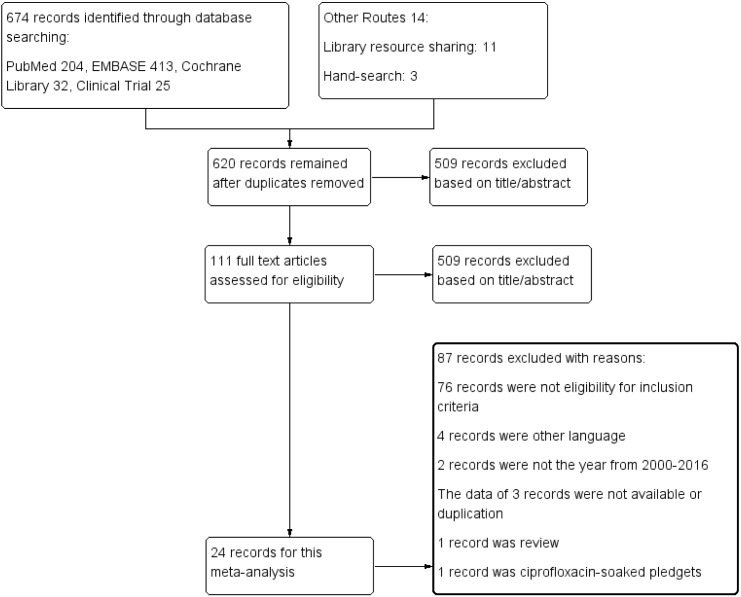
A systematic review and meta-analysis of randomized controlled trials and observational studies was performed. The PubMed, EMBASE, Cochrane Library and Clinical Trials databases were searched to identify studies published until Feb. 2016. The relative risk (RR) for each clinical outcome data is presented with 95% confidence intervals (CIs). Pooled estimates of effects were calculated using random-effect models.
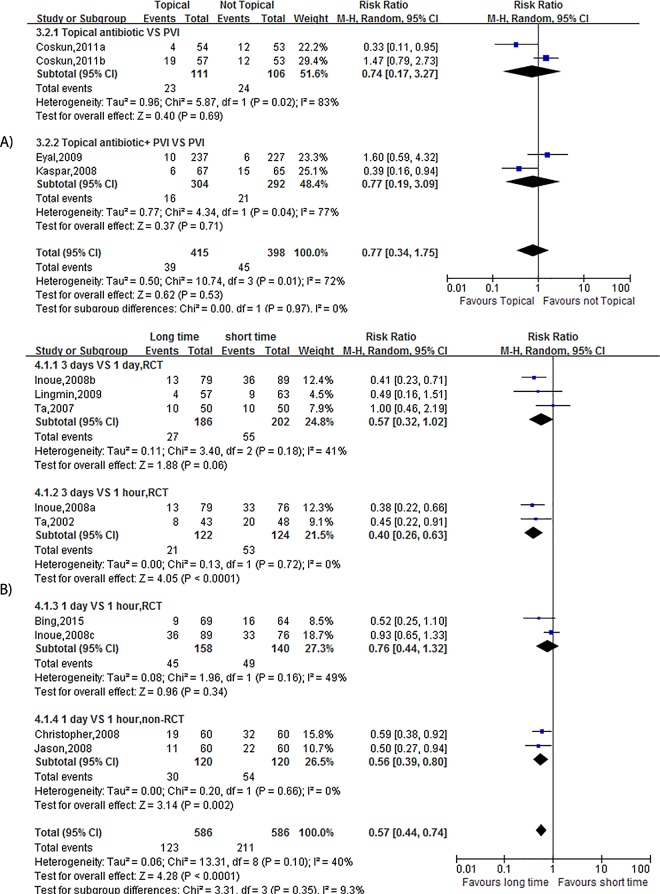
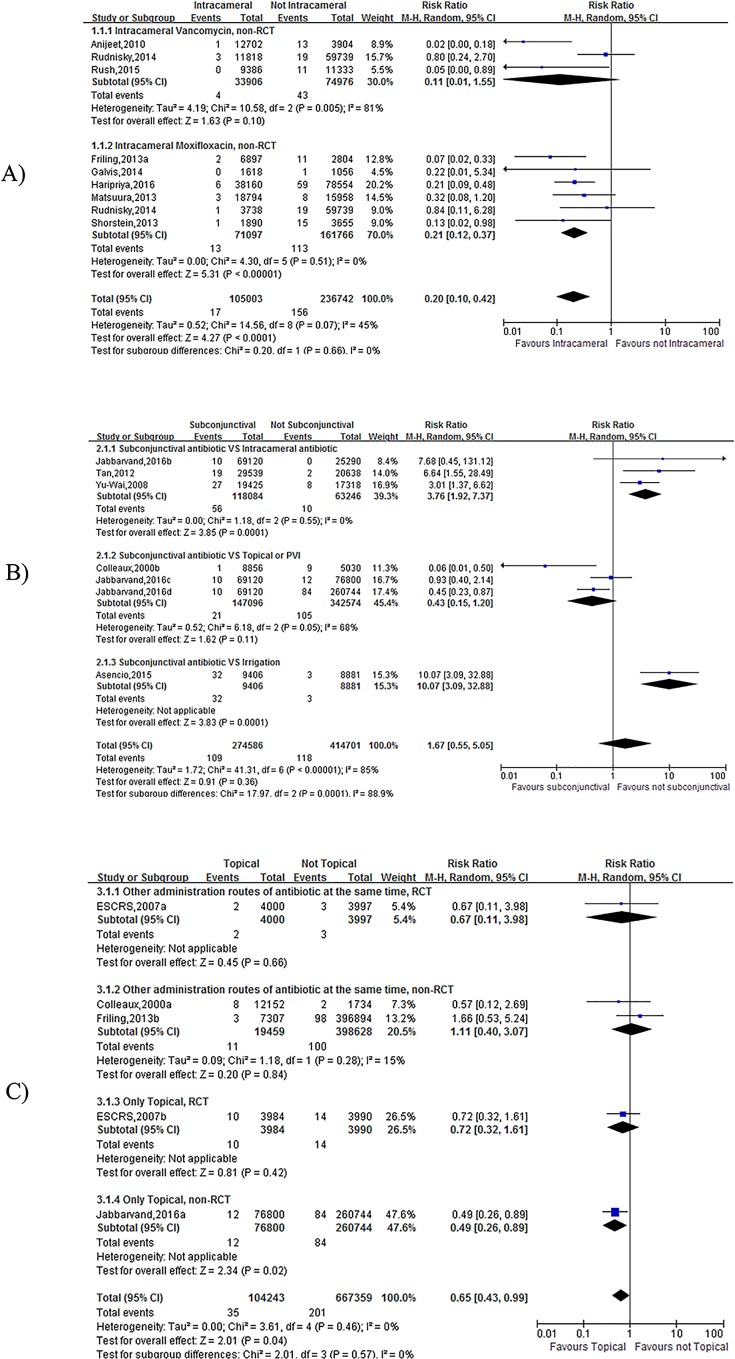
Thirty-four studies from twenty-four reports involving 1264797 eyes were included in this analysis. Endophthalmitis occurred, on average, in one out of 6177 eyes when intracameral vancomycin/moxifloxacin were used and in one out of 1517 eyes when intracameral vancomycin/moxifloxacin were not used. The relative risk (95% CI) of endophthalmitis was reduced to 0.20 (0.10, 0.42) when intracameral antibiotics were used (p<0.0001). The subconjunctival injection of antibiotics was not superior to other administration routes included in this study (RR = 1.67, 95% CI (0.55, 5.05), p = 0.36). A statistically significant difference was found in the rate of endophthalmitis between the use and lack of use of topical antibiotics (RR = 0.65, 95% CI (0.43, 0.99), p = 0.04). However, no statistically significant difference was found in microbial isolation rates between these groups (RR = 0.77, 95% CI (0.34, 1.75), p = 0.53). When long-term and short-term use of topical antibiotics before surgery were compared, a statistically significant difference was found in microbial isolation rates (RR = 0.57, 95% CI (0.44, 0.74), p<0.0001).
This meta-analysis concluded intracameral antibiotics are effective at preventing endophthalmitis in ocular surgery. A randomized controlled trial confirms the efficacy of cefuroxime but recent large cohort studies support the efficacy of vancomycin/moxifloxacin intracamerally. Intracameral antibitoics are superior to subconjunctival injections but that irrigation antibitoic data are not of enough quality to make a comparison. Different results were found in two clinical outcomes between the use or lack of use of topical antibiotic therapy, we did not find sufficient evidence to conclude that its use prevents endophthalmitis.
术后眼内炎是眼科手术中一种罕见且可怕的并发症,因为它常常导致无法挽回的视力丧失。尽管世界各地已经开展了许多旨在降低眼内炎发生率的眼科研究,但围绕一些问题仍存在争议,包括抗菌药物的选择及其给药途径、持续时间和时机。本研究的目的是调查其中一些尚未解决的问题。
对随机对照试验和观察性研究进行系统评价和荟萃分析。检索了PubMed、EMBASE、Cochrane图书馆和临床试验数据库,以识别截至2016年2月发表的研究。每个临床结局数据的相对风险(RR)以95%置信区间(CI)呈现。使用随机效应模型计算效应的合并估计值。
本分析纳入了来自24份报告的34项研究,涉及1264797只眼。当使用前房内万古霉素/莫西沙星时,眼内炎平均发生在6177只眼中的1只;当未使用前房内万古霉素/莫西沙星时,眼内炎平均发生在1517只眼中的1只。使用前房内抗生素时,眼内炎的相对风险(95%CI)降至0.20(0.10,0.42)(p<0.0001)。结膜下注射抗生素并不优于本研究中包括的其他给药途径(RR = 1.67,95%CI(0.55,5.05),p = 0.36)。在使用和未使用局部抗生素之间,眼内炎发生率存在统计学显著差异(RR = 0.65,95%CI(0.43,0.99),p = 0.04)。然而,这些组之间的微生物分离率没有统计学显著差异(RR = 0.77,95%CI(0.34,1.75),p = 0.53)。当比较手术前长期和短期使用局部抗生素时,微生物分离率存在统计学显著差异(RR = 0.57,95%CI(0.44,0.74),p<0.0001)。
这项荟萃分析得出结论,前房内抗生素在预防眼科手术中的眼内炎方面是有效的。一项随机对照试验证实了头孢呋辛的疗效,但最近的大型队列研究支持前房内万古霉素/莫西沙星的疗效。前房内抗生素优于结膜下注射,但冲洗抗生素的数据质量不足以进行比较。在使用或不使用局部抗生素治疗的两种临床结局中发现了不同的结果,我们没有找到足够的证据得出其使用可预防眼内炎的结论。