Arauz Antonio, Morelos Eugenia, Colín Jonathan, Roldán Javier, Barboza Miguel A
Stroke Clinic, Instituto Nacional de Neurología y Neurocirugía Manuel Velasco Suárez, Mexico City, Mexico.
Instituto Nacional de Cardiología Ignacio Chávez, Mexico City, Mexico.
PLoS One. 2016 Nov 10;11(11):e0166091. doi: 10.1371/journal.pone.0166091. eCollection 2016.
Embolic stroke of undetermined source (ESUS) recurrence and functional outcome from long-term follow-up is not well delineated. The purpose of this study is to compare these functional variables between ESUS vs. cardioembolic stroke (CS) patients.
We analyzed data of consecutive ESUS and CS patients from our institutional database, from January 2003 until April 2015. The endpoints were stroke recurrence, mortality and poor clinical outcome (Modified Rankin Score 3-6), at discharge, 6 months and final follow-up. Adjusted multivariate Cox analysis and Kaplan-Meier curves were used to estimate the probability of recurrence and death.
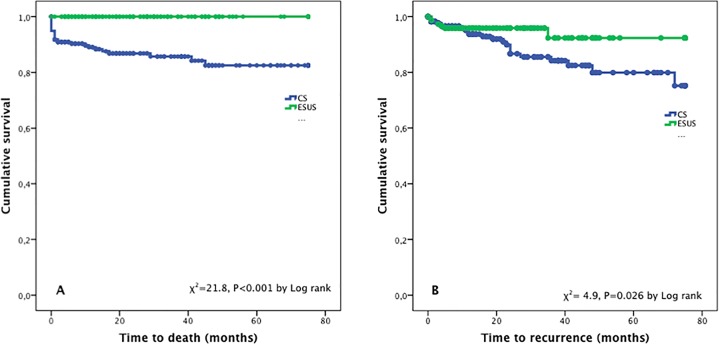
149 ESUS (median age 44 years) and 235 CS (median age 66 years) consecutive patients were included in the study. Median follow-up period for the entire sample was 19 months (interquartile range 6.0-45.0 months). Stroke recurrence was similar between ESUS and CS patients (5.4% vs. 9.8% respectively, p = 0.12). Death occurred in 30 CS cases (12.8%), with a cumulative probability of survival of 77%. Poor functional outcome was present in 58.3%, 54.0% and 54.9% at discharge, 6 months and final follow-up respectively in CS patients, significantly worst compared to ESUS cases (HR 3.1; CI 95% 1.96-4.68). Oral anticoagulation presents with a HR 8.01 for recurrence, and antiplatelet therapy had the highest risk for recurrence for both groups (HR 24.3).
ESUS patients are substantially younger than CS patients but have a stroke recurrence rate similar to CS patients, with a lower mortality rate, and better functional outcome on long-term follow-up.
不明来源栓塞性卒中(ESUS)的复发情况以及长期随访后的功能结局尚未得到充分阐明。本研究的目的是比较ESUS患者与心源性栓塞性卒中(CS)患者之间的这些功能变量。
我们分析了2003年1月至2015年4月来自我们机构数据库的连续ESUS和CS患者的数据。终点指标为出院时、6个月及最终随访时的卒中复发、死亡率及不良临床结局(改良Rankin量表评分3 - 6分)。采用校正多因素Cox分析和Kaplan - Meier曲线来估计复发和死亡的概率。
本研究纳入了149例ESUS连续患者(中位年龄44岁)和235例CS连续患者(中位年龄66岁)。整个样本的中位随访期为19个月(四分位间距6.0 - 45.0个月)。ESUS和CS患者的卒中复发情况相似(分别为5.4%和9.8%,p = 0.12)。30例CS患者死亡(12.8%),累积生存概率为77%。CS患者出院时、6个月及最终随访时不良功能结局的发生率分别为58.3%、54.0%和54.9%,与ESUS患者相比明显更差(风险比3.1;95%置信区间1.96 - 4.68)。口服抗凝治疗的复发风险比为8.01,两组中抗血小板治疗的复发风险最高(风险比24.3)。
ESUS患者比CS患者年轻得多,但卒中复发率与CS患者相似,死亡率较低,长期随访时功能结局更好。