Moon Joon Ho, Kim Kyoung Min, Kim Jung Hee, Moon Jae Hoon, Choi Sung Hee, Lim Soo, Lim Jae-Young, Kim Ki Woong, Park Kyong Soo, Jang Hak Chul
Department of Internal Medicine, Seoul National University College of Medicine, Seoul, Korea.
Department of Internal Medicine, Seoul National University Hospital, Seoul, Korea.
PLoS One. 2016 Nov 10;11(11):e0166344. doi: 10.1371/journal.pone.0166344. eCollection 2016.
We evaluated the Foundation for the National Institutes of Health (FNIH) Sarcopenia Project's recommended criteria for sarcopenia's association with mortality among older Korean adults.
We conducted a community-based prospective cohort study which included 560 (285 men and 275 women) older Korean adults aged ≥65 years. Muscle mass (appendicular skeletal muscle mass-to-body mass index ratio (ASM/BMI)), handgrip strength, and walking velocity were evaluated in association with all-cause mortality during 6-year follow-up. Both the lowest quintile for each parameter (ethnic-specific cutoff) and FNIH-recommended values were used as cutoffs.
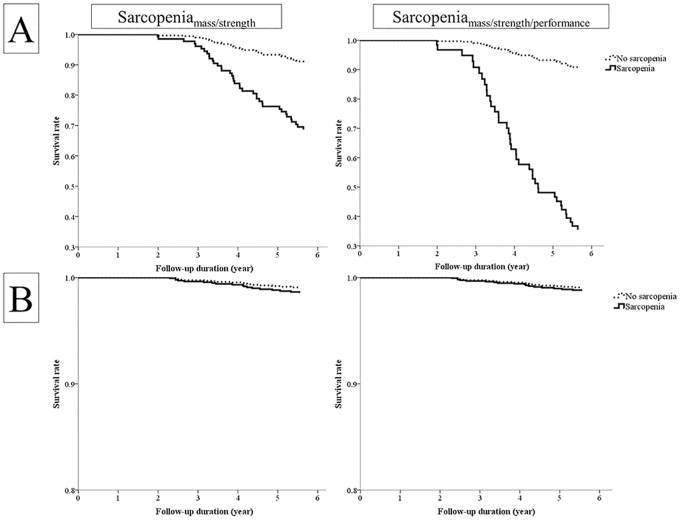
Forty men (14.0%) and 21 women (7.6%) died during 6-year follow-up. The deceased subjects were older and had lower ASM, handgrip strength, and walking velocity. Sarcopenia defined by both low lean mass and weakness had a 4.13 (95% CI, 1.69-10.11) times higher risk of death, and sarcopenia defined by a combination of low lean mass, weakness, and slowness had a 9.56 (3.16-28.90) times higher risk of death after adjusting for covariates in men. However, these significant associations were not observed in women. In terms of cutoffs of each parameter, using the lowest quintile showed better predictive values in mortality than using the FNIH-recommended values. Moreover, new muscle mass index, ASM/BMI, provided better prognostic values than ASM/height2 in all associations.
New sarcopenia definition by FNIH was better able to predict 6-year mortality among Korean men. Moreover, ethnic-specific cutoffs, the lowest quintile for each parameter, predicted the higher risk of mortality than the FNIH-recommended values.
我们评估了美国国立卫生研究院基金会(FNIH)肌肉减少症项目推荐的关于韩国老年人群中肌肉减少症与死亡率相关性的标准。
我们开展了一项基于社区的前瞻性队列研究,纳入了560名年龄≥65岁的韩国老年人(285名男性和275名女性)。在6年随访期间,评估肌肉量(四肢骨骼肌质量与体重指数之比(ASM/BMI))、握力和步行速度与全因死亡率的相关性。每个参数的最低五分位数(特定种族临界值)和FNIH推荐值均用作临界值。
在6年随访期间,40名男性(14.0%)和21名女性(7.6%)死亡。死亡受试者年龄更大,ASM、握力和步行速度更低。低瘦体重和虚弱共同定义的肌肉减少症在调整协变量后,男性死亡风险高4.13倍(95%置信区间,1.69 - 10.11),低瘦体重、虚弱和缓慢共同定义的肌肉减少症死亡风险高9.56倍(3.16 - 28.90)。然而,在女性中未观察到这些显著关联。就每个参数的临界值而言,使用最低五分位数在预测死亡率方面比使用FNIH推荐值具有更好的预测价值。此外,新的肌肉量指数ASM/BMI在所有关联中比ASM/身高²提供了更好的预后价值。
FNIH新的肌肉减少症定义能更好地预测韩国男性的6年死亡率。此外,特定种族临界值,即每个参数的最低五分位数,比FNIH推荐值预测的死亡风险更高。