Fabiani Massimo, Riccardo Flavia, Di Napoli Anteo, Gargiulo Lidia, Declich Silvia, Petrelli Alessio
National Centre for Epidemiology, Surveillance and Health Promotion (CNESPS), Italian National Institute of Health (ISS), Rome, Italy.
European Programme for Intervention Epidemiology Training (EPIET), European Centre for Disease Prevention and Control (ECDC), Stockholm, Sweden.
PLoS One. 2016 Nov 10;11(11):e0166517. doi: 10.1371/journal.pone.0166517. eCollection 2016.
Due to their increased vulnerability, immigrants are considered a priority group for communicable disease prevention and control in Europe. This study aims to compare influenza vaccination coverage (IVC) between regular immigrants and Italian citizens at risk for its complications and evaluate factors affecting differences.
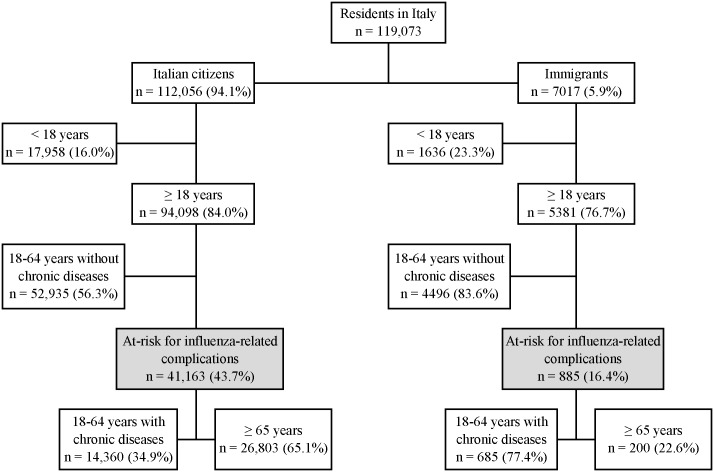
Based on data collected by the National Institute of Statistics during a population-based cross-sectional survey conducted in Italy in 2012-2013, we analysed information on 42,048 adult residents (≥ 18 years) at risk for influenza-related complications and with free access to vaccination (elderly residents ≥ 65 years and residents with specific chronic diseases). We compared IVC between 885 regular immigrants and 41,163 Italian citizens using log-binomial models and stratifying immigrants by area of origin and length of stay in Italy (recent: < 10 years; long-term: ≥ 10 years).
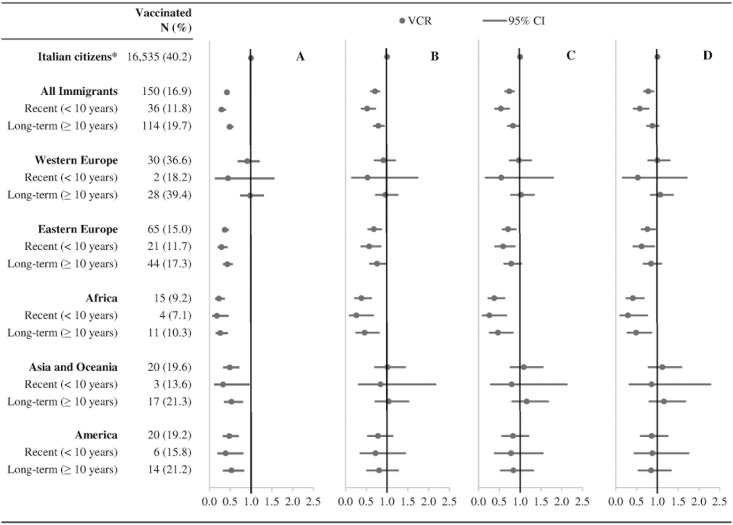
IVC among all immigrants was 16.9% compared to 40.2% among Italian citizens (vaccination coverage ratio (VCR) = 0.42, 95% confidence interval (CI): 0.36-0.49). Adjusting for sex, age and area of residence, this difference was greatly reduced but remained statistically significant (VCR = 0.71, 95 CI: 0.61-0.81). Further adjustment for socio-economic factors (education, occupation, family composition and economic status) and a composite indicator of health-services utilization did not affect the difference (VCR = 0.78, 95% CI: 0.68-0.90). However, after adjustments, only long-term immigrants from Africa (VCR = 0.49, 95% CI: 0.28-0.85) and recent immigrants (VCR = 0.58, 95% CI: 0.43-0.78) showed a significantly different IVC compared to Italian citizens.
Differences in demographic characteristics, socio-economic conditions and health-services utilization explained the reduced IVC in most long-term immigrants compared to Italian citizens. By contrast, these differences did not explain the reduced IVC in long-term immigrants from Africa and recent immigrants. This suggests that IVC in these sub-groups is affected by other informal barriers (e.g., cultural and linguistic) that need to be investigated to promote effective immunization access strategies.
由于移民群体的脆弱性增加,他们被视为欧洲传染病预防和控制的重点群体。本研究旨在比较普通移民与有流感并发症风险的意大利公民之间的流感疫苗接种覆盖率(IVC),并评估影响差异的因素。
基于意大利国家统计局在2012 - 2013年进行的一项基于人群的横断面调查所收集的数据,我们分析了42,048名有流感相关并发症风险且可免费接种疫苗的成年居民(≥18岁)的信息(65岁及以上老年居民和患有特定慢性病的居民)。我们使用对数二项模型,按移民的原籍地区和在意大利的停留时间(近期:<10年;长期:≥10年)对移民进行分层,比较了885名普通移民和41,163名意大利公民的IVC。
所有移民的IVC为16.9%,而意大利公民为40.2%(疫苗接种覆盖率(VCR)= 0.42,95%置信区间(CI):0.36 - 0.49)。在对性别、年龄和居住地区进行调整后,这种差异大幅缩小,但仍具有统计学意义(VCR = 0.71,95% CI:0.61 - 0.81)。进一步对社会经济因素(教育、职业、家庭构成和经济状况)以及卫生服务利用综合指标进行调整后,差异没有受到影响(VCR = 0.78,95% CI:0.68 - 0.90)。然而,调整后,只有来自非洲的长期移民(VCR = 0.49,95% CI:0.28 - 0.85)和近期移民(VCR = 0.58,95% CI:0.43 - 0.78)与意大利公民相比,IVC存在显著差异。
人口特征(人口统计学特征)、社会经济状况和卫生服务利用方面的差异解释了与意大利公民相比,大多数长期移民的IVC较低的原因。相比之下,这些差异并不能解释来自非洲的长期移民和近期移民IVC较低的情况。这表明这些亚组中的IVC受到其他非正式障碍(如文化和语言)的影响,需要对此进行调查,以促进有效的免疫接种获取策略。