Roederer Thomas, Mollo Bastien, Vincent Charline, Leduc Ghislain, Sayyad-Hilario Jessica, Mosnier Marine, Vandentorren Stéphanie
Epicentre, Paris, France.
Médecins Sans Frontières, Paris, France.
Commun Med (Lond). 2023 Feb 20;3(1):30. doi: 10.1038/s43856-023-00257-1.
Migrants, people experiencing homelessness (PEH), or precariously housed (PH) are at high risk for COVID-19 infection, hospitalization, and death from COVID-19. However, while data on COVID-19 vaccine uptake in these populations are available in the USA, Canada, and Denmark, we are lacking, to the best of our knowledge, data from France.
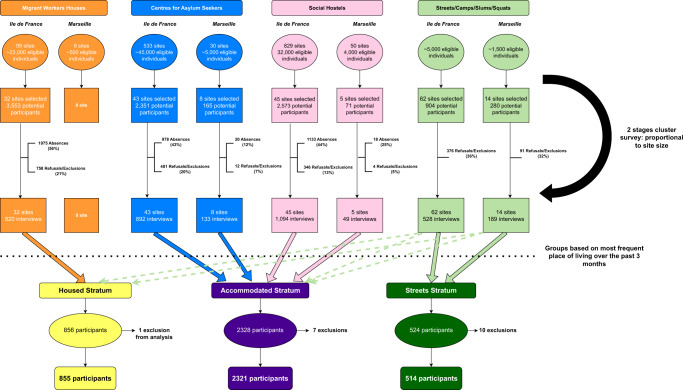
In late 2021, we carried out a cross-sectional survey to determine COVID-19 vaccine coverage in PEH/PH residing in Ile-de-France and Marseille, France, and to explore its drivers. Participants aged over 18 years were interviewed face-to-face where they slept the previous night, in their preferred language, and then stratified for analysis into three housing groups (Streets, Accommodated, and Precariously Housed). Standardized vaccination rates were computed and compared to the French population. Multilevel univariate and multivariable logistic regression models were built.
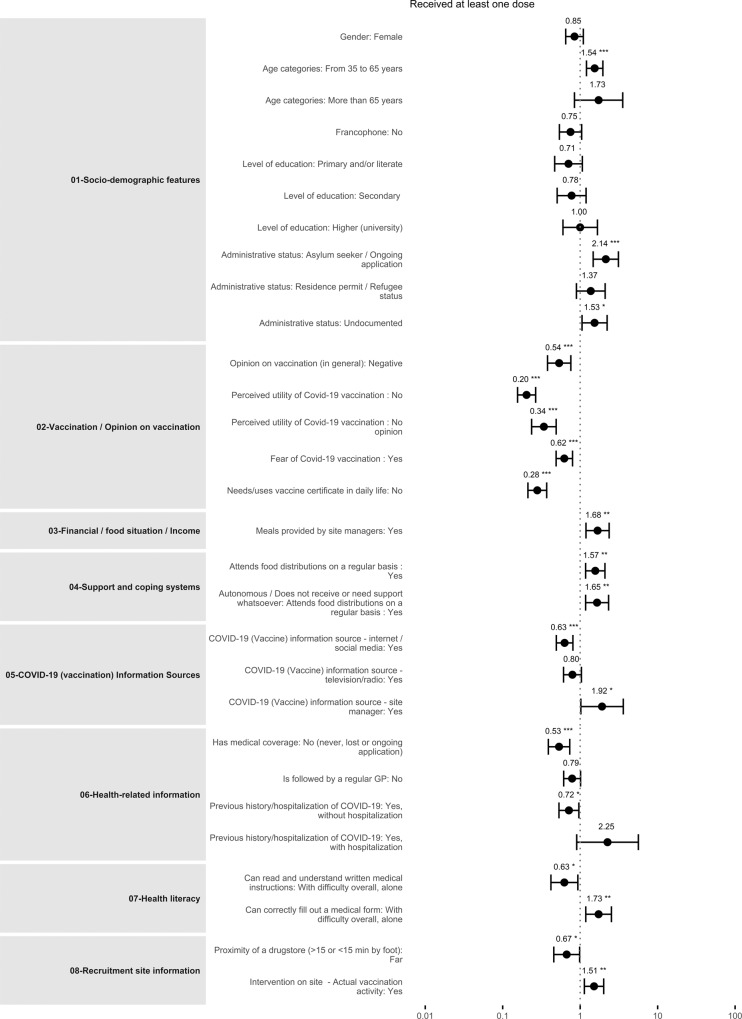
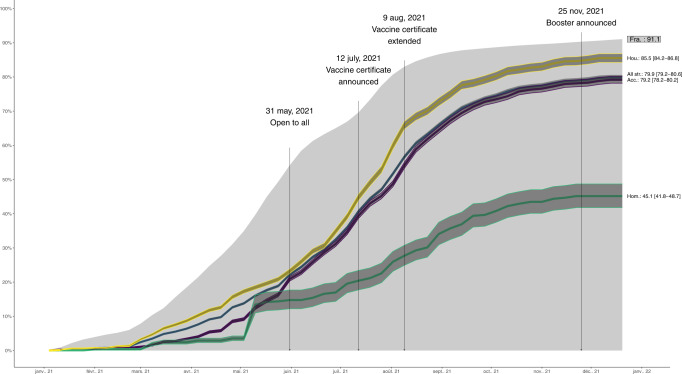
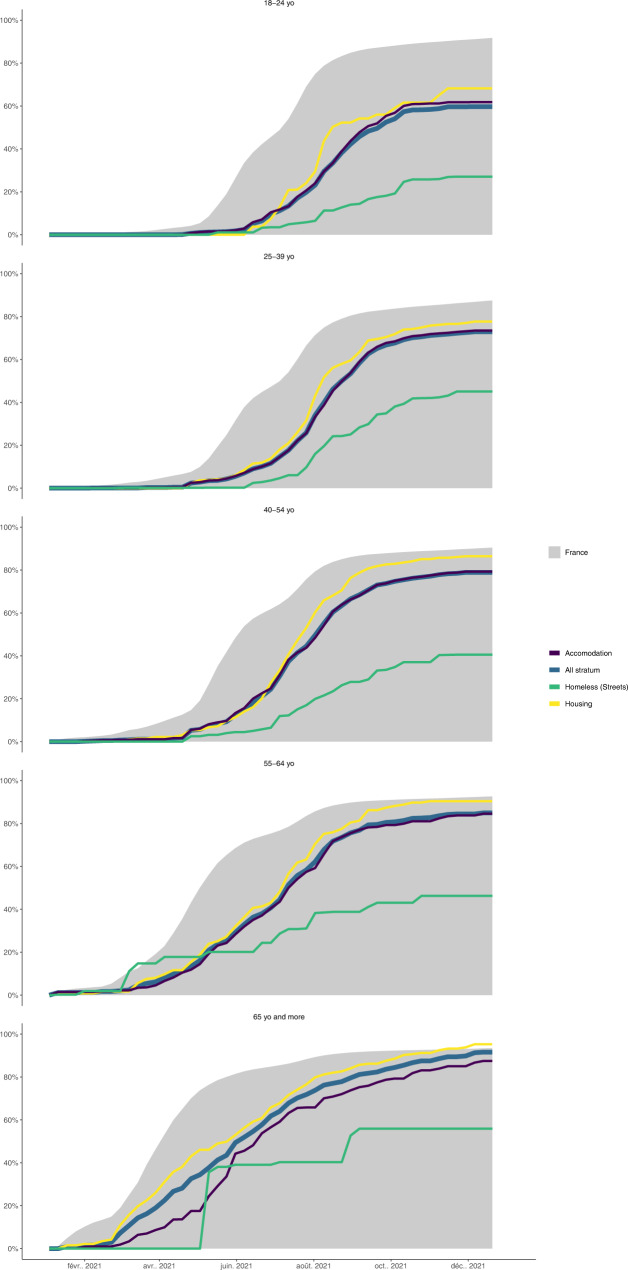
We find that 76.2% (95% confidence interval [CI] 74.3-78.1) of the 3690 participants received at least one COVID-19 vaccine dose while 91.1% of the French population did so. Vaccine uptake varies by stratum, with the highest uptake (85.6%; reference) in PH, followed by Accommodated (75.4%; adjusted odds-ratio = 0.79; 95% CI 0.51-1.09 vs. PH) and lowest in Streets (42.0%; AOR = 0.38; 95%CI 0.25-0.57 vs. PH). Use for vaccine certificate, age, socioeconomic factors, and vaccine hesitancy is associated with vaccination coverage.
In France, PEH/PH, and especially the most excluded, are less likely than the general population to receive COVID-19 vaccines. While vaccine mandate has proved an effective strategy, targeted outreach, on-site vaccinations, and sensitization activities are strategies enhancing vaccine uptake that can easily be replicated in future campaigns and other settings.
移民、无家可归者或居住条件不稳定者感染新冠病毒、因新冠病毒住院及死亡的风险很高。然而,尽管在美国、加拿大和丹麦有关于这些人群接种新冠疫苗的数据,但据我们所知,法国缺乏相关数据。
2021年末,我们开展了一项横断面调查,以确定居住在法国法兰西岛和马赛的无家可归者或居住条件不稳定者的新冠疫苗接种率,并探究其影响因素。对18岁以上的参与者在前一晚睡觉的地方进行面对面访谈,使用他们首选的语言,然后将其分为三个居住组(街头居住、有住处、居住条件不稳定)进行分层分析。计算标准化接种率,并与法国总体人群进行比较。建立多水平单变量和多变量逻辑回归模型。
我们发现,3690名参与者中有76.2%(95%置信区间[CI]74.3 - 78.1)至少接种了一剂新冠疫苗,而法国总体人群的这一比例为91.1%。疫苗接种率因分层而异,居住条件不稳定者的接种率最高(85.6%;参照),其次是有住处者(75.4%;调整后的优势比=0.79;95%CI 0.51 - 1.09,与居住条件不稳定者相比),街头居住者的接种率最低(42.0%;调整后的优势比=0.38;95%CI 0.25 - 0.57,与居住条件不稳定者相比)。疫苗接种证明的用途、年龄、社会经济因素以及疫苗犹豫与疫苗接种率相关。
在法国,无家可归者或居住条件不稳定者,尤其是最受排斥的人群,接种新冠疫苗的可能性低于普通人群。虽然疫苗强制令已被证明是一种有效的策略,但有针对性的宣传、现场接种和宣传活动是提高疫苗接种率的策略,这些策略可在未来的活动和其他环境中轻松复制。