Ghodsi Delaram, Omidvar Nasrin, Eini-Zinab Hassan, Rashidian Arash, Raghfar Hossein
Department of Community Nutrition, Faculty of Nutrition Sciences and Food Technology, Shahid Beheshti University of Medical Sciences, Tehran, Iran.
Department of Health Management and Economics, School of Public Health, Tehran University of Medical Sciences, Tehran, Iran; Department of Information, Evidence and Research, Eastern Mediterranean Region, World Health Organization, Cairo, Egypt.
Int J Prev Med. 2016 Sep 14;7:108. doi: 10.4103/2008-7802.190605. eCollection 2016.
Food aid programs are strategies that aim to improve nutritional status and to tackle food insecurity. This study aimed to evaluate the effect of a National Food Supplementary Program for Children on households' food security.
The study sample included 359 mothers of children aged 6-72 months under the coverage of the program in two provinces of Iran. Demographic and socioeconomic characteristics of the households and percentage of supplementary food items consumed by target child were assessed by a questionnaire and checklist. Data on household food security were collected by locally adapted Household Food Insecurity Access Scale at the baseline of the study and 6 months thereafter.
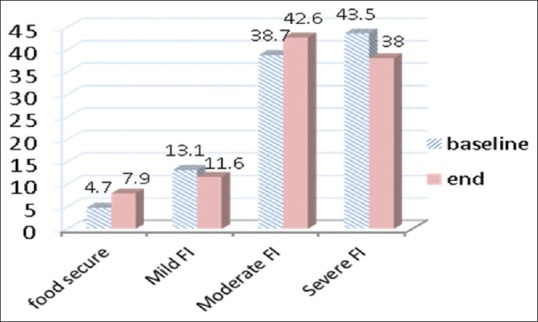
At the baseline, only 4.7% of families were food secure, while 43.5% were severely food insecure, and these proportions were changed to 7.9% and 38%, respectively ( < 0.001), at the end of the study. Odds of having worse food insecurity in households with medium and high wealth index was 65% and 87% lower than those with low wealth index, respectively (odds ratio [OR] = 0.35, 95% confidence interval [CI]: 0.2-0.61, and OR = 0.23, 95% CI: 0.12-0.43). Food sharing was common among more than 95% of the studied households. Mean maternal body mass index (BMI) increased significantly after 6 months ( < 0.001). However, there was no significant association between mother's BMI and household food security in the baseline and at the end of the study ( > 0.05).
Findings show that the food supplementary program for children can also improve the household food security status. Further research is needed to assess other factors that affect the effectiveness of this kind of programs.
粮食援助计划是旨在改善营养状况和解决粮食不安全问题的策略。本研究旨在评估一项全国儿童食品补充计划对家庭粮食安全的影响。
研究样本包括伊朗两个省份该计划覆盖范围内6至72个月儿童的359名母亲。通过问卷和清单评估家庭的人口统计学和社会经济特征以及目标儿童食用补充食品项目的百分比。在研究基线和此后6个月,通过当地改编的家庭粮食不安全获取量表收集家庭粮食安全数据。
在基线时,只有4.7%的家庭粮食安全,而43.5%的家庭粮食严重不安全,在研究结束时,这些比例分别变为7.9%和38%(<0.001)。中等和高财富指数家庭粮食不安全状况更差的几率分别比低财富指数家庭低65%和87%(优势比[OR]=0.35,95%置信区间[CI]:0.2 - 0.61,以及OR = 0.23,95% CI:0.12 - 0.43)。超过95%的研究家庭中食物共享很常见。6个月后母亲的平均体重指数(BMI)显著增加(<0.001)。然而,在基线和研究结束时,母亲的BMI与家庭粮食安全之间没有显著关联(>0.05)。
研究结果表明,儿童食品补充计划也可以改善家庭粮食安全状况。需要进一步研究以评估影响这类计划有效性的其他因素。