Whitton Alexis E, Van't Veer Ashlee, Kakani Pragya, Dillon Daniel G, Ironside Manon L, Haile Anja, Crowley David J, Pizzagalli Diego A
McLean Hospital, United States; Harvard Medical School, United States.
McLean Hospital, United States.
Psychoneuroendocrinology. 2017 Jan;75:164-172. doi: 10.1016/j.psyneuen.2016.10.007. Epub 2016 Oct 17.
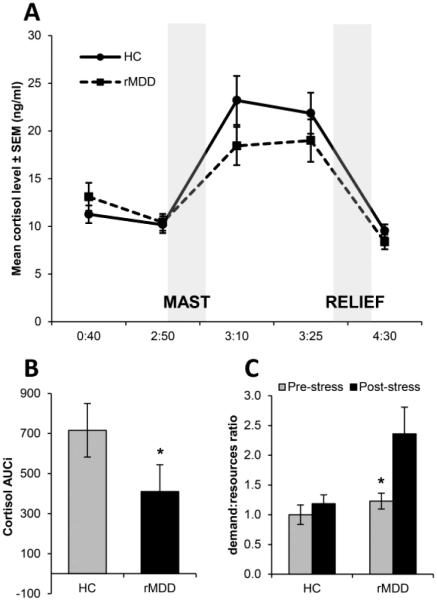
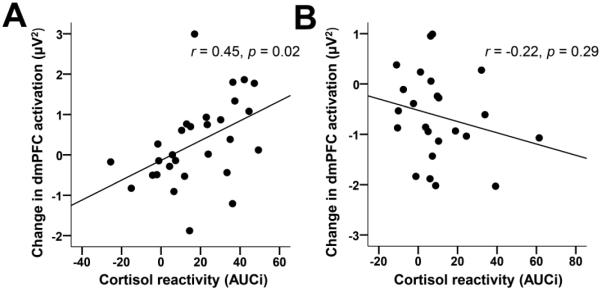
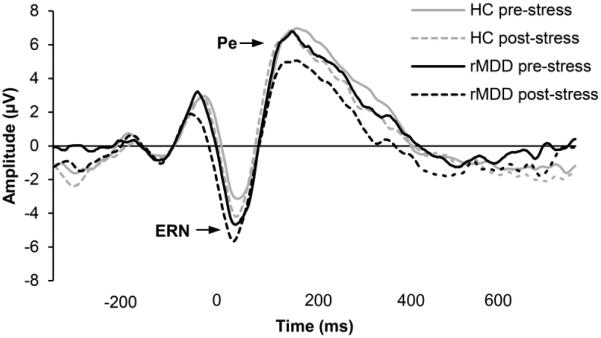
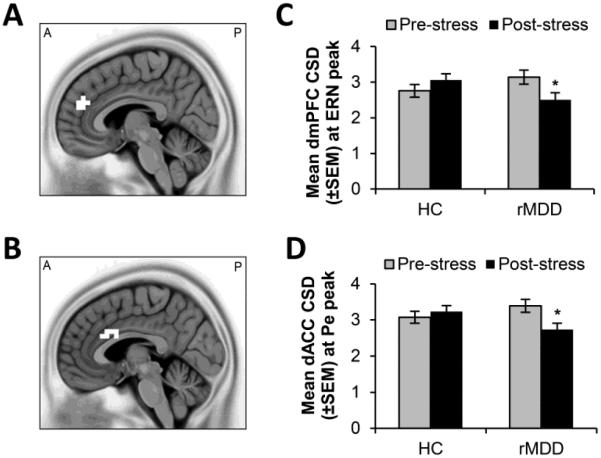
Deficits in cognitive control are a hallmark characteristic of depression, however less is known about the degree to which they persist beyond symptom remission and might contribute to symptom recurrence in remitted individuals (rMDD). Evidence indicates that stress interferes with cognitive control, highlighting a potential mechanism by which stress precipitates depression relapse. Therefore, this study examined whether stress exposure elicits deficits in error monitoring - a component of cognitive control thought to be particularly implicated in the ability to adaptively respond to negative feedback - in individuals with rMDD. Unmedicated individuals with rMDD (n=30) and healthy controls (n=34) performed an Eriksen Flanker task before and 45min after an acute stressor while 128-channel event-related potentials (ERPs) were recorded. Flanker interference effects and post-error adjustments were examined, and ERP analyses focused on the error-related negativity (ERN) and error positivity (Pe). Standardized low resolution electromagnetic tomography (sLORETA) was used to examine stress-induced changes in current source density. Individuals with rMDD showed blunted cortisol reactivity to the stressor, coupled with heightened self-reported stress reactivity. Although no significant effects of group or stress were observed in scalp-level ERPs, source-level analyses indicated that among the rMDD group only, stress caused a reduction in activation in frontocingulate regions critically implicated in error monitoring. The magnitude of stress-induced decreases in frontocingulate activation correlated with heightened self-reported stress reactivity, and also predicted heightened levels of stress and depression 18 months later in the entire sample. These findings suggest that individuals with rMDD show a stress-induced disruption in frontocingulate function that is linked to heightened stress reactivity, and this disruption prospectively predicts heightened levels of future stress and depressive symptomatology.
认知控制缺陷是抑郁症的一个标志性特征,然而,对于这些缺陷在症状缓解后持续存在的程度以及它们可能导致缓解期个体(复发性重度抑郁症,rMDD)症状复发的程度,人们了解较少。有证据表明,压力会干扰认知控制,这凸显了压力促使抑郁症复发的一种潜在机制。因此,本研究调查了压力暴露是否会引发rMDD个体的错误监测缺陷(认知控制的一个组成部分,被认为与对负面反馈进行适应性反应的能力特别相关)。未服药的rMDD个体(n = 30)和健康对照者(n = 34)在急性应激源之前和之后45分钟进行了埃里克森侧翼任务,同时记录128通道事件相关电位(ERP)。研究了侧翼干扰效应和错误后调整,ERP分析聚焦于错误相关负波(ERN)和错误正波(Pe)。使用标准化低分辨率电磁断层扫描(sLORETA)来检查应激源引起的电流源密度变化。rMDD个体对应激源的皮质醇反应迟钝,同时自我报告的应激反应增强。虽然在头皮水平的ERP中未观察到组间或压力的显著影响,但源水平分析表明,仅在rMDD组中,压力导致关键参与错误监测的额扣带区域激活减少。应激源引起的额扣带激活减少的程度与自我报告的应激反应增强相关,并且还预测了18个月后整个样本中应激和抑郁水平的升高。这些发现表明,rMDD个体表现出应激源引起的额扣带功能破坏,这与应激反应增强有关,并且这种破坏前瞻性地预测了未来应激和抑郁症状水平的升高。