Rodriguez Robert M, Hendey Gregory W, Mower William R
Department of Emergency Medicine, University of California, San Francisco, California, United States.
Department of Emergency Medicine, UCSF Fresno Medical Education and Research, Fresno, California, United States.
Am J Emerg Med. 2017 Jan;35(1):164-170. doi: 10.1016/j.ajem.2016.10.066. Epub 2016 Oct 29.
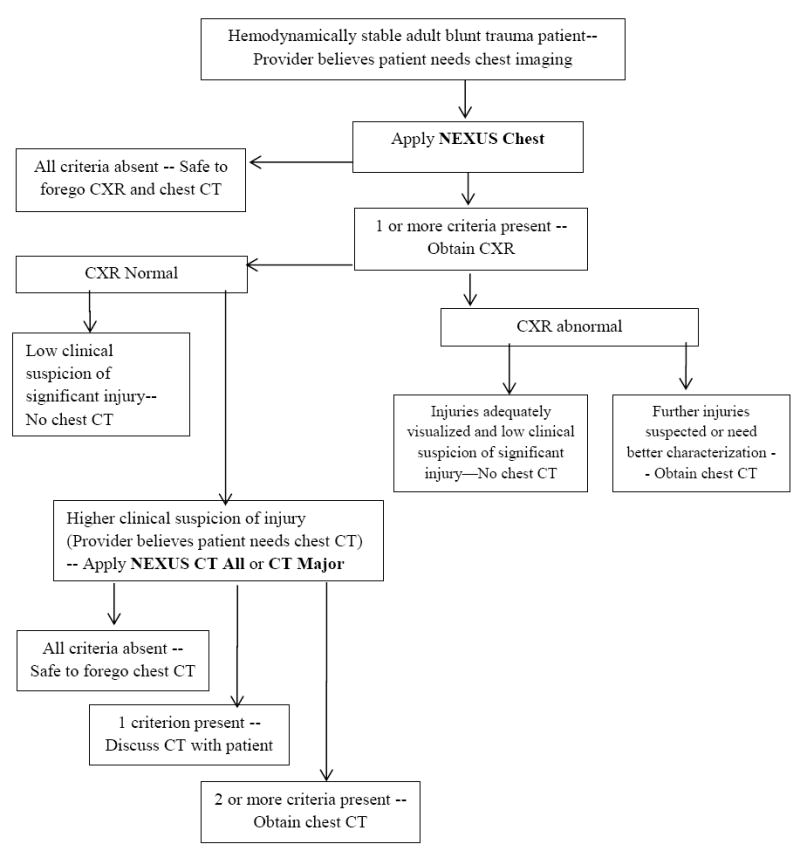
Chest imaging plays a prominent role in blunt trauma patient evaluation, but indiscriminate imaging is expensive, may delay care, and unnecessarily exposes patients to potentially harmful ionizing radiation. To improve diagnostic chest imaging utilization, we conducted 3 prospective multicenter studies over 12years to derive and validate decision instruments (DIs) to guide the use of chest x-ray (CXR) and chest computed tomography (CT). The first DI, NEXUS Chest x-ray, consists of seven criteria (Age >60years; rapid deceleration mechanism; chest pain; intoxication; altered mental status; distracting painful injury; and chest wall tenderness) and exhibits a sensitivity of 99.0% (95% confidence interval [CI] 98.2-99.4%) and a specificity of 13.3% (95% CI, 12.6%-14.0%) for detecting clinically significant injuries. We developed two NEXUS Chest CT DIs, which are both highly reliable in detecting clinically major injuries (sensitivity of 99.2%; 95% CI 95.4-100%). Designed primarily to focus on detecting major injuries, the NEXUS Chest CT-Major DI consists of six criteria (abnormal CXR; distracting injury; chest wall tenderness; sternal tenderness; thoracic spine tenderness; and scapular tenderness) and exhibits higher specificity (37.9%; 95% CI 35.8-40.1%). Designed to reliability detect both major and minor injuries (sensitivity 95.4%; 95% CI 93.6-96.9%) with resulting lower specificity (25.5%; 95% CI 23.5-27.5%), the NEXUS CT-All rule consists of seven elements (the six NEXUS CT-Major criteria plus rapid deceleration mechanism). The purpose of this review is to synthesize the three DIs into a novel, cohesive summary algorithm with practical implementation recommendations to guide selective chest imaging in adult blunt trauma patients.
胸部成像在钝性创伤患者评估中起着重要作用,但不加区分地进行成像既昂贵,又可能延误治疗,还会让患者不必要地暴露于潜在有害的电离辐射中。为了提高胸部诊断成像的利用率,我们在12年中开展了3项前瞻性多中心研究,以推导和验证用于指导胸部X线(CXR)和胸部计算机断层扫描(CT)使用的决策工具(DIs)。第一个决策工具NEXUS胸部X线检查包括七个标准(年龄>60岁;快速减速机制;胸痛;中毒;精神状态改变;分散注意力的疼痛性损伤;以及胸壁压痛),在检测具有临床意义的损伤方面,其敏感性为99.0%(95%置信区间[CI]98.2 - 99.4%),特异性为13.3%(95%CI,12.6% - 14.0%)。我们开发了两种NEXUS胸部CT决策工具,它们在检测临床上的主要损伤方面都高度可靠(敏感性为99.2%;95%CI 95.4 - 100%)。NEXUS胸部CT - 主要决策工具主要设计用于专注于检测主要损伤,由六个标准(异常CXR;分散注意力的损伤;胸壁压痛;胸骨压痛;胸椎压痛;以及肩胛骨压痛)组成,具有更高的特异性(37.9%;95%CI 3