Venselaar Jack L M, Slotman Ben J, Guedea Ferran, Ventura Montse, Londres Bradley, Francois Guy
Instituut Verbeeten, Tilburg, The Netherlands.
VU University Medical Center, Amsterdam, The Netherlands.
J Contemp Brachytherapy. 2010 Dec;2(4):145-152. doi: 10.5114/jcb.2010.19493. Epub 2011 Jan 14.
The goal of the ESTRO Patterns of Care study for Brachytherapy in Europe (PCBE) 2002 was to develop an aid to analyse brachytherapy practices. A 2 version of the PCB questionnaire was created for 2007. Data over 2007 were collected at the radiotherapy institutions in The Netherlands and compared with those from 2002. The aim of this study is to describe national brachytherapy practices, to demonstrate trends, and to provide data for rational health care planning.
Data were collected using a web-based questionnaire. For each centre, a local coordinator, responsible for coordinating the questionnaires and support of the further analysis was assigned. Data from the national cancer incidence registry was used for comparison with the data from the 21 Dutch departments.
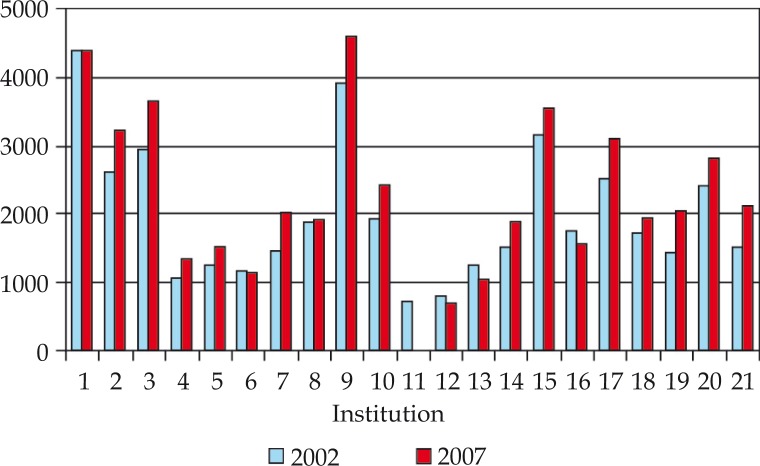
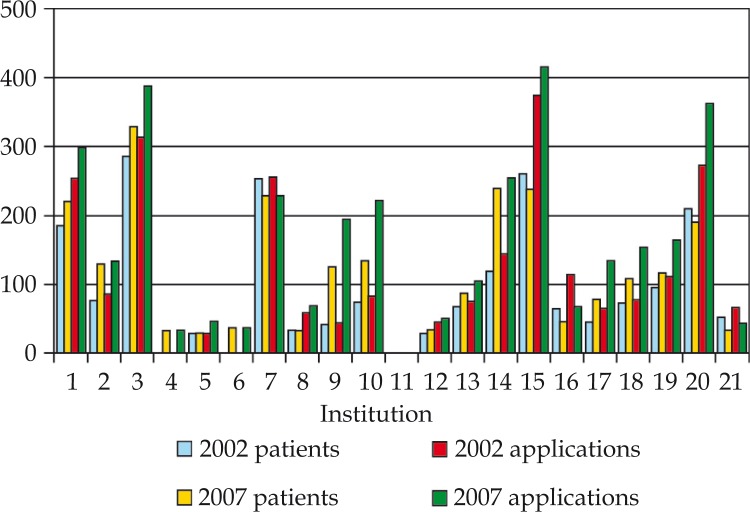
There was a decrease in low-dose rate equipment in parallel to an increase in both pulsed-dose rate and high-dose rate equipment. The use of 3D CT and MR based imaging techniques showed a slow rise. The most common clinical procedures were for prostate, gynaecological, and oesophageal tumours. A large increase (146%) in permanent implant prostate applications using 125I seeds was observed. The numbers of oesophageal and gynaecological treatments remained stable. There is concern on the low numbers of cases treated in some institutions for a few complex treatment sites. For head and neck, anal canal, paediatrics, bladder and eye interventions it ranged from 3-20 patients per year per institution.
The increase in number of patient treated with brachytherapy is in accordance with the increases in cancer incidence. The percentage of all radiotherapy patients treated with brachytherapy (approximately 5%) remained stable. The survey identified certain trends in resources and techniques, as well as areas of expected improvement and possible gain in clinical outcome. Data reported from this survey can be used for further planning of resources, facilities and concentration of a low-volume specialised and complex treatments.
欧洲近距离放射治疗的欧洲放射肿瘤学会(ESTRO)治疗模式研究(PCBE)2002的目标是开发一种辅助工具来分析近距离放射治疗实践。2007年创建了PC问卷的第2版。收集了荷兰放疗机构2007年的数据,并与2002年的数据进行了比较。本研究的目的是描述全国近距离放射治疗实践,展示趋势,并为合理的医疗保健规划提供数据。
使用基于网络的问卷收集数据。为每个中心指定了一名当地协调员,负责协调问卷并支持进一步分析。国家癌症发病率登记处的数据用于与21个荷兰科室的数据进行比较。
低剂量率设备减少,同时脉冲剂量率和高剂量率设备增加。基于3D CT和MR的成像技术的使用呈缓慢上升趋势。最常见的临床程序用于前列腺、妇科和食管肿瘤。观察到使用125I种子的永久性植入前列腺应用大幅增加(146%)。食管和妇科治疗的数量保持稳定。一些机构对少数复杂治疗部位的治疗病例数较少表示担忧。对于头颈部、肛管、儿科、膀胱和眼部干预,每个机构每年的病例数为3 - 20例。
接受近距离放射治疗的患者数量增加与癌症发病率的增加一致。接受近距离放射治疗的所有放疗患者的百分比(约5%)保持稳定。该调查确定了资源和技术方面的某些趋势,以及预期改善的领域和临床结果可能的获益。本次调查报告的数据可用于进一步规划资源、设施以及集中开展小容量的专门和复杂治疗。