Li Long, Zhang Wenyan, Wang Jizeng
Key Laboratory of Mechanics on Disaster and Environment in Western China, Ministry of Education , College of Civil Engineering and Mechanics , Lanzhou University, Lanzhou, Gansu 730000 , People's Republic of China.
R Soc Open Sci. 2016 Oct 19;3(10):160539. doi: 10.1098/rsos.160539. eCollection 2016 Oct.
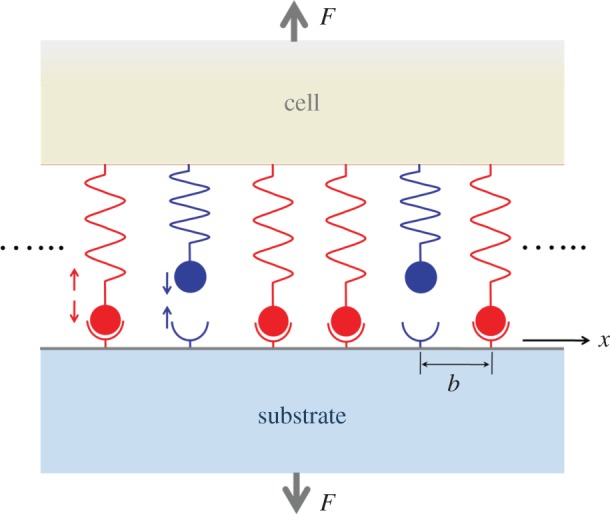
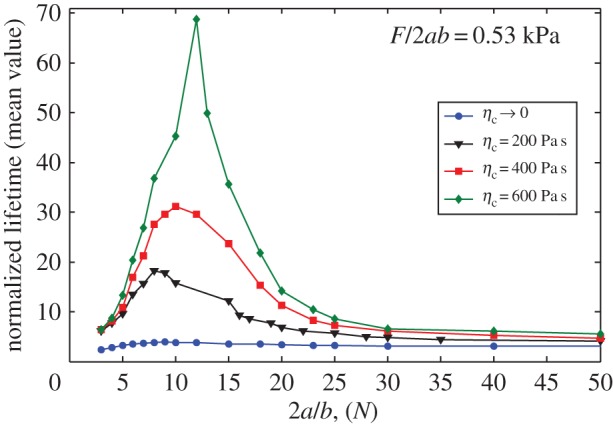
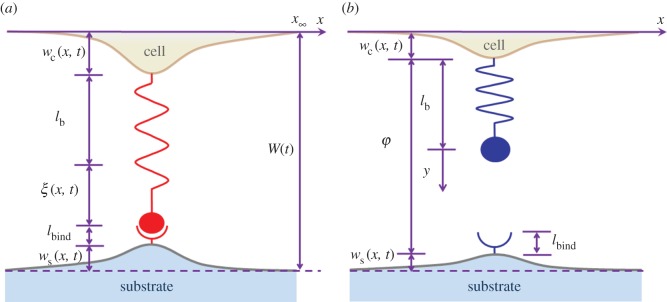
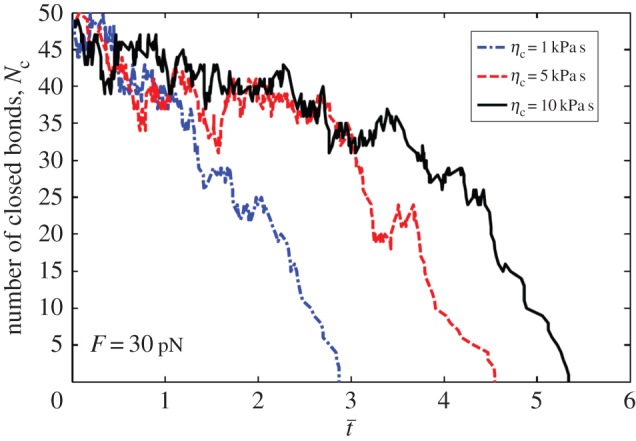
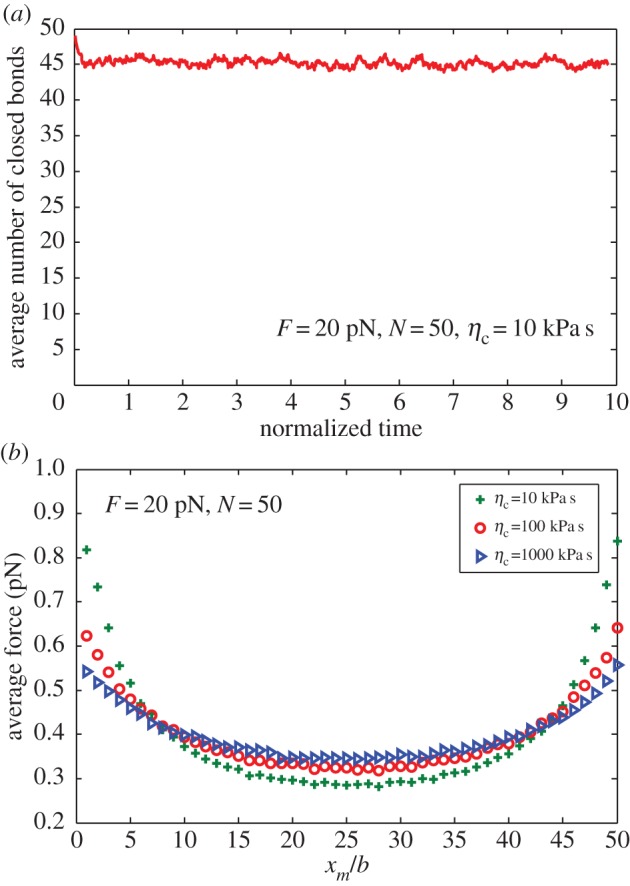
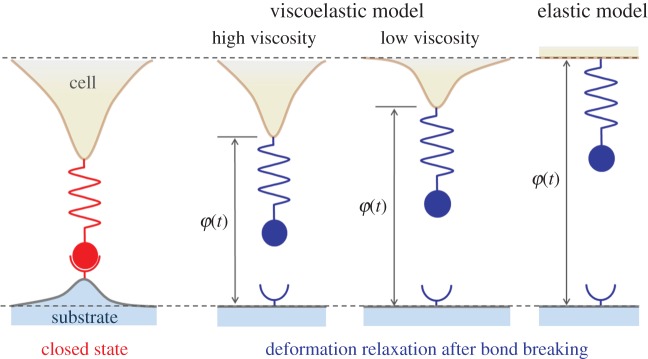
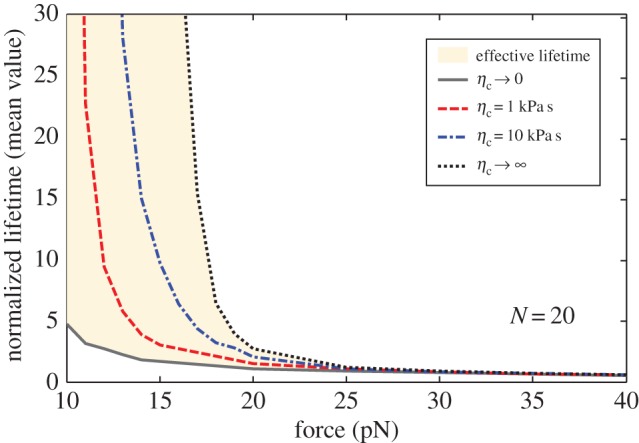
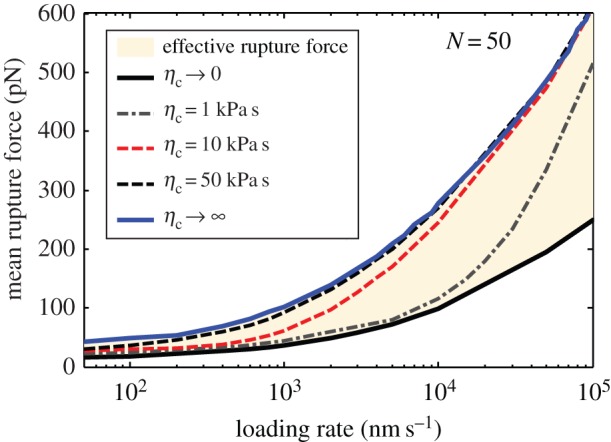
Cells can adapt their mechanical properties through cytoskeleton remodelling in response to external stimuli when the cells adhere to the extracellular matrix (ECM). Many studies have investigated the effects of cell and ECM elasticity on cell adhesion. However, experiments determined that cells are viscoelastic and exhibiting stress relaxation, and the mechanism behind the effect of cellular viscoelasticity on the cell adhesion behaviour remains unclear. Therefore, we propose a theoretical model of a cluster of ligand-receptor bonds between two dissimilar viscoelastic media subjected to an applied tensile load. In this model, the distribution of interfacial traction is assumed to follow classical continuum viscoelastic equations, whereas the rupture and rebinding of individual molecular bonds are governed by stochastic equations. On the basis of this model, we determined that viscosity can significantly increase the lifetime, stability and dynamic strength of the adhesion cluster of molecular bonds, because deformation relaxation attributed to the viscoelastic property can increase the rebinding probability of each open bond and reduce the stress concentration in the adhesion area.
当细胞粘附于细胞外基质(ECM)时,细胞可通过细胞骨架重塑来适应其力学特性,以应对外部刺激。许多研究探讨了细胞和ECM弹性对细胞粘附的影响。然而,实验表明细胞具有粘弹性并表现出应力松弛,而细胞粘弹性对细胞粘附行为影响背后的机制仍不清楚。因此,我们提出了一个理论模型,用于描述在施加拉伸载荷的情况下,两种不同粘弹性介质之间配体-受体键簇的情况。在该模型中,界面牵引力的分布假定遵循经典的连续粘弹性方程,而单个分子键的断裂和重新结合则由随机方程控制。基于此模型,我们确定粘度可显著增加分子键粘附簇的寿命、稳定性和动态强度,因为粘弹性特性引起的松驰变形可增加每个开放键的重新结合概率,并降低粘附区域的应力集中。