Padilla Mario, Amsalem Etya, Altman Naomi, Hefetz Abraham, Grozinger Christina M
Department of Entomology, Center for Pollinator Research, Center for Chemical Ecology , The Pennsylvania State University , University Park, PA 16802 , USA.
Department of Statistics, Huck Institutes of Life Sciences, Clinical and Translational Sciences Institute , The Pennsylvania State University , University Park, PA 16802 , USA.
R Soc Open Sci. 2016 Oct 19;3(10):160576. doi: 10.1098/rsos.160576. eCollection 2016 Oct.
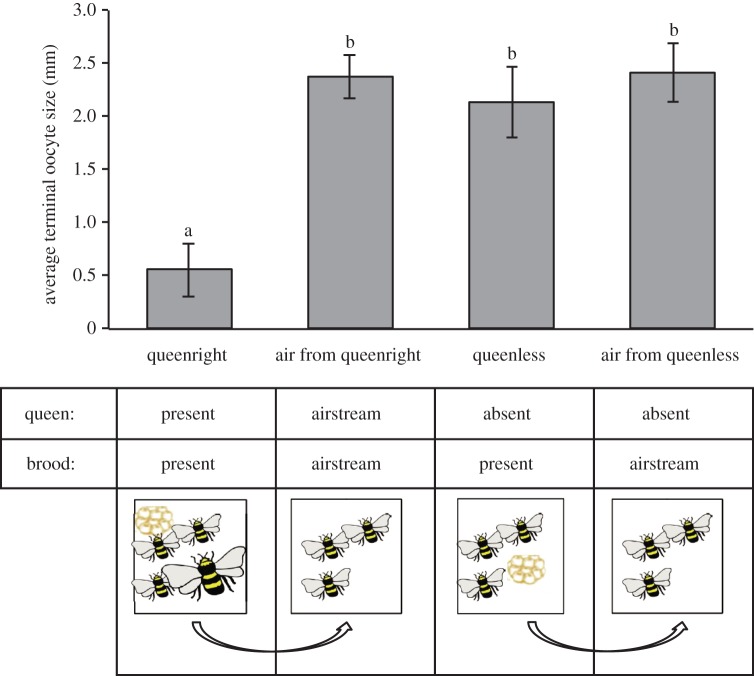
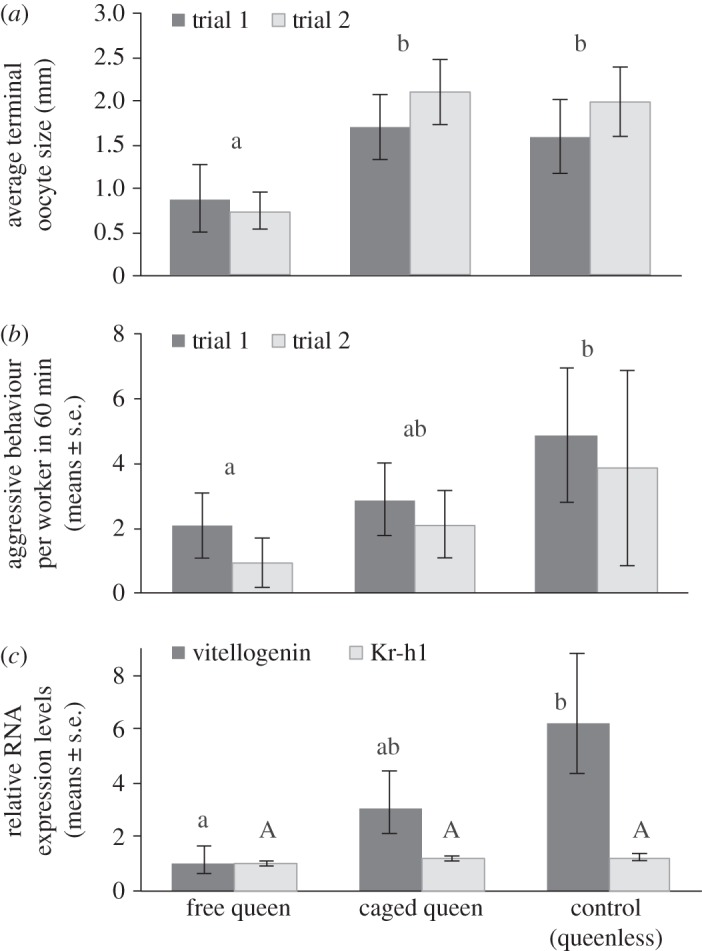
Reproductive division of labour is a hallmark of eusociality, but disentangling the underlying proximate mechanisms can be challenging. In bumblebees, workers isolated from the queen can activate their ovaries and lay haploid, male eggs. We investigated if volatile, contact, visual or behavioural cues produced by the queen or brood mediate reproductive dominance in Exposure to queen-produced volatiles, brood-produced volatiles and direct contact with pupae did not reduce worker ovary activation; only direct contact with the queen could reduce ovary activation. We evaluated behaviour, physiology and gene expression patterns in workers that were reared in chambers with all stages of brood and a free queen, caged queen (where workers could contact the queen, but the queen was unable to initiate interactions) or no queen. Workers housed with a caged queen or no queen fully activated their ovaries, whereas ovary activation in workers housed with a free queen was completely inhibited. The caged queen marginally reduced worker aggression and expression of an aggression-associated gene relative to queenless workers. Thus, queen-initiated behavioural interactions appear necessary to establish reproductive dominance. Queen-produced chemical cues may function secondarily in a context-specific manner to augment behavioural cues, as reliable or honest signal.
生殖分工是真社会性的一个标志,但厘清其潜在的近端机制可能具有挑战性。在熊蜂中,与蜂王隔离的工蜂能够激活它们的卵巢并产下单倍体的雄卵。我们研究了蜂王或幼虫产生的挥发性、接触性、视觉或行为线索是否介导了生殖优势。暴露于蜂王产生的挥发性物质、幼虫产生的挥发性物质以及与蛹的直接接触并不会降低工蜂卵巢的激活;只有与蜂王的直接接触能够降低卵巢的激活。我们评估了在有各阶段幼虫和自由活动蜂王的蜂箱中、笼养蜂王(工蜂可以接触蜂王,但蜂王无法发起互动)或无蜂王的蜂箱中饲养的工蜂的行为、生理和基因表达模式。与笼养蜂王或无蜂王一起饲养的工蜂完全激活了它们的卵巢,而与自由活动蜂王一起饲养的工蜂的卵巢激活则被完全抑制。相对于无蜂王的工蜂,笼养蜂王略微降低了工蜂的攻击性以及一个与攻击相关基因的表达。因此,蜂王发起的行为互动似乎是建立生殖优势所必需的。蜂王产生的化学线索可能以特定情境的方式起到辅助作用,增强行为线索,作为可靠或诚实的信号。