Sarro Erica, Tripodi Amber, Woodard S Hollis
Department of Entomology, University of California Riverside, 900 University Ave, Riverside, CA 92521, USA.
Integr Org Biol. 2022 Feb 11;4(1):obac007. doi: 10.1093/iob/obac007. eCollection 2022.
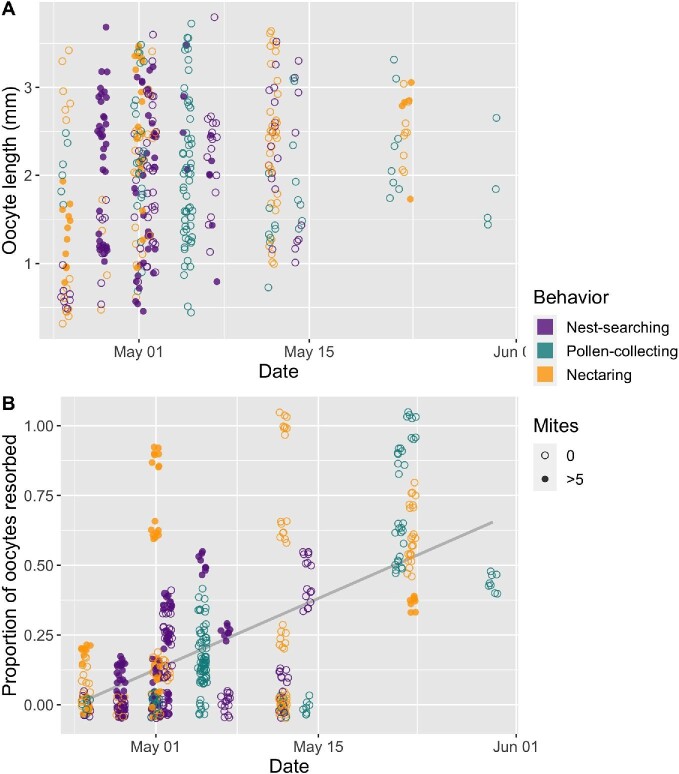
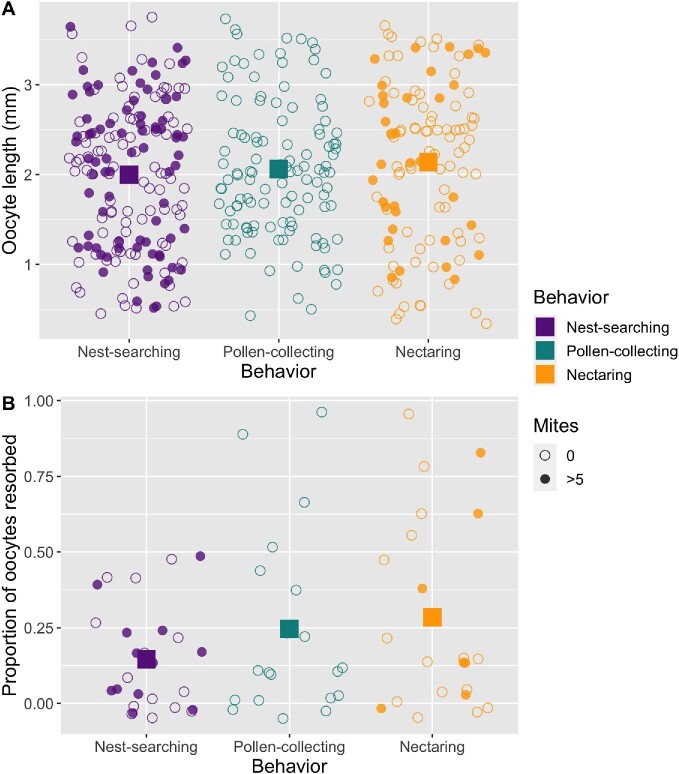
Studies on the physiological states of wild-caught organisms are essential to uncovering the links between ecological and physiological processes. Bumble bee queens emerge from overwintering in the spring. At this time, queens develop their ovaries and search for a nest site in which to start a colony. Whether these two processes, ovary development and nest-searching, interact with or influence one another remains an unresolved question in behavioral physiology. We explored the hypothesis that ovary development and nest-searching might be mechanistically connected, by testing whether (1) ovary development precedes nest-searching behavior; (2) nest occupation precedes ovary development; or (3) ovary development and nest-searching occur independently, in bumble bee () queens. We collected queens either nest-searching (and thus prior to occupying a nest) or pollen-collecting (and thus provisioning an occupied nest) and measured their degree of ovary activation. We further screened these queens for parasites or other symbionts, to identify additional factors that may impact their reproductive success at this time. We found that queens searched for and occupied nests at all stages of ovary development, indicating that these processes occur independently in this system. Nest-searching queens were more likely to have substantial mite loads than pollen-collecting queens, who had already located and occupied a nest. However, mite loads did not significantly predict ovary developmental status. Collectively, our work shows that nesting status and symbionts alone are insufficient to explain the variation in spring bumble bee queen ovary development. We propose that ovary development and nest-searching occur opportunistically, which may enable queens to begin laying eggs earlier in the season than if these processes occurred in discrete succession.
对野生捕获生物的生理状态进行研究,对于揭示生态与生理过程之间的联系至关重要。熊蜂蜂后在春季从越冬状态中苏醒。此时,蜂后会发育卵巢并寻找一个筑巢地点来建立蜂群。卵巢发育和寻找巢穴这两个过程是否相互作用或相互影响,在行为生理学中仍是一个未解决的问题。我们探讨了这样一个假设,即卵巢发育和寻找巢穴可能在机制上存在关联,通过测试在熊蜂( )蜂后中:(1)卵巢发育是否先于寻找巢穴行为;(2)占据巢穴是否先于卵巢发育;或者(3)卵巢发育和寻找巢穴是否独立发生。我们收集了正在寻找巢穴(因此在占据巢穴之前)或正在采集花粉(因此在为已占据的巢穴储备食物)的蜂后,并测量它们的卵巢激活程度。我们进一步对这些蜂后进行寄生虫或其他共生体筛查,以确定此时可能影响其繁殖成功率的其他因素。我们发现,蜂后在卵巢发育的所有阶段都会寻找并占据巢穴,这表明在这个系统中这些过程是独立发生的。正在寻找巢穴的蜂后比已经找到并占据巢穴的采集花粉的蜂后更有可能携带大量螨虫。然而,螨虫数量并不能显著预测卵巢发育状态。总体而言,我们的研究表明,仅筑巢状态和共生体不足以解释春季熊蜂蜂后卵巢发育的差异。我们提出,卵巢发育和寻找巢穴是机会性发生的,这可能使蜂后比这些过程按离散顺序发生时更早开始产卵。