Dhingani Dhaval Durlabhbhai, Boruah Deb Kumar, Dutta Hemonta Kumar, Gogoi Rudra Kanta
Department of Radio Diagnosis, Assam Medical College and Hospital, Dibrugarh, Assam, India.
Department of Pediatric Surgery, Assam Medical College and Hospital, Dibrugarh, Assam, India.
J Pediatr Neurosci. 2016 Jul-Sep;11(3):206-212. doi: 10.4103/1817-1745.193374.
Spinal dysraphisms are congenital abnormalities of the spine due to imperfect fusion of midline mesenchymal, bony and neural structures. Imaging plays a vital role in their evaluation as significant portion of patients may present with concurrent anomalies that need to be corrected simultaneously to avoid repeat surgeries.
The aims of the study were to evaluate Spinal dysraphisms using USG and MRI and to correlate imaging findings with operative findings in patients undergoing surgery.
Hospital based observational study conducted over a period of year.
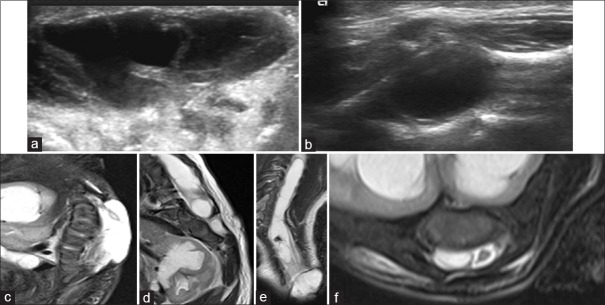
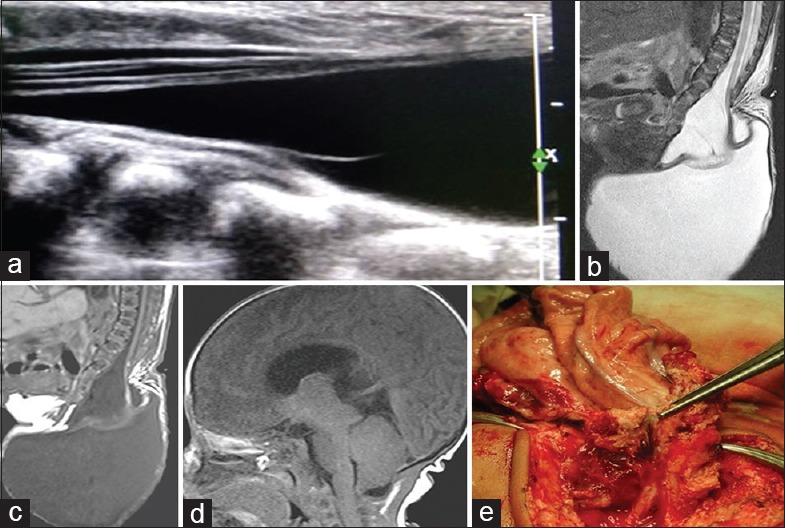
38 cases of both sexes and below 12 years of age with spinal dysraphism were studied. USG was performed in 29 cases where acoustic window was available for proper evaluation. MRI was performed in all cases. USG findings were compared with MRI findings and operative follow up was taken in 23 cases who underwent operative management.
Results were analysed using percentage and arithmetic mean.
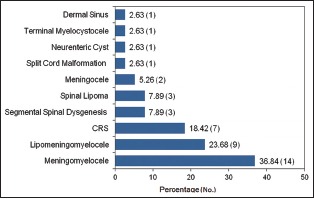
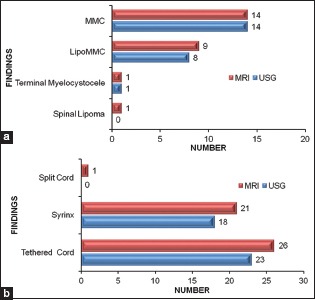
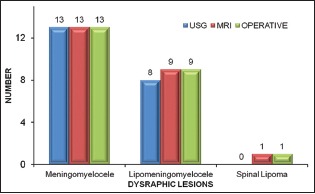
39.47 % cases were male and 60.53 % cases were female. Neonatal period was the most common presenting age group. Closed spinal dysraphism (63.16%) was more common than open (36.84%). 79.31% cases showed full agreement between spinal USG and MRI examinations and 6 out of 20.69% showed partial agreement. On operative correlation, USG findings were confirmatory in 91.30% cases and MRI findings were confirmatory in 100% cases.
USG can be used as the initial modality for evaluation of spinal dysraphism as well as for screening of suspected cases. MRI is indicated to confirm abnormal USG findings, which shows all concurrent abnormalities and also provides additional anatomical details relevant to surgical planning.
脊柱裂是由于中线间充质、骨骼和神经结构融合不完全导致的先天性脊柱异常。影像学检查在其评估中起着至关重要的作用,因为相当一部分患者可能同时存在需要同时矫正的异常情况,以避免再次手术。
本研究的目的是使用超声(USG)和磁共振成像(MRI)评估脊柱裂,并将影像学检查结果与接受手术治疗患者的手术结果进行关联。
基于医院的观察性研究,为期一年。
研究了38例年龄在12岁以下的脊柱裂患者,男女不限。29例有合适声学窗可进行恰当评估的患者进行了超声检查。所有病例均进行了MRI检查。将超声检查结果与MRI检查结果进行比较,并对23例接受手术治疗的患者进行了手术随访。
结果采用百分比和算术平均值进行分析。
男性患者占39.47%,女性患者占60.53%。新生儿期是最常见的发病年龄组。闭合性脊柱裂(63.16%)比开放性脊柱裂(36.84%)更常见。79.31%的病例脊柱超声检查和MRI检查结果完全一致,20.69%的病例中有6例部分一致。在手术相关性方面,超声检查结果在91.30%的病例中得到证实,MRI检查结果在100%的病例中得到证实。
超声可作为评估脊柱裂以及筛查疑似病例的初始检查方法。对于超声检查异常结果,需行MRI检查以明确诊断,MRI可显示所有并发异常情况,并提供与手术规划相关的额外解剖细节。